Andrée: Jaffna, Ceylon. Circa 1893.
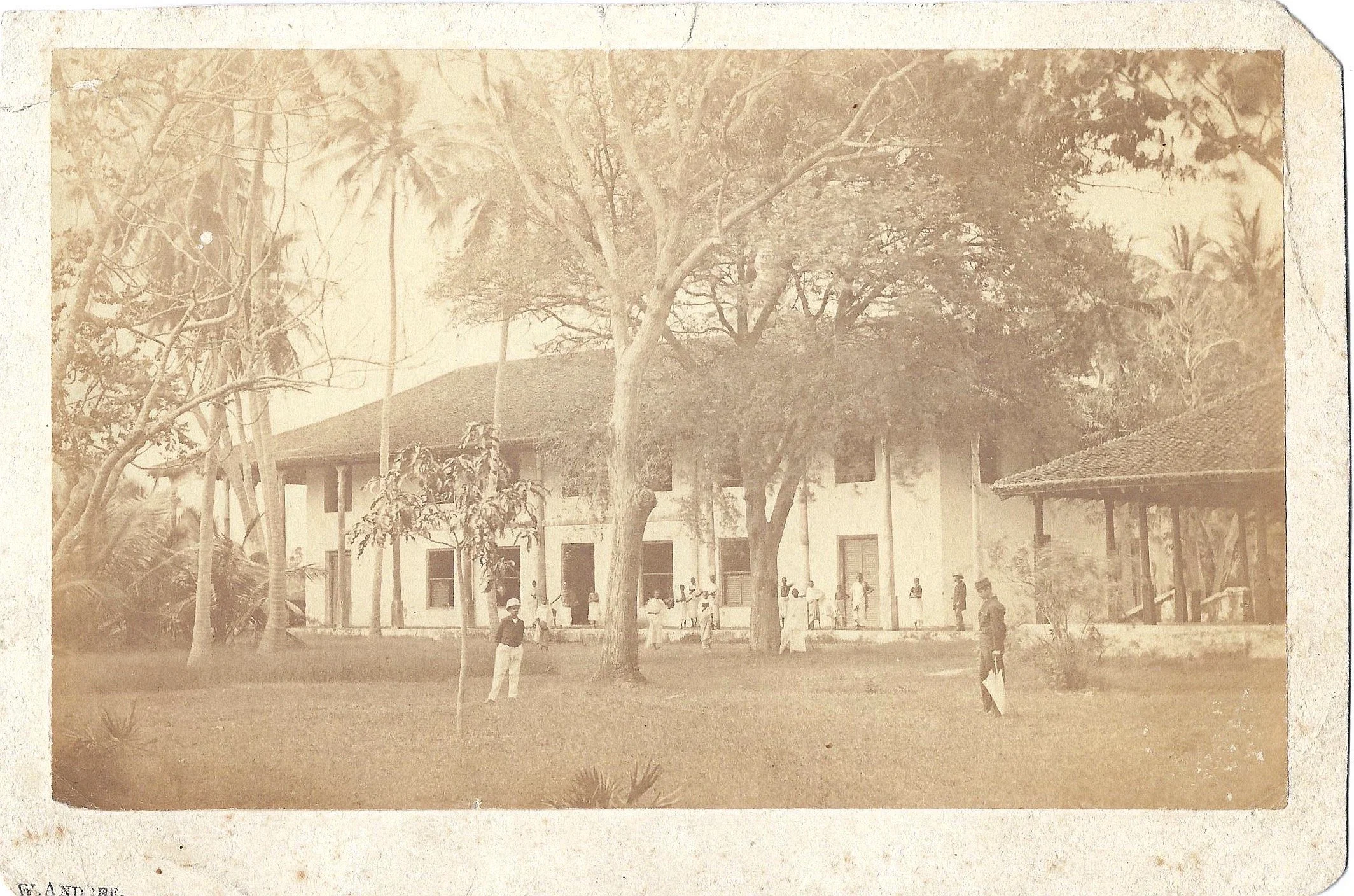
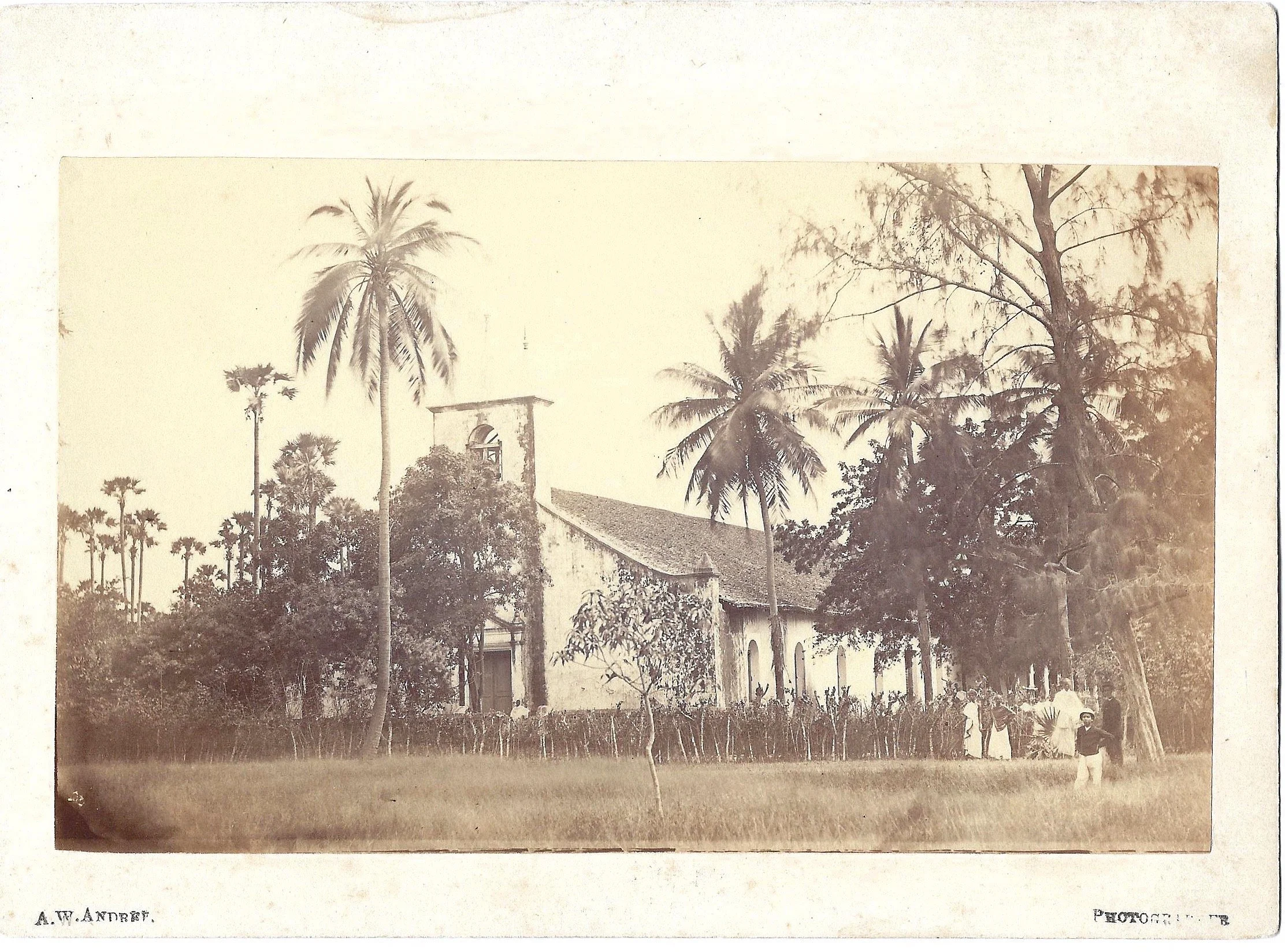
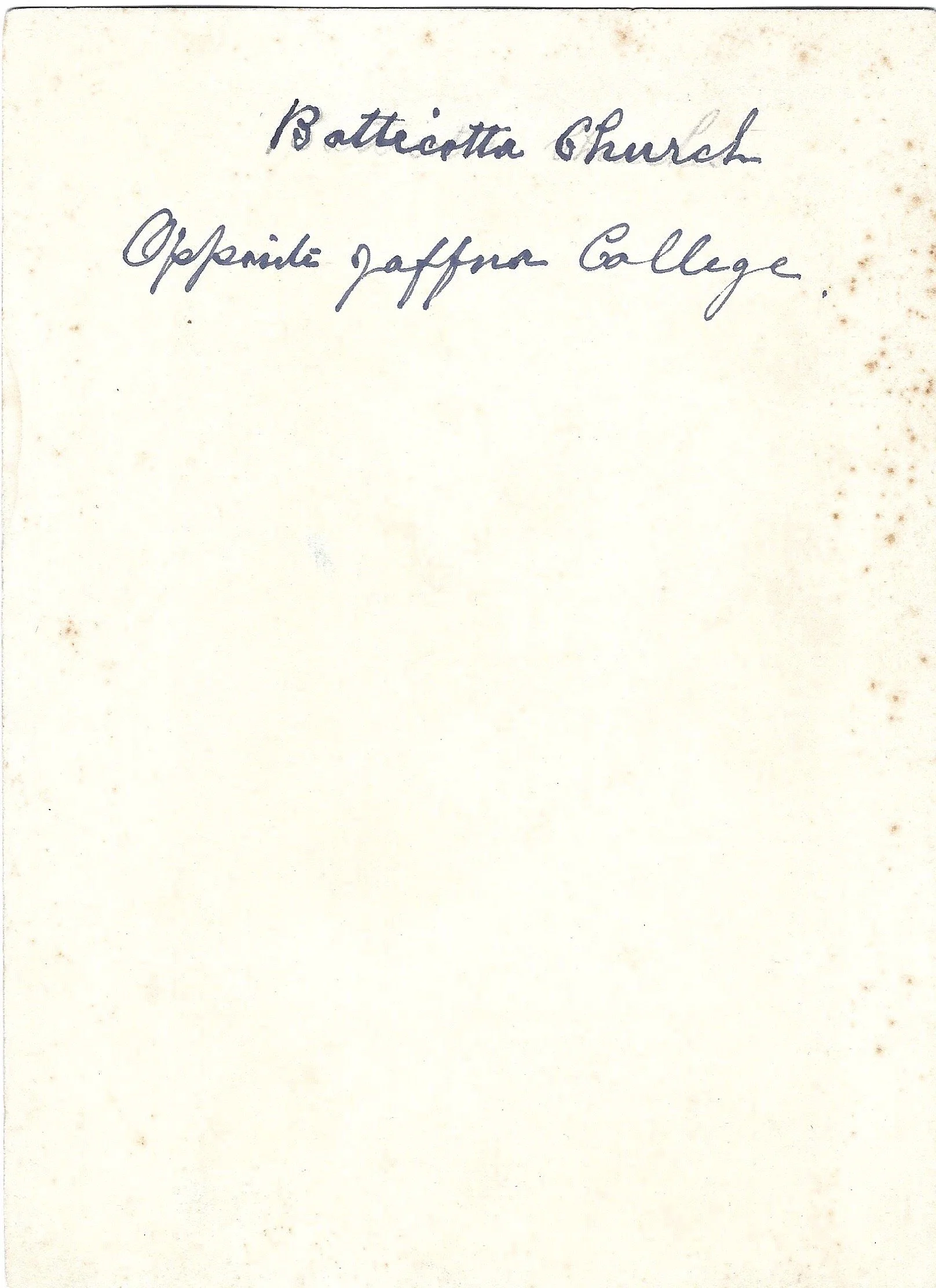
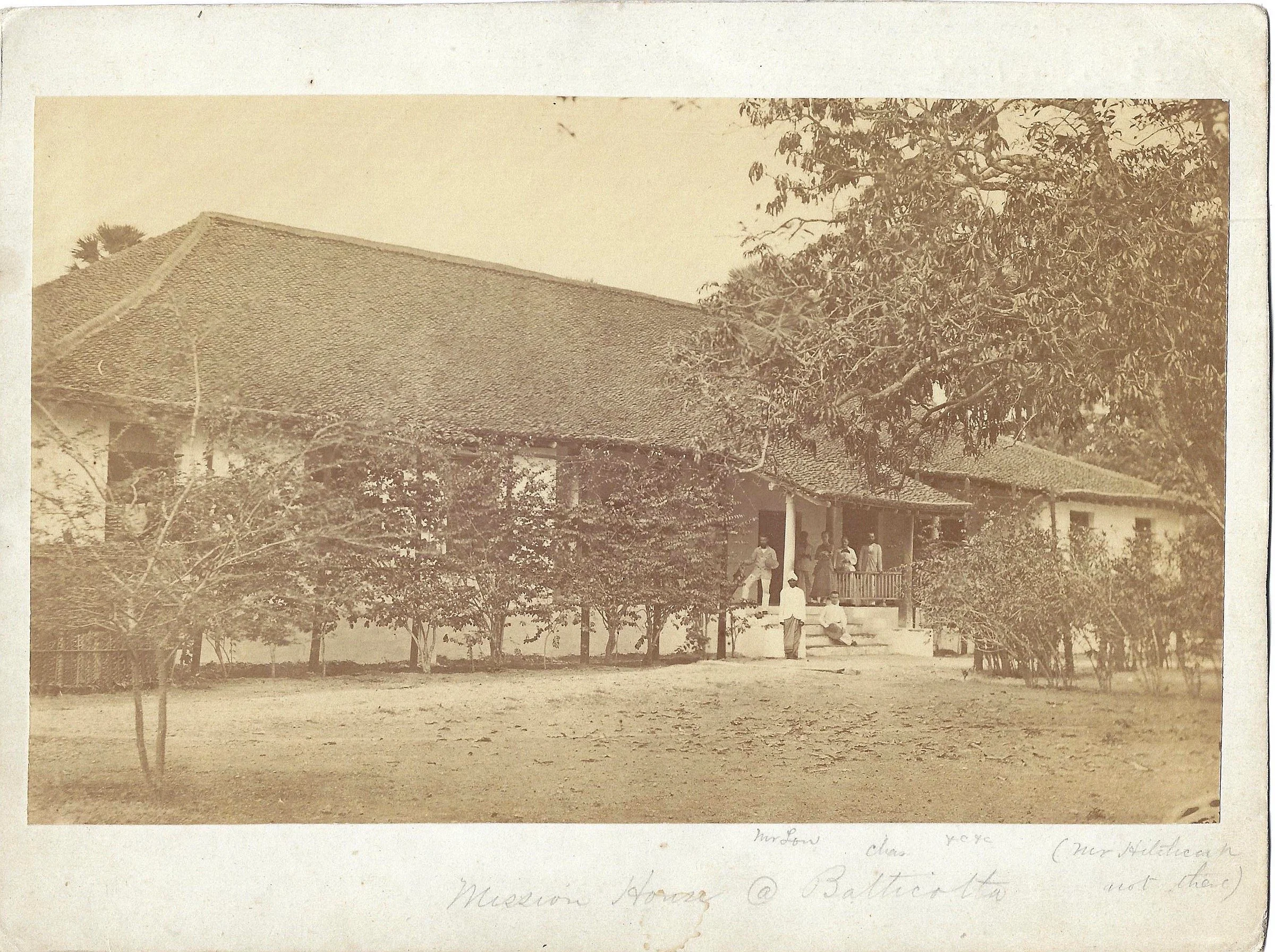
3 albumen prints, measuring 4” x 6.25” to 4.5” x 7” plus mounts. Two captioned in blue ink at versos, reading “Jaffna College,” and “Batticotta Church, Opposite Jaffna College.” One captioned in pencil at foot of mount, reading “Mission House @ Batticotta,” and identifying several people including one “Mr Low” and a “Mr Hitchcock.” CONDITION: Good, print of Jaffna college with .75” tears at edges, minimal foxing and offsetting to versos of mounts, photographs clear with strong tonality and minimal fading.
A trio of images showing two pioneering western-style educational institutions in nineteenth century Sri Lanka, as represented by an award-winning Sri Lankan photographer.
These photographs show Jaffna College, the Batticotta church, and the mission house in the church’s grounds. While the building for each picture in question is the most noticeable feature of each image, also noticeable in these photographs are the robe-clad Sri Lankans seen alongside missionaries as well as Sri Lankans in western dress. The town of Jaffna appears to be a place in transition, a place where western architecture, culture, and religious practices were growing in influence among the indigenous peoples.
The Batticotta church was established around 1823 by the American Ceylon Mission, who had arrived to the island in 1813. As with other mission churches, at Batticotta, the ACM trained preachers, teachers, and community leaders in English and the dominant language of Sri Lanka, Tamil. While searching for more effective ways to present medical conditions to their students in Sri Lanka, American missionaries introduced photography, via the daguerreotype, at the Batticota seminary in 1853. Shortly after, by 1855, facing mounting financial stress, Batticotta was closed as a center for higher learning, and it was only in 1872, when “the alumni of the…Seminary and other local Christians led a campaign to re-open the seminary and…Jaffna College was opened on the former…site as a successor.”
Photographer Adolphus William Andrée (circa 1860–1909) was a “Jaffna-born Ceylonese studio photographer who founded the Hopetown Studio in Colombo, was lauded for his work internationally at the 1900 Exposition Universelle, Paris, and the 1904 World’s Fair in St. Louis.” Like other indigenous photographers from Sri Lanka, Andrée was likely educated at Jaffna College prior to taking these images.
OCLC locates a single publication by Andrée, namely his Illustrations of Life in the Boer Camp (Colombo 1901), held at Cambridge. We locate another small collection where some of his photographs can be found at Cambridge (Y303G), and then single images taken by Andrée at the Met (2025.979) and the NYPL (4044639).
Sources Consulted: Nishantha Hewage, “From Batticotta Seminary to Jaffna College, Vaddukkoddai” at DBSJeyaraj online; John Martyn, Martyn’s Notes on Jaffna (New Delhi 2002); Vindhya Buthpitiya, “Studio East: Everyday Photography” at EidolonJournal online.
Andrée: Jaffna, Ceylon. Circa 1893.
3 albumen prints, measuring 4” x 6.25” to 4.5” x 7” plus mounts. Two captioned in blue ink at versos, reading “Jaffna College,” and “Batticotta Church, Opposite Jaffna College.” One captioned in pencil at foot of mount, reading “Mission House @ Batticotta,” and identifying several people including one “Mr Low” and a “Mr Hitchcock.” CONDITION: Good, print of Jaffna college with .75” tears at edges, minimal foxing and offsetting to versos of mounts, photographs clear with strong tonality and minimal fading.
A trio of images showing two pioneering western-style educational institutions in nineteenth century Sri Lanka, as represented by an award-winning Sri Lankan photographer.
These photographs show Jaffna College, the Batticotta church, and the mission house in the church’s grounds. While the building for each picture in question is the most noticeable feature of each image, also noticeable in these photographs are the robe-clad Sri Lankans seen alongside missionaries as well as Sri Lankans in western dress. The town of Jaffna appears to be a place in transition, a place where western architecture, culture, and religious practices were growing in influence among the indigenous peoples.
The Batticotta church was established around 1823 by the American Ceylon Mission, who had arrived to the island in 1813. As with other mission churches, at Batticotta, the ACM trained preachers, teachers, and community leaders in English and the dominant language of Sri Lanka, Tamil. While searching for more effective ways to present medical conditions to their students in Sri Lanka, American missionaries introduced photography, via the daguerreotype, at the Batticota seminary in 1853. Shortly after, by 1855, facing mounting financial stress, Batticotta was closed as a center for higher learning, and it was only in 1872, when “the alumni of the…Seminary and other local Christians led a campaign to re-open the seminary and…Jaffna College was opened on the former…site as a successor.”
Photographer Adolphus William Andrée (circa 1860–1909) was a “Jaffna-born Ceylonese studio photographer who founded the Hopetown Studio in Colombo, was lauded for his work internationally at the 1900 Exposition Universelle, Paris, and the 1904 World’s Fair in St. Louis.” Like other indigenous photographers from Sri Lanka, Andrée was likely educated at Jaffna College prior to taking these images.
OCLC locates a single publication by Andrée, namely his Illustrations of Life in the Boer Camp (Colombo 1901), held at Cambridge. We locate another small collection where some of his photographs can be found at Cambridge (Y303G), and then single images taken by Andrée at the Met (2025.979) and the NYPL (4044639).
Sources Consulted: Nishantha Hewage, “From Batticotta Seminary to Jaffna College, Vaddukkoddai” at DBSJeyaraj online; John Martyn, Martyn’s Notes on Jaffna (New Delhi 2002); Vindhya Buthpitiya, “Studio East: Everyday Photography” at EidolonJournal online.
![[Sarojini Naidu at the Scottish Rite Auditorium].](https://images.squarespace-cdn.com/content/v1/687efeb0f3827b1e917a0b60/5aa76c12-6a1c-46ea-bb41-2c0da67df639/SarojiniNaiduFlierRecto.jpeg)