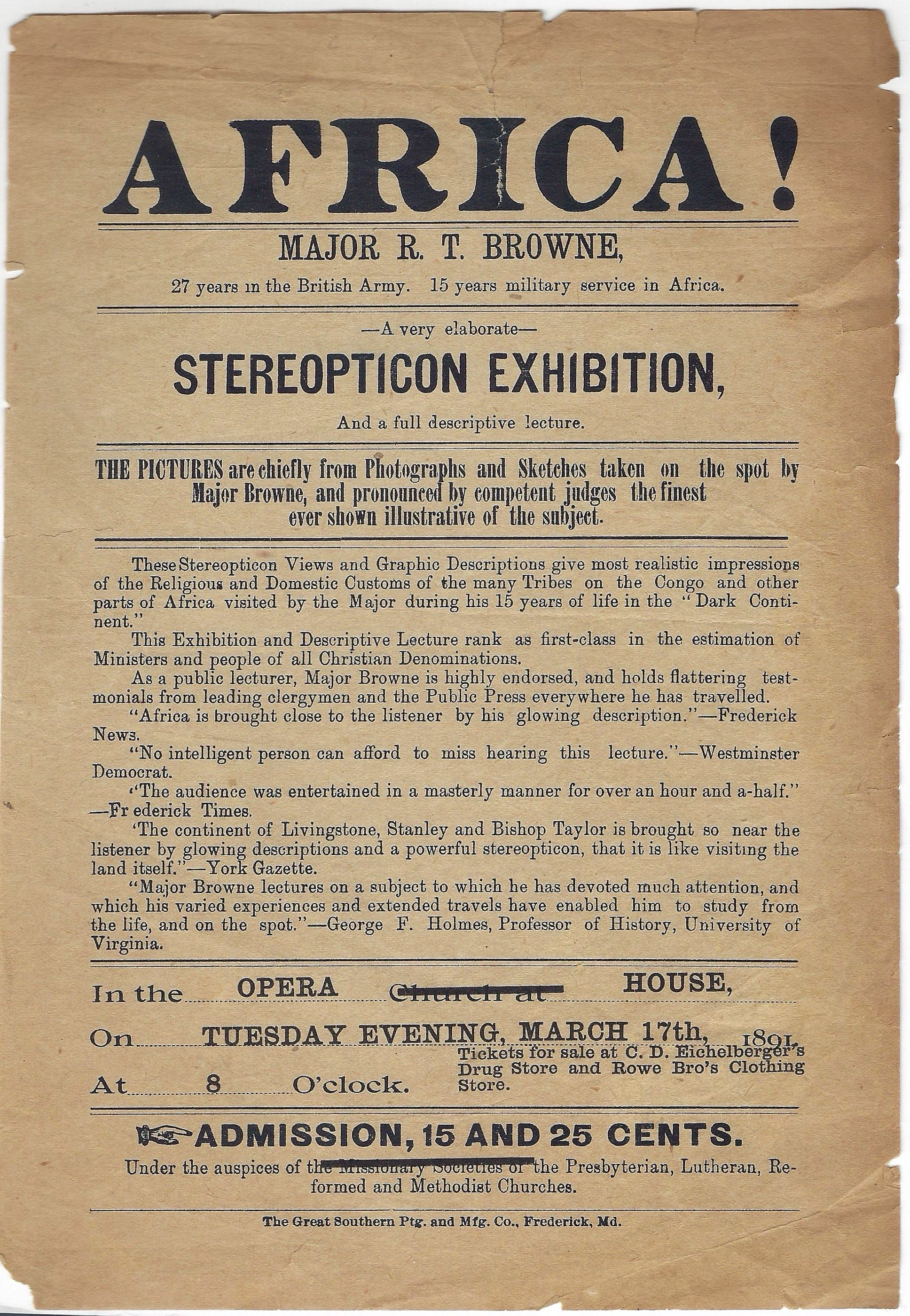
Broadsheet, 9.25” x 8.25”. Text printed at recto only. Portions of text redacted, but remains legible. CONDITION: Good, short chips to edges, two .75” tears along horizontal fold, .75” tear at lower margin, 1.5” tear at upper margin, text clear and clean.
An apparently unrecorded advertisement of a British Major’s illustrated exhibition and lecture on the Congo, delivered before a Christian audience.
This broadside describes an “elaborate stereopticon exhibition and a full descriptive lecture” delivered by Major R. T. Browne, a soldier who had spent “27 years in the British Army” and who had seen “15 years military service in Africa.” His lecture on “the Religious and Domestic Customs of the…Tribes on the Congo” was remarkable for its “Stereopticon Views” and “Graphic Descriptions,” which were drawn “from Photographs and Sketches taken on the spot by…Browne.” The affair was ranked among the “first class” on its subject by the attending “ministers and people of all Christian Denominations.” A testimonial printed by a reporter from the York Gazette states that “the continent of Livingstone, Stanley and Bishop Taylor is brought so near the listener by glowing descriptions and a powerful stereopticon, that it is like visiting the land itself.”
The newspaper record indicates that Major R. T. Browne enlisted in the English army when he was seventeen, and before retiring from service at fifty-three, he “spent 15 years in Africa, six years in India, and two years in China.” Upon his retirement, he began lecturing in 1886, mostly in the United States, where he had frequent engagements until May of 1892. Beyond Maryland, Browne made appearances in New York, Virginia, and Pennsylvania, and was sponsored by a variety of Protestant missionary groups including Lutherans, Presbyterians, and Methodists. His lectures were well-attended, due in no small part to his use of stereopticon pictures. An article from May of 1892 remarks that Browne made it a point to teach his attendees that “there are many different races in Africa,” and that the continent boasts a remarkable religious diversity. By the end of his career, he recommended that rather than sending “white men to the dark continent to preach the gospel to the heathen,” it would be more effective “to bring African boys to the civilized continent countries, educate them, and send them back…to preach the gospel.”
Broadsheet, 9.25” x 8.25”. Text printed at recto only. Portions of text redacted, but remains legible. CONDITION: Good, short chips to edges, two .75” tears along horizontal fold, .75” tear at lower margin, 1.5” tear at upper margin, text clear and clean.
An apparently unrecorded advertisement of a British Major’s illustrated exhibition and lecture on the Congo, delivered before a Christian audience.
This broadside describes an “elaborate stereopticon exhibition and a full descriptive lecture” delivered by Major R. T. Browne, a soldier who had spent “27 years in the British Army” and who had seen “15 years military service in Africa.” His lecture on “the Religious and Domestic Customs of the…Tribes on the Congo” was remarkable for its “Stereopticon Views” and “Graphic Descriptions,” which were drawn “from Photographs and Sketches taken on the spot by…Browne.” The affair was ranked among the “first class” on its subject by the attending “ministers and people of all Christian Denominations.” A testimonial printed by a reporter from the York Gazette states that “the continent of Livingstone, Stanley and Bishop Taylor is brought so near the listener by glowing descriptions and a powerful stereopticon, that it is like visiting the land itself.”
The newspaper record indicates that Major R. T. Browne enlisted in the English army when he was seventeen, and before retiring from service at fifty-three, he “spent 15 years in Africa, six years in India, and two years in China.” Upon his retirement, he began lecturing in 1886, mostly in the United States, where he had frequent engagements until May of 1892. Beyond Maryland, Browne made appearances in New York, Virginia, and Pennsylvania, and was sponsored by a variety of Protestant missionary groups including Lutherans, Presbyterians, and Methodists. His lectures were well-attended, due in no small part to his use of stereopticon pictures. An article from May of 1892 remarks that Browne made it a point to teach his attendees that “there are many different races in Africa,” and that the continent boasts a remarkable religious diversity. By the end of his career, he recommended that rather than sending “white men to the dark continent to preach the gospel to the heathen,” it would be more effective “to bring African boys to the civilized continent countries, educate them, and send them back…to preach the gospel.”