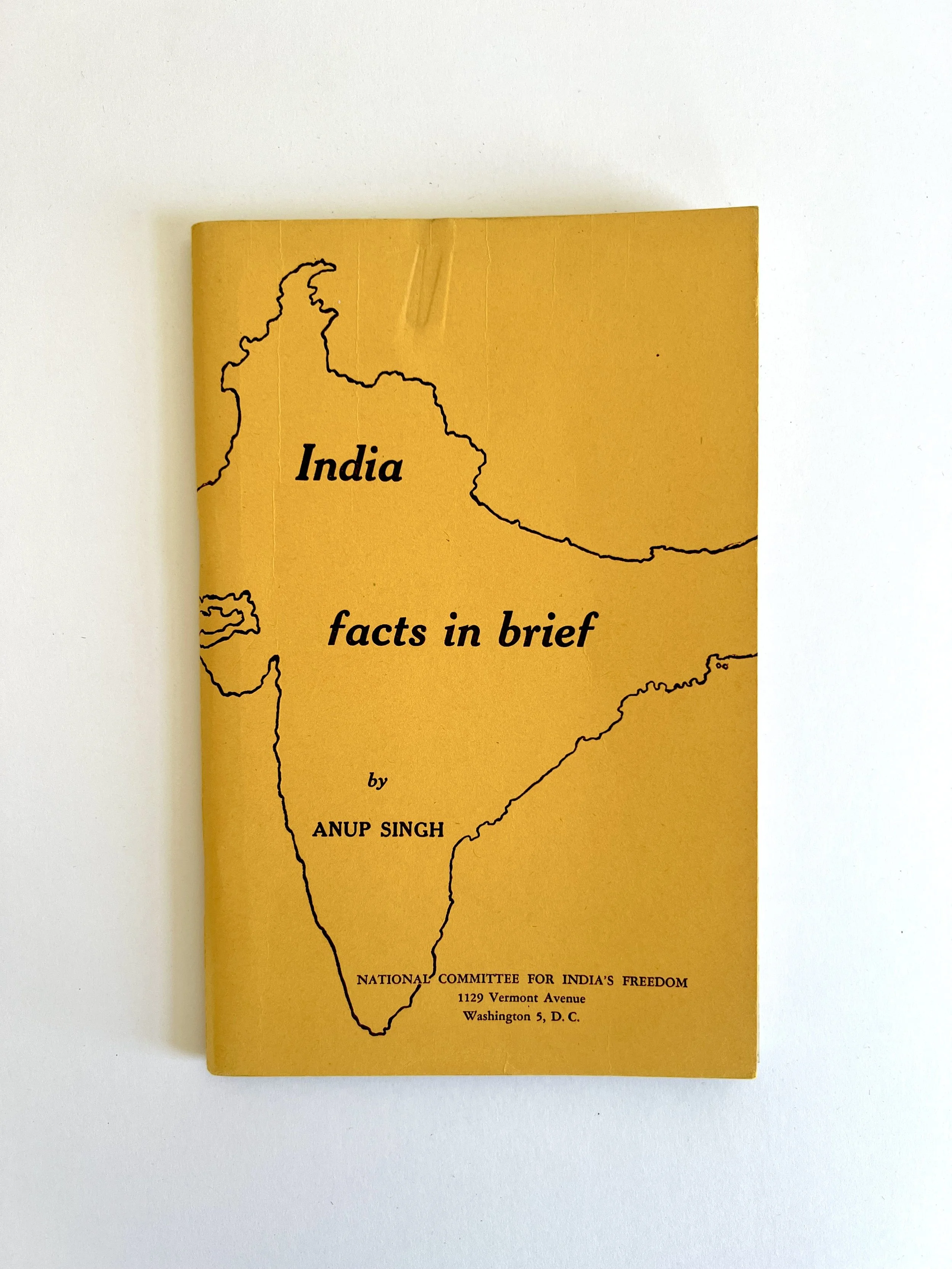
National Committee for India’s Freedom: 1129 Vermont Avenue, Washington 5, D.C. [1945].
Staple-bound wrappers. 71 pp. Text printed inside wrappers. With a typescript letter signed in ink by A.N. Subrahmanyam, Consulate-General of India, San Francisco, laid in. CONDITION: Near-fine, indentation of paper clip to front wrapper and consulate-general’s letter, browning from paper-clip affecting a few leaves.
A scarce and highly erudite introduction to the diversity of India and the injustices inflicted by colonial rule, appealing to the hearts and minds of Americans to push for the subcontinent’s independence after WWII.
The booklet advises on the facts of India as they stood the Second World War, with a focus on India’s material contribution to the war effort. The author notes that “India, oldest example of foreign domination, typifies the position of virtually all other colonials…Now more than ever, India has a special claim upon our attention.” He assures his readers that “India is not demanding an isolationist independence…impossible in an ever-growing, interdependent world, but only that degree of independence that will…enable her to contribute her share in the coming world order.” Among the subjects discussed are the results of “Britain’s Political Hold;” “India and the War;” “Independence—British and Indian Viewpoints;” “India and America;” and “India Tomorrow."
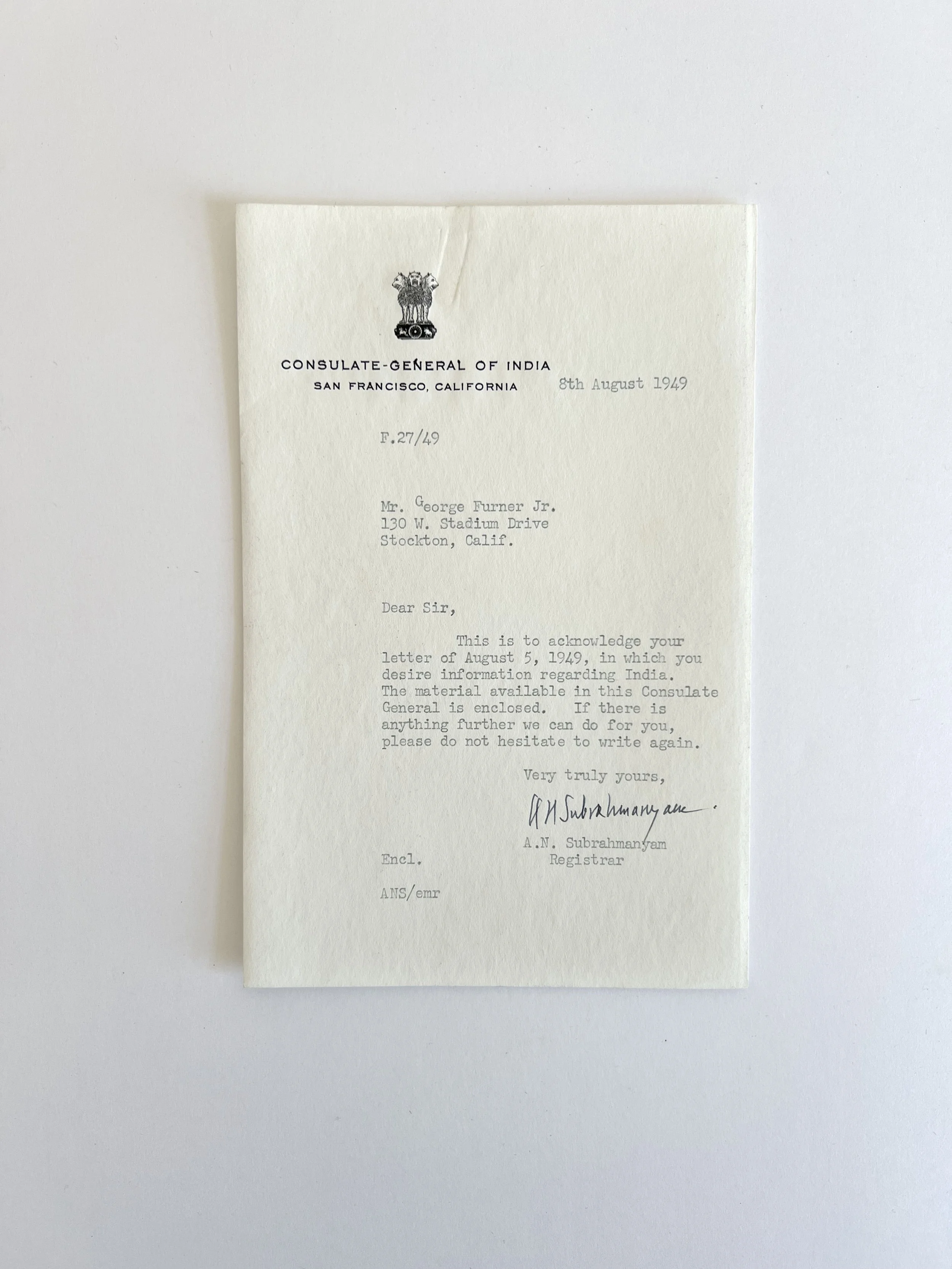
The accompanying letter, dated “8th August 1949,” by Subrahmanyam is addressed to Mr. George Furner Jr., of 130 W. Stadium Drive, Stockton, California. It reads, in part, “this is to acknowledge your letter of August 5 1949, in which you desire information regarding India. The material available in this Consulate Generale is enclosed,” i.e., the present volume. We have been unable to locate further information on Subrahmanyam via the newspaper record. However, from SAADA’s digital repository, we see that he signed at least one other letter, that one sent to Bhagwan Singh Gyanee which enclosed the revolutionary Sikh guru’s forms to apply for Indian citizenship.
Anup Singh Dhillon (1900?–) served for several years as the secretary for the D.C.-based National Committee for India’s Freedom, an organization that had been promoting Indian interests to concerned Americans as early as 1943. A 1930s pamphlet digitized by SAADA indicates that Singh was “from Amritsar…He received his early education in his native land…He has studied at the University of California, and later graduated from the University of Kansas with high distinction…Recently, he has held Goodwin Fellowship at Harvard University while a candidate” for a PhD. Regarding his other advocacy work, the pamphlet notes that Singh “has always taken an active interest in the problems of his countrymen…He was president of the Sikh League on the Pacific Coast” as well as the “Hindustan Pacific Association in Southern California.”
6 in OCLC, at Stanford, Emory, the University of Illinois, NYPL, the HRC, and UWMadison.
Sources Consulted: “Pamphlet about Anup Singh Dhillon” at SouthAsianAmericanDigitalArchive online.
National Committee for India’s Freedom: 1129 Vermont Avenue, Washington 5, D.C. [1945].
Staple-bound wrappers. 71 pp. Text printed inside wrappers. With a typescript letter signed in ink by A.N. Subrahmanyam, Consulate-General of India, San Francisco, laid in. CONDITION: Near-fine, indentation of paper clip to front wrapper and consulate-general’s letter, browning from paper-clip affecting a few leaves.
A scarce and highly erudite introduction to the diversity of India and the injustices inflicted by colonial rule, appealing to the hearts and minds of Americans to push for the subcontinent’s independence after WWII.
The booklet advises on the facts of India as they stood the Second World War, with a focus on India’s material contribution to the war effort. The author notes that “India, oldest example of foreign domination, typifies the position of virtually all other colonials…Now more than ever, India has a special claim upon our attention.” He assures his readers that “India is not demanding an isolationist independence…impossible in an ever-growing, interdependent world, but only that degree of independence that will…enable her to contribute her share in the coming world order.” Among the subjects discussed are the results of “Britain’s Political Hold;” “India and the War;” “Independence—British and Indian Viewpoints;” “India and America;” and “India Tomorrow."
The accompanying letter, dated “8th August 1949,” by Subrahmanyam is addressed to Mr. George Furner Jr., of 130 W. Stadium Drive, Stockton, California. It reads, in part, “this is to acknowledge your letter of August 5 1949, in which you desire information regarding India. The material available in this Consulate Generale is enclosed,” i.e., the present volume. We have been unable to locate further information on Subrahmanyam via the newspaper record. However, from SAADA’s digital repository, we see that he signed at least one other letter, that one sent to Bhagwan Singh Gyanee which enclosed the revolutionary Sikh guru’s forms to apply for Indian citizenship.
Anup Singh Dhillon (1900?–) served for several years as the secretary for the D.C.-based National Committee for India’s Freedom, an organization that had been promoting Indian interests to concerned Americans as early as 1943. A 1930s pamphlet digitized by SAADA indicates that Singh was “from Amritsar…He received his early education in his native land…He has studied at the University of California, and later graduated from the University of Kansas with high distinction…Recently, he has held Goodwin Fellowship at Harvard University while a candidate” for a PhD. Regarding his other advocacy work, the pamphlet notes that Singh “has always taken an active interest in the problems of his countrymen…He was president of the Sikh League on the Pacific Coast” as well as the “Hindustan Pacific Association in Southern California.”
6 in OCLC, at Stanford, Emory, the University of Illinois, NYPL, the HRC, and UWMadison.
Sources Consulted: “Pamphlet about Anup Singh Dhillon” at SouthAsianAmericanDigitalArchive online.