
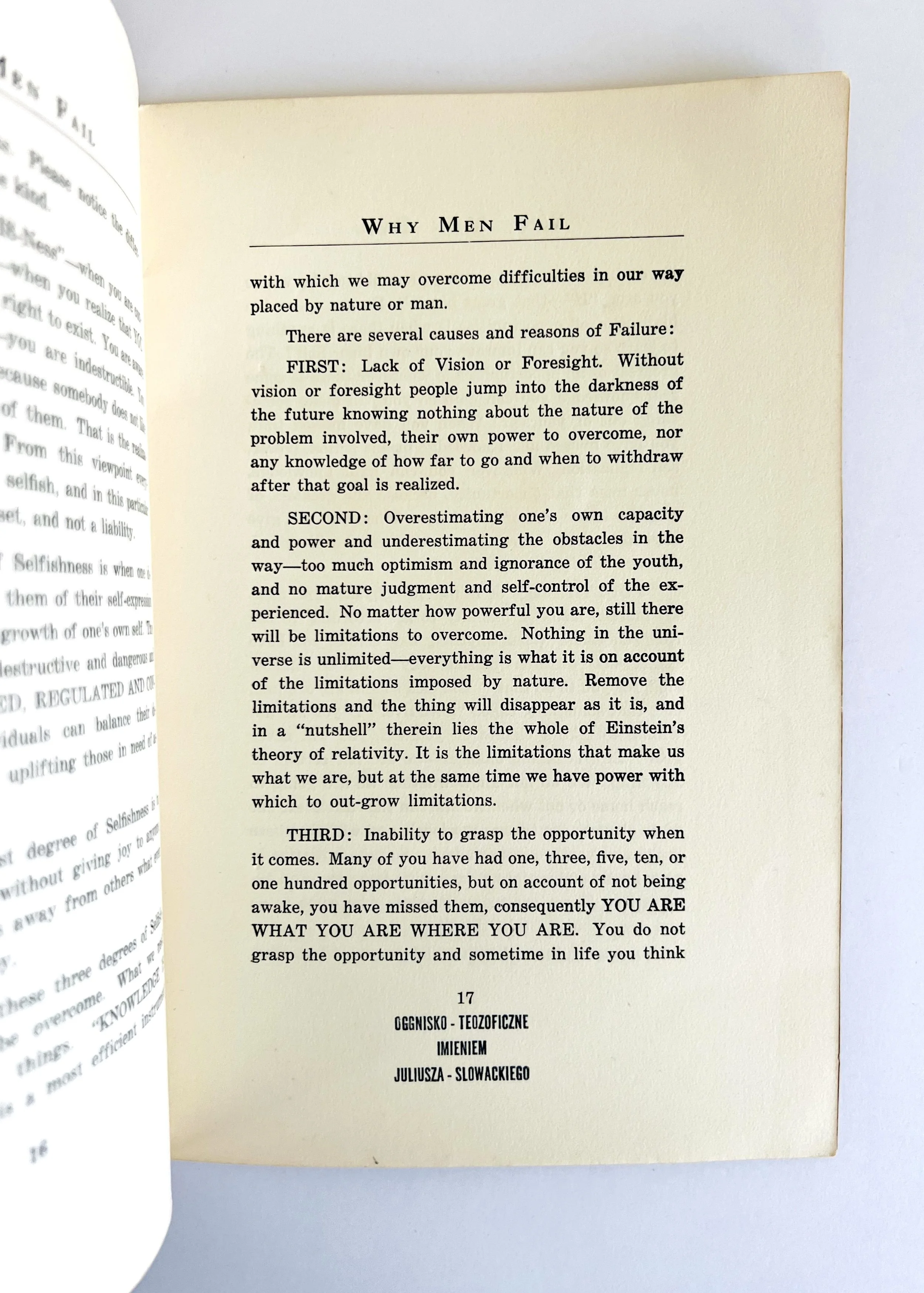
Atlantic Printers: Miami Beach, Florida. 1931.
Staple-bound wrappers. 23 pp. Library label covering half of bottom staple at spine. Occasional ink-stamps reading “Oggnisko-teozoficzne Imieniem Juliusza-Slowackiego” at margins. CONDITION: Very good, staples beginning to rust, occasional annotating in red ink and pencil.
A highly evocative example of New Thought philosophy told through the exotic voice of a a Punjabi revolutionary guru, from the library of a Polish Theosophical Society in America.
This book emphasizes to readers the importance of “SELF-EXPRESSION” that is here considered, “THE LAW OF BEING.” Much of the text is concerned with “Why Men Fail” to express and actualize themselves, considered from “Objective,” “Subjective,” and “Comparative” perspectives. Among the reasons given are such causes as “looking for some kind of authority to rule you…without having the personal experience or vision” to reach a goal, or, when “you have realized what you expected, but the loss of time, energy and material far surpasses the benefits.” As with other New Thought authors writing in the wake of the Great Depression, Gyanee provides advice on “MAKING A SUCCESS WITH MONEY.” He wisely says, “money cannot make a man, but a man CAN make money,” and he cautions his readers from cultivating too much selfishness.
Bhagwan Singh “Gyanee” (1884–1962) was a Sikh priest who became the president of the Ghadar party, a coalition of Indians in North America who attempted to organize an armed revolution in India from overseas. After delivering several anti-establishment speeches during the 1907 Punjab unrest, Gyanee became a known seditionist against the British Raj, and had to leave his wife and two young children while he fled abroad. Following a failed attempt to procure arms and ammunition from the Germans, Gyanee would escape from Japan and end up in San Francisco by 1914. Upon his arrival, he was elected President of Ghadar Party to fill the role left by their recently fled leader, Lala Hardayal. Soon after, during the onset of the First World War, the party signed a declaration of war against the British and asserted that India was a sovereign nation. Shortley thereafter, the Ghadarites were all arrested, and, upon his freedom, Gyanee embarked upon a career as a spiritual guru and began lecturing on health-culture, creativity, and numerous other self-help related topics (closely adjacent to what was then-understood as yoga).
It appears that the Ognisko-Teozoficzne Imieniem Juliusza-Slowackiego was one of two Polish Theosophical centers established in the US, founded in 1923 by one Helena Staś. We locate no trace of them in the newspaper record, only in some secondary literature.
Sources Consulted: Philip Deslippe, “Rishis and Rebels: the Punjabi Sikh Presence in Early American Yoga,” 2016; Polskie Tradycje Ezoteryczne 1890–1939: Teozofia i Antropozofia (Gdansk 2019), p. 92.
Atlantic Printers: Miami Beach, Florida. 1931.
Staple-bound wrappers. 23 pp. Library label covering half of bottom staple at spine. Occasional ink-stamps reading “Oggnisko-teozoficzne Imieniem Juliusza-Slowackiego” at margins. CONDITION: Very good, staples beginning to rust, occasional annotating in red ink and pencil.
A highly evocative example of New Thought philosophy told through the exotic voice of a a Punjabi revolutionary guru, from the library of a Polish Theosophical Society in America.
This book emphasizes to readers the importance of “SELF-EXPRESSION” that is here considered, “THE LAW OF BEING.” Much of the text is concerned with “Why Men Fail” to express and actualize themselves, considered from “Objective,” “Subjective,” and “Comparative” perspectives. Among the reasons given are such causes as “looking for some kind of authority to rule you…without having the personal experience or vision” to reach a goal, or, when “you have realized what you expected, but the loss of time, energy and material far surpasses the benefits.” As with other New Thought authors writing in the wake of the Great Depression, Gyanee provides advice on “MAKING A SUCCESS WITH MONEY.” He wisely says, “money cannot make a man, but a man CAN make money,” and he cautions his readers from cultivating too much selfishness.
Bhagwan Singh “Gyanee” (1884–1962) was a Sikh priest who became the president of the Ghadar party, a coalition of Indians in North America who attempted to organize an armed revolution in India from overseas. After delivering several anti-establishment speeches during the 1907 Punjab unrest, Gyanee became a known seditionist against the British Raj, and had to leave his wife and two young children while he fled abroad. Following a failed attempt to procure arms and ammunition from the Germans, Gyanee would escape from Japan and end up in San Francisco by 1914. Upon his arrival, he was elected President of Ghadar Party to fill the role left by their recently fled leader, Lala Hardayal. Soon after, during the onset of the First World War, the party signed a declaration of war against the British and asserted that India was a sovereign nation. Shortley thereafter, the Ghadarites were all arrested, and, upon his freedom, Gyanee embarked upon a career as a spiritual guru and began lecturing on health-culture, creativity, and numerous other self-help related topics (closely adjacent to what was then-understood as yoga).
It appears that the Ognisko-Teozoficzne Imieniem Juliusza-Slowackiego was one of two Polish Theosophical centers established in the US, founded in 1923 by one Helena Staś. We locate no trace of them in the newspaper record, only in some secondary literature.
Sources Consulted: Philip Deslippe, “Rishis and Rebels: the Punjabi Sikh Presence in Early American Yoga,” 2016; Polskie Tradycje Ezoteryczne 1890–1939: Teozofia i Antropozofia (Gdansk 2019), p. 92.

![Pundit Acharya. Studies in Neuro-Bio-Electronics: The Doctor’s Book of Yogas. Vol. 1 [with] Studies in Neuro-Bio-Electronics: Training of the Brain by the Brain. Vol. 2 [with 3 pieces of ephemera].](https://images.squarespace-cdn.com/content/v1/687efeb0f3827b1e917a0b60/d0e3a66c-eb7e-4867-afa4-03e5730ae75b/AcharyaElectronicsCover.jpeg)