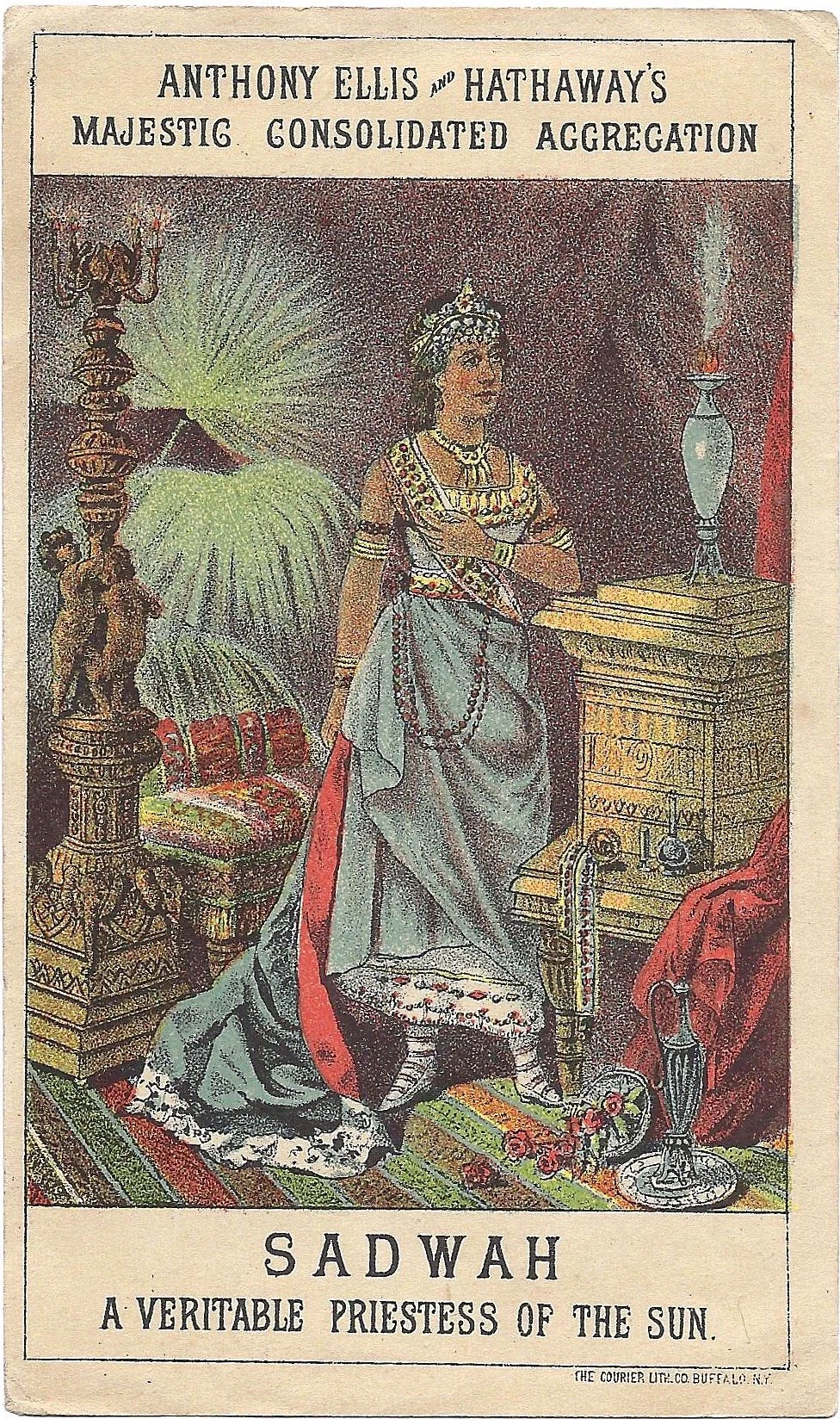
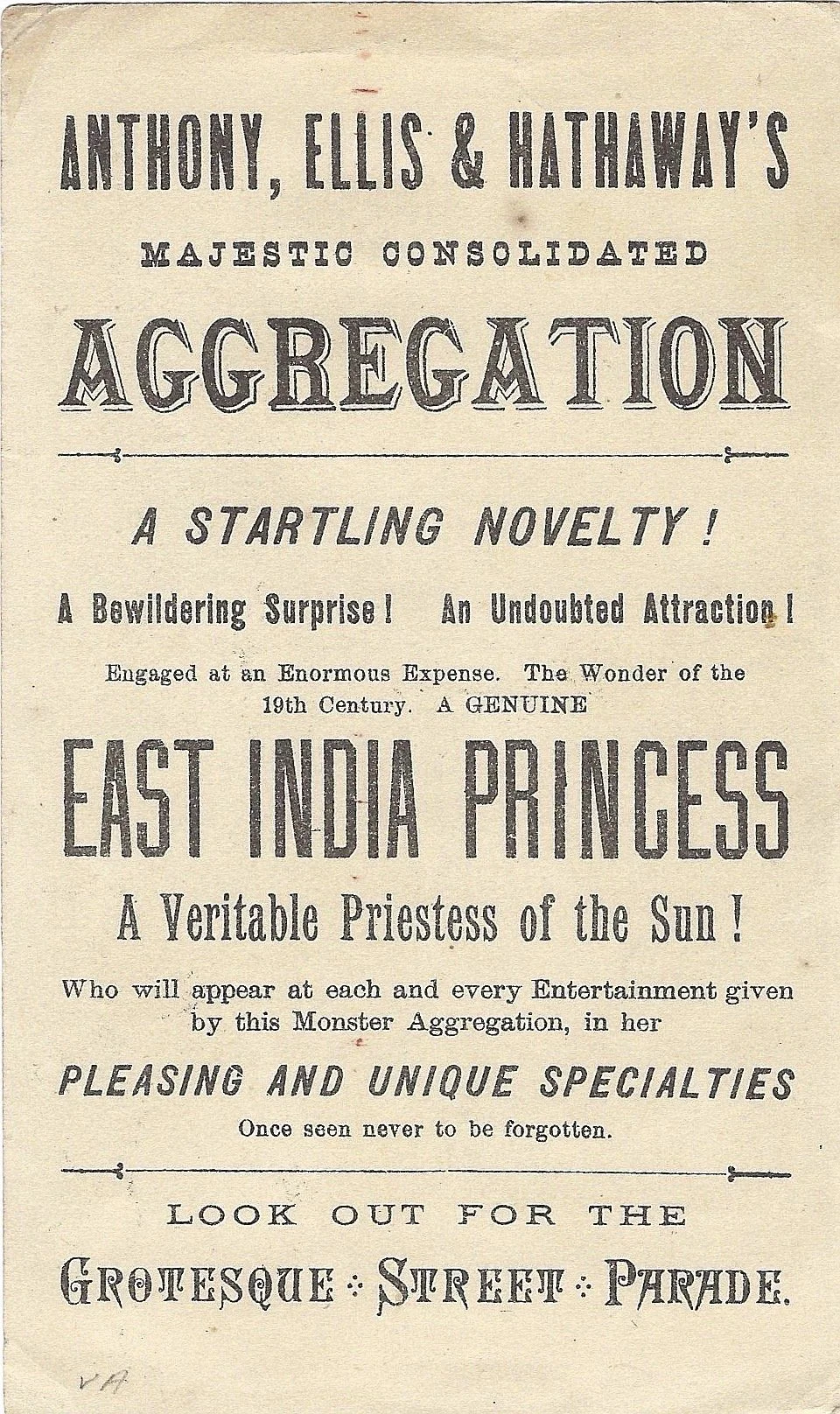
Broadside, 5.5” x 3.25”. Lithographic illus. at recto, text at verso. CONDITION: Very good, corners minimally creased, minimal foxing to verso, image clear and clean, no tears.
A delightful illustrated advertisement for a nineteenth century “East Indian” circus act, demonstrating off the exotic allure of Zoroastrian sun-worship.
This promotional sheet announces a performance by Sadwah, an “East India princess” who was reportedly a true “priestess of the sun,” contracted “at great expense” by the Anthony, Ellis, and Hathaway circus in 1881. The illustration shows Sadwah, a proud tan-skinned woman wearing a diadem and a blue and yellow dress, with bangles on her arms and wrists and a bejewelled sash across her chest. Lending her act a flair of the exotic, the illustrators depict Sadwah looking at a fiery lamp, while behind her shines a bright light, perhaps representing the sun.
Promoters Anthony, Ellis, and Hathaway describe Sadwah’s act as “a bewildering surprise” that presented a number of “pleasing and unique specialties” never before seen in America. The period press suggests that her specialties consisted of singing “remarkable songs and dances” in her “native languages” that emulated the rituals of the “fire worshippers” of the Zoroastrian community, known as “Parsis,” in South Asia. Parsis, a diasporic community from Iran who migrated to the Indian subcontinent in the seventh century, gathered prominently in the states of Gujarat and Maharashtra, in the northwest and western India. By this point in the nineteenth century, Americans would have been familiar with the city of Bombay (present-day Mumbai), the most prominent city in the state of Maharashtra. However, the contemporary press provides varying accounts of Sadwah’s heritage, reporting at one time that she was “princess of the Jucas,” and at others that she was a “royal princess of the Incas.” While it is not impossible for there to have been a minor princely state known as “the Jucas” in South Asia, we are aware of no such place, and we are quite confident that there was no “Inca” state in the Indian subcontinent.
In light of the conflicting reports and our inability to locate Sadwah in the period census, we believe that her “East Indian” persona was a ruse made to lend the Anthony, Ellis, and Hathaway circus an oriental act. As Zoroastrian Parsis constitute a minority within South Asia’s diverse religious landscape, Sadwah’s act was likely one of the first public imaginations of what Zoroastrianism looked like before the American public.
OCLC locates no holdings. We regularly handle examples of nineteenth century stereotypes of South Asians, but this is the first time we have encountered an American representation of a Zoroastrian performer.
Broadside, 5.5” x 3.25”. Lithographic illus. at recto, text at verso. CONDITION: Very good, corners minimally creased, minimal foxing to verso, image clear and clean, no tears.
A delightful illustrated advertisement for a nineteenth century “East Indian” circus act, demonstrating off the exotic allure of Zoroastrian sun-worship.
This promotional sheet announces a performance by Sadwah, an “East India princess” who was reportedly a true “priestess of the sun,” contracted “at great expense” by the Anthony, Ellis, and Hathaway circus in 1881. The illustration shows Sadwah, a proud tan-skinned woman wearing a diadem and a blue and yellow dress, with bangles on her arms and wrists and a bejewelled sash across her chest. Lending her act a flair of the exotic, the illustrators depict Sadwah looking at a fiery lamp, while behind her shines a bright light, perhaps representing the sun.
Promoters Anthony, Ellis, and Hathaway describe Sadwah’s act as “a bewildering surprise” that presented a number of “pleasing and unique specialties” never before seen in America. The period press suggests that her specialties consisted of singing “remarkable songs and dances” in her “native languages” that emulated the rituals of the “fire worshippers” of the Zoroastrian community, known as “Parsis,” in South Asia. Parsis, a diasporic community from Iran who migrated to the Indian subcontinent in the seventh century, gathered prominently in the states of Gujarat and Maharashtra, in the northwest and western India. By this point in the nineteenth century, Americans would have been familiar with the city of Bombay (present-day Mumbai), the most prominent city in the state of Maharashtra. However, the contemporary press provides varying accounts of Sadwah’s heritage, reporting at one time that she was “princess of the Jucas,” and at others that she was a “royal princess of the Incas.” While it is not impossible for there to have been a minor princely state known as “the Jucas” in South Asia, we are aware of no such place, and we are quite confident that there was no “Inca” state in the Indian subcontinent.
In light of the conflicting reports and our inability to locate Sadwah in the period census, we believe that her “East Indian” persona was a ruse made to lend the Anthony, Ellis, and Hathaway circus an oriental act. As Zoroastrian Parsis constitute a minority within South Asia’s diverse religious landscape, Sadwah’s act was likely one of the first public imaginations of what Zoroastrianism looked like before the American public.
OCLC locates no holdings. We regularly handle examples of nineteenth century stereotypes of South Asians, but this is the first time we have encountered an American representation of a Zoroastrian performer.