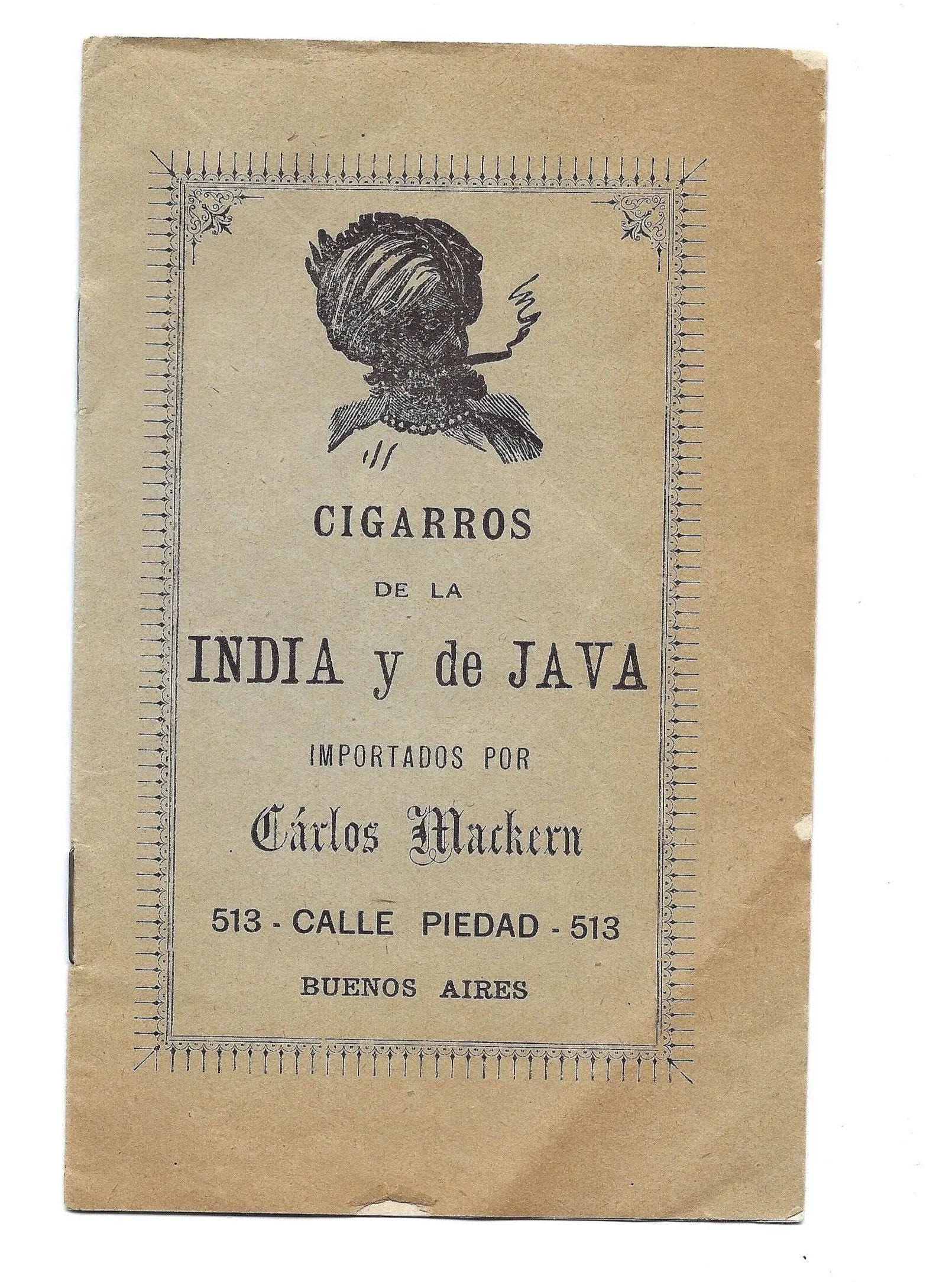
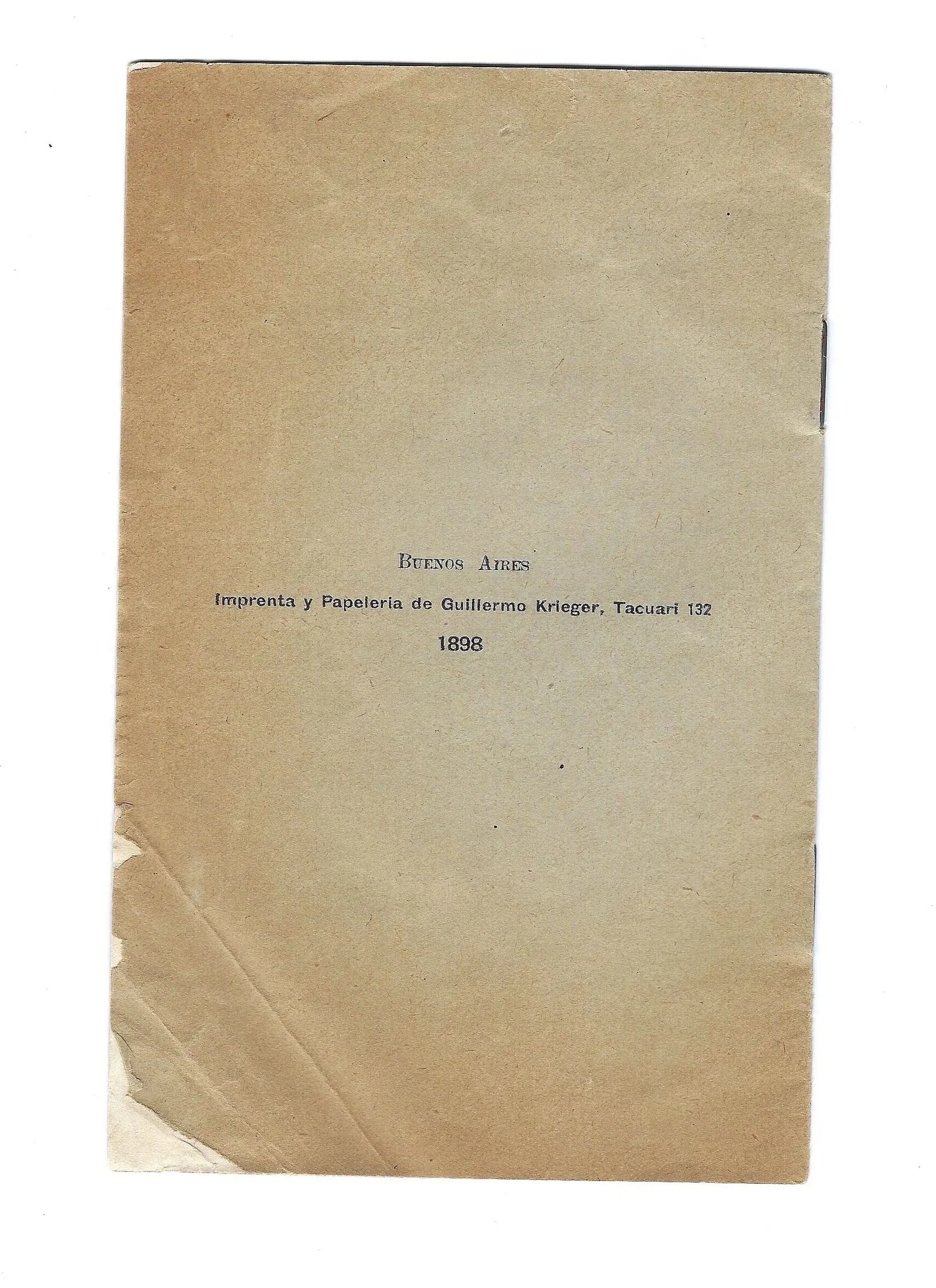
Cárlos Mackern: 513 Calle Road. Buenos Aires. Imprenta y Papelería de Guillermo Krieger, Tacuari 132. 1898.
Staple-bound wrappers, 6.75” x 4.25”. 7 pp. 1 pg. pub. ads. CONDITION: Good, lower third of spine split, chips at extremities of front wrapper and a short tear at upper edge, rear wrapper chipped at extremities and a short tear at upper edge, text block and wrappers creased.
A turban-clad advertisement issued by an Argentine agent for J.B.Pace’s tobacco company, offering Indian-made cigars as a modest-priced alternative to the Cuban cigar.
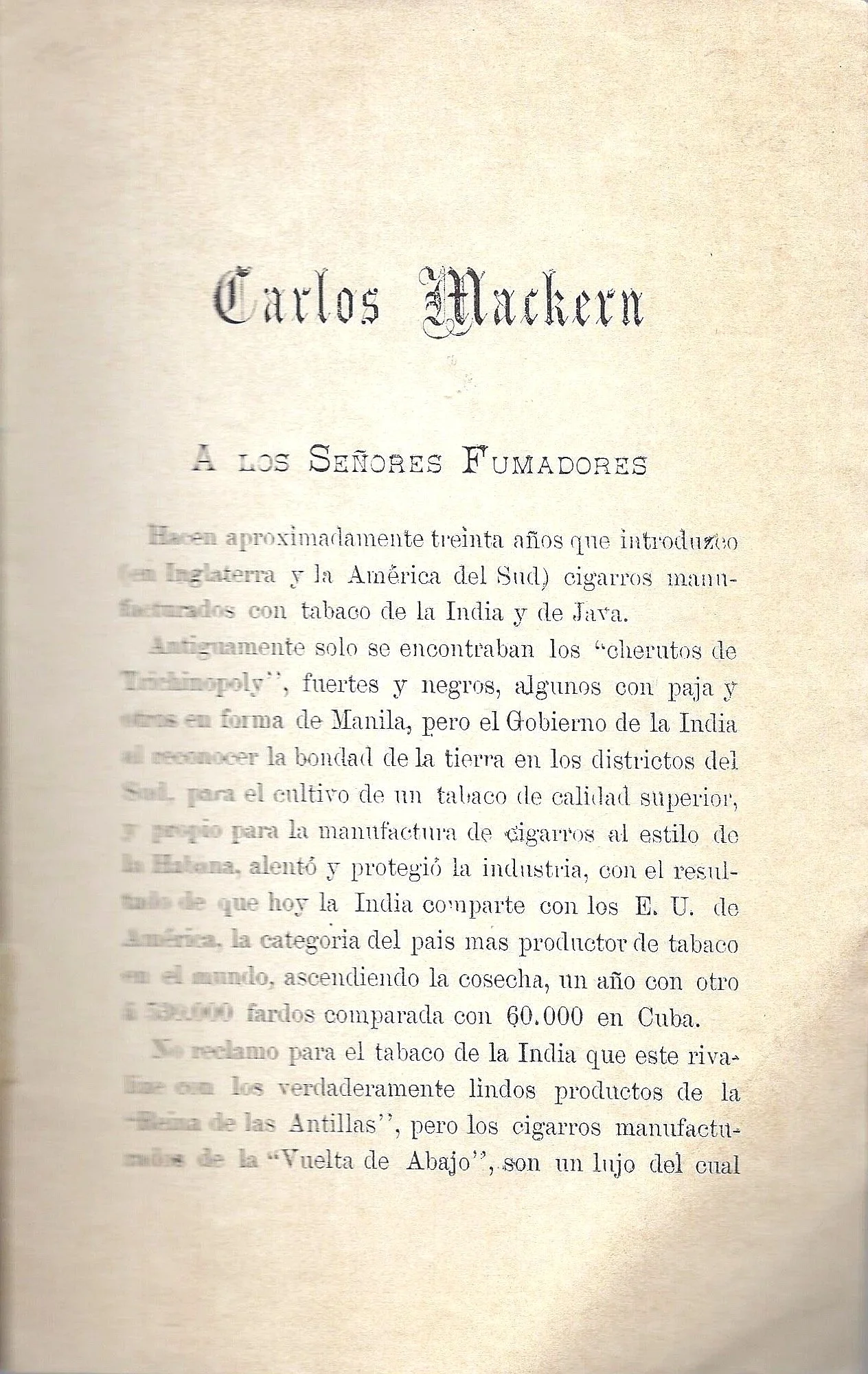
This pamphlet commends the affordability and quality of South Indian cigars that were imported by Cárlos Mackern to Argentina. At the time of the pamphlet’s publication, tobacco from India was widely used to manufacture the “Trichinopoly cheroot,” which had become one of the subcontinent’s most popular exports in the Victorian era. According to this pamphlet, by the late nineteenth century India was the world’s second largest producer of tobacco after America, producing “530,000 fardos comparada con 60.000 en Cuba.” While the Trichinopoly cheroot was known for its robust flavor and coarse draw, the cigars offered by Mackern were a blend of South Indian tobacco crops. Though they did not rival the quality of the most luxurious Cuban cigars, Mackern’s Indian-made cigars were nonetheless smooth, sweet, and aromatic. They were of the “suaves” (mild) variety, and offered the more cash-strapped fumador a smoking experience comparable to the Cuban Habano, without breaking the bank.
In addition to mild Indian cigars, Mackern also imported harsher blends from “Java,” “Java-Sumatra,” and “Dindigul.” After importing cigars from India and Javafor thirty years, Mackern considered himself something of a specialist as an importer of “Cigarros Orientales” in Argentina. On that basis, he assured his customers that all of his products came directly from a single manufacturer in Trichinopoly. His brands came in four sizes and three degrees of strength and flavor, and were packaged in boxes of one hundred each. Among the brands advertised here are the “Vice-roy,” “Orientale. Flor fina, extra,” and “Indios Puros.”
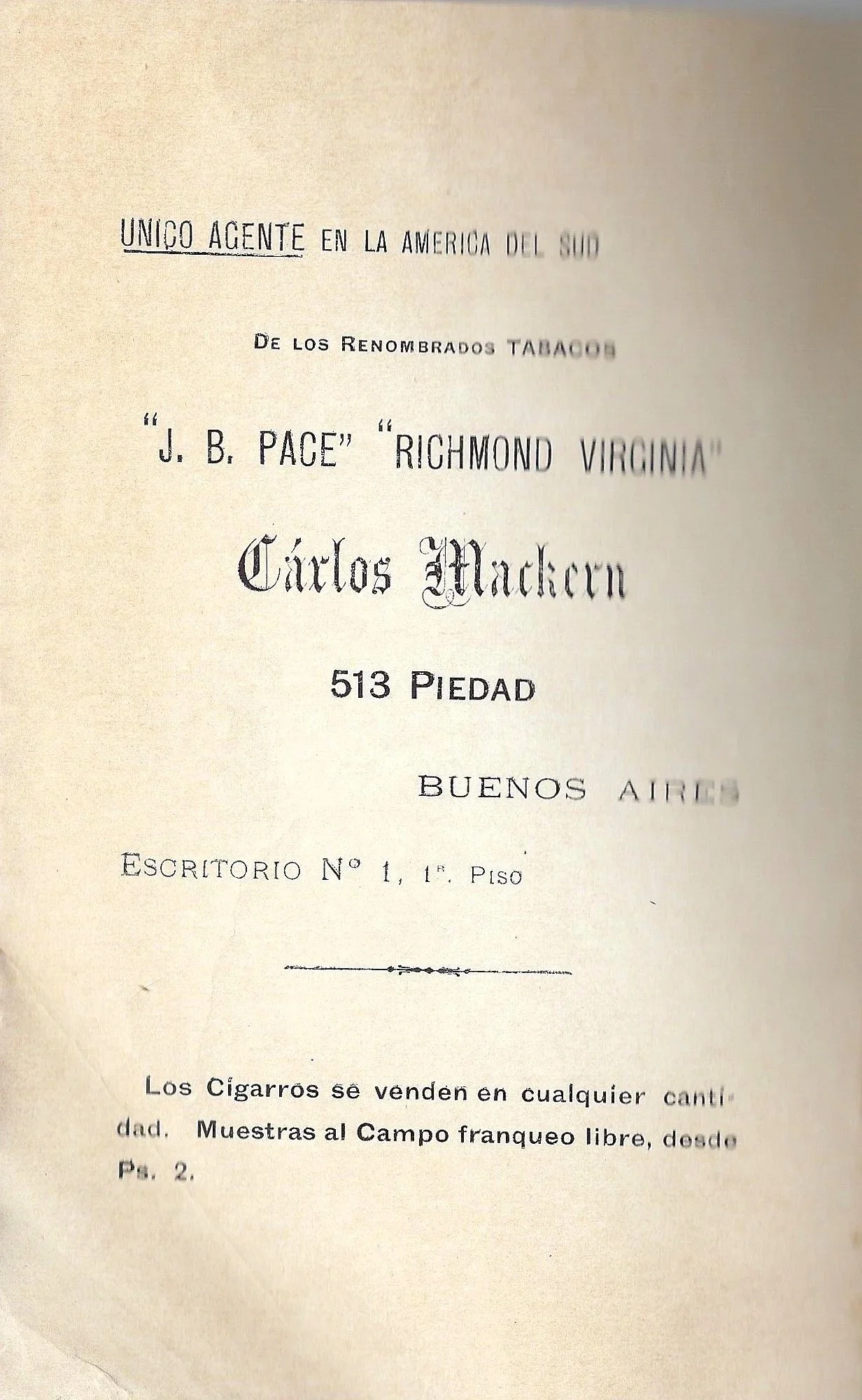
The sole trace of Mackern in the newspaper record is his marriage, which took place in October 1900, in London. This report indicates that Mackern was a “Don” from Buenos Aires, and that he married “Emma, second daughter of James Read, Esq., of St. Ives, Cornwall.” From the advertisement on the last leaf of the pamphlet, we know that at the time of issue, Mackern was under the employ of J.B. Pace, hence suggesting that Pace’s far-reaching American company not only shipped cigars to India, but that they also imported cigars from the subcontinent to be consumed in other markets.
J.B. Pace was a significant manufacturer of tobacco in America during the late nineteenth century. Based in Richmond, Virginia, the company was founded in 1865, and came to “employ between three and four hundred hands” and soon gained “a capacity for turning out 10,000 pounds of tobacco a day. They made more…twist, coils, and light pressed goods than any factory in the United States…They…established trade all over the United States, and shipped to India, England, Canada, Africa, South America, the Sandwich Islands, and British Columbia.
OCLC records no copies of this pamphlet.
Sources Consulted: “RVA Legends – J.B. Pace Tobacco Co.,” at RVAHub online
Cárlos Mackern: 513 Calle Road. Buenos Aires. Imprenta y Papelería de Guillermo Krieger, Tacuari 132. 1898.
Staple-bound wrappers, 6.75” x 4.25”. 7 pp. 1 pg. pub. ads. CONDITION: Good, lower third of spine split, chips at extremities of front wrapper and a short tear at upper edge, rear wrapper chipped at extremities and a short tear at upper edge, text block and wrappers creased.
A turban-clad advertisement issued by an Argentine agent for J.B.Pace’s tobacco company, offering Indian-made cigars as a modest-priced alternative to the Cuban cigar.
This pamphlet commends the affordability and quality of South Indian cigars that were imported by Cárlos Mackern to Argentina. At the time of the pamphlet’s publication, tobacco from India was widely used to manufacture the “Trichinopoly cheroot,” which had become one of the subcontinent’s most popular exports in the Victorian era. According to this pamphlet, by the late nineteenth century India was the world’s second largest producer of tobacco after America, producing “530,000 fardos comparada con 60.000 en Cuba.” While the Trichinopoly cheroot was known for its robust flavor and coarse draw, the cigars offered by Mackern were a blend of South Indian tobacco crops. Though they did not rival the quality of the most luxurious Cuban cigars, Mackern’s Indian-made cigars were nonetheless smooth, sweet, and aromatic. They were of the “suaves” (mild) variety, and offered the more cash-strapped fumador a smoking experience comparable to the Cuban Habano, without breaking the bank.
In addition to mild Indian cigars, Mackern also imported harsher blends from “Java,” “Java-Sumatra,” and “Dindigul.” After importing cigars from India and Javafor thirty years, Mackern considered himself something of a specialist as an importer of “Cigarros Orientales” in Argentina. On that basis, he assured his customers that all of his products came directly from a single manufacturer in Trichinopoly. His brands came in four sizes and three degrees of strength and flavor, and were packaged in boxes of one hundred each. Among the brands advertised here are the “Vice-roy,” “Orientale. Flor fina, extra,” and “Indios Puros.”
The sole trace of Mackern in the newspaper record is his marriage, which took place in October 1900, in London. This report indicates that Mackern was a “Don” from Buenos Aires, and that he married “Emma, second daughter of James Read, Esq., of St. Ives, Cornwall.” From the advertisement on the last leaf of the pamphlet, we know that at the time of issue, Mackern was under the employ of J.B. Pace, hence suggesting that Pace’s far-reaching American company not only shipped cigars to India, but that they also imported cigars from the subcontinent to be consumed in other markets.
J.B. Pace was a significant manufacturer of tobacco in America during the late nineteenth century. Based in Richmond, Virginia, the company was founded in 1865, and came to “employ between three and four hundred hands” and soon gained “a capacity for turning out 10,000 pounds of tobacco a day. They made more…twist, coils, and light pressed goods than any factory in the United States…They…established trade all over the United States, and shipped to India, England, Canada, Africa, South America, the Sandwich Islands, and British Columbia.
OCLC records no copies of this pamphlet.
Sources Consulted: “RVA Legends – J.B. Pace Tobacco Co.,” at RVAHub online
![Paul Oberst, photog. [Studio portrait of children in an oriental rug store].](https://images.squarespace-cdn.com/content/v1/687efeb0f3827b1e917a0b60/77315bff-97b4-43e3-803d-d55c73f26b9a/OberstChildRugmakersPhotoScn.jpg)