Kobe. Circa 1890.
Hand-colored photograph, 8.25” x 10.25”, adhered to gray mount. Captioned in the negative, at lower corner of image. CONDITION: Very good, some curling and warping to edges, minimal bubbling from adhesive, image clear and color bright.
A delightful promotional image taken by a Japanese studio specializing in hand-colored photography for the tourist trade.
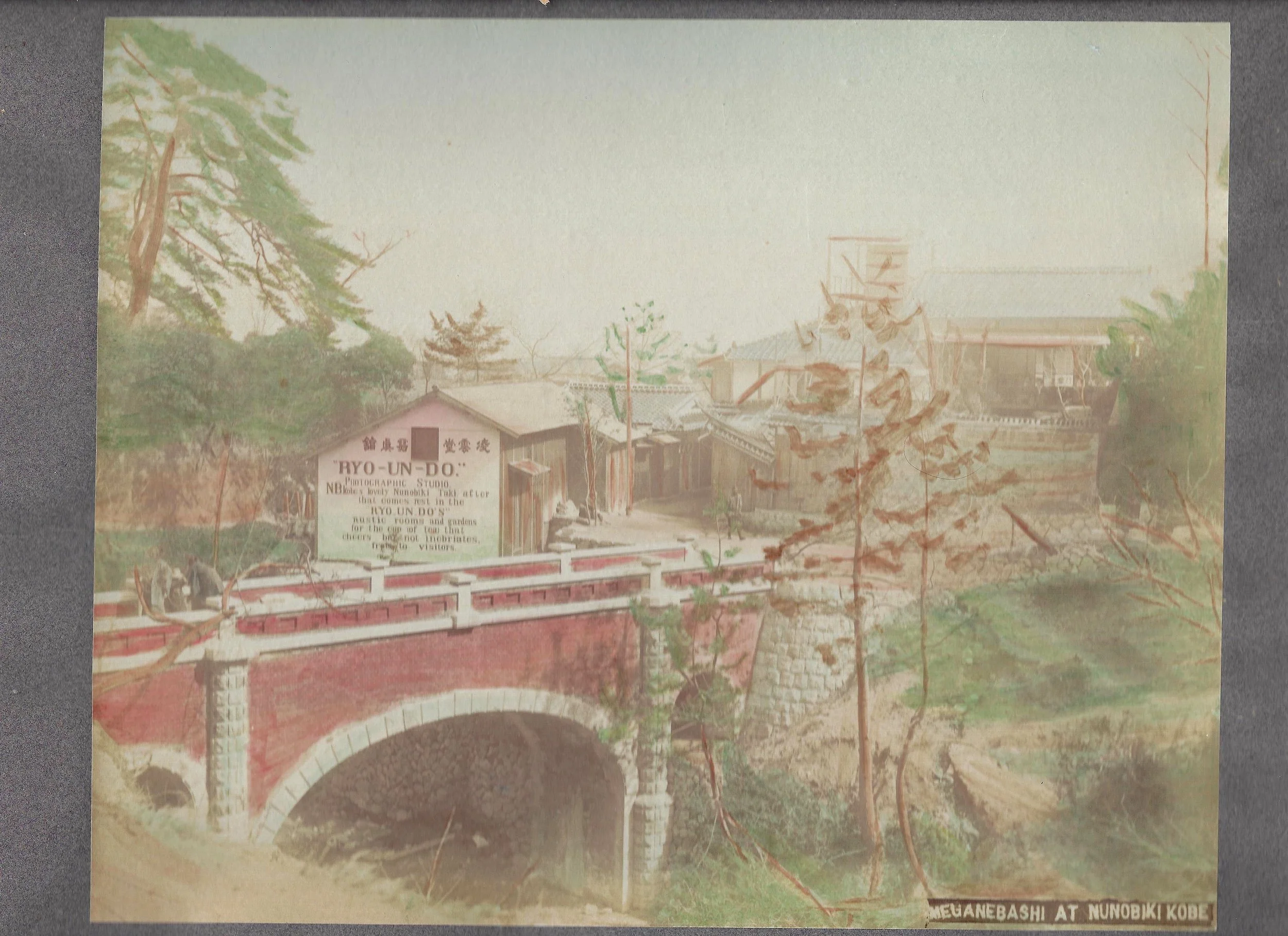
This color photograph shows the Meganebashi, or “Spectacles Bridge,” in the Nunobiki neighborhood of Kobe. At the left of the image, there is a family of three, likely two parents and a young child, admiring the view from the bridge. This spectacle-like structure, made entirely out of brick and helping to modernize Kobe’s water supply, was a landmark destination for tourists both foreign and domestic who came to the city during the Meiji Era (1862–1912).
In the background of this tableaux can be seen the studio of “RYO-UN-DO,” a firm that, on top of providing hand-colored photographs, also offered “rustic rooms and gardens,” as well as free tea to sitters. The studio catered especially to foreign tourists who, coming to appreciate Japan’s scenic beauty and unique culture, wanted to take artistic images of this faraway land home with them. Studios such as Ryoundo’s in Kobe produced “meticulously hand-colored” photographs via watercolor paints, “creating beautiful works that resembled color photographs…The choice of subjects, the skillful composition, and the beautiful coloring contributed to creating the myth of…the mysterious Orient, rather than depicting the reality” of a modern, westernizing Japan. Done in concert with other studios specializing in painted photographs, Ryoundo’s studio helped make “hand-colored photographs…a popular…souvenir for foreigners and one of Japan's most important exports.”
We have located an exhibit on Japan’s hand-colored photography industry, staged at the Japan Cultural Expo in Kobe, in 2024. Apart from that, there seems to be minimal institutional documentation of the vernacular Japanese firms facilitating this artistic phenomenon.
Sources Consulted: “The Uniqueness of Hand-colored Japanese Photography in the Bakumatsu and Meiji Eras” at JapanCulturalExpo2.0 online.
Kobe. Circa 1890.
Hand-colored photograph, 8.25” x 10.25”, adhered to gray mount. Captioned in the negative, at lower corner of image. CONDITION: Very good, some curling and warping to edges, minimal bubbling from adhesive, image clear and color bright.
A delightful promotional image taken by a Japanese studio specializing in hand-colored photography for the tourist trade.
This color photograph shows the Meganebashi, or “Spectacles Bridge,” in the Nunobiki neighborhood of Kobe. At the left of the image, there is a family of three, likely two parents and a young child, admiring the view from the bridge. This spectacle-like structure, made entirely out of brick and helping to modernize Kobe’s water supply, was a landmark destination for tourists both foreign and domestic who came to the city during the Meiji Era (1862–1912).
In the background of this tableaux can be seen the studio of “RYO-UN-DO,” a firm that, on top of providing hand-colored photographs, also offered “rustic rooms and gardens,” as well as free tea to sitters. The studio catered especially to foreign tourists who, coming to appreciate Japan’s scenic beauty and unique culture, wanted to take artistic images of this faraway land home with them. Studios such as Ryoundo’s in Kobe produced “meticulously hand-colored” photographs via watercolor paints, “creating beautiful works that resembled color photographs…The choice of subjects, the skillful composition, and the beautiful coloring contributed to creating the myth of…the mysterious Orient, rather than depicting the reality” of a modern, westernizing Japan. Done in concert with other studios specializing in painted photographs, Ryoundo’s studio helped make “hand-colored photographs…a popular…souvenir for foreigners and one of Japan's most important exports.”
We have located an exhibit on Japan’s hand-colored photography industry, staged at the Japan Cultural Expo in Kobe, in 2024. Apart from that, there seems to be minimal institutional documentation of the vernacular Japanese firms facilitating this artistic phenomenon.
Sources Consulted: “The Uniqueness of Hand-colored Japanese Photography in the Bakumatsu and Meiji Eras” at JapanCulturalExpo2.0 online.