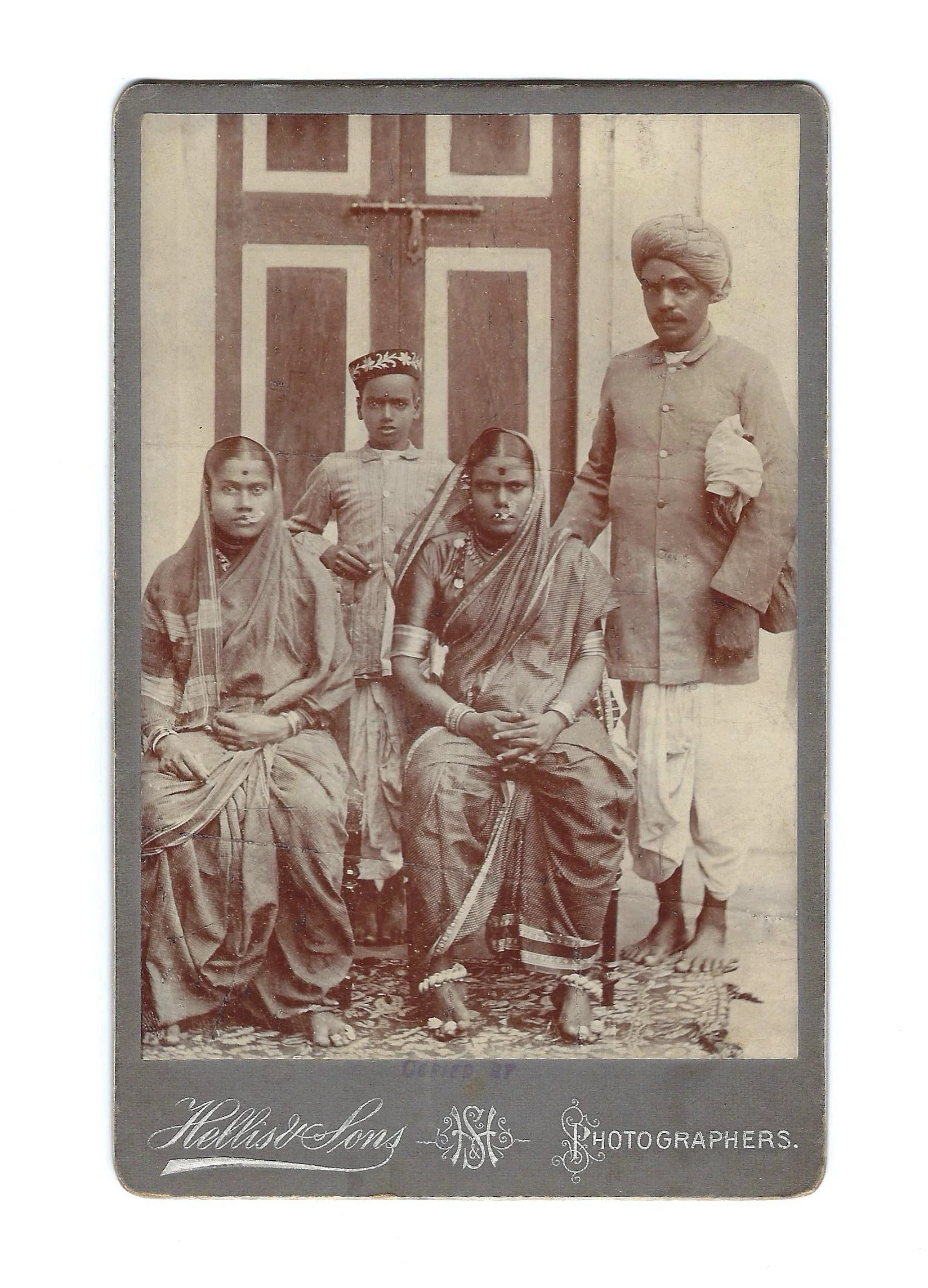
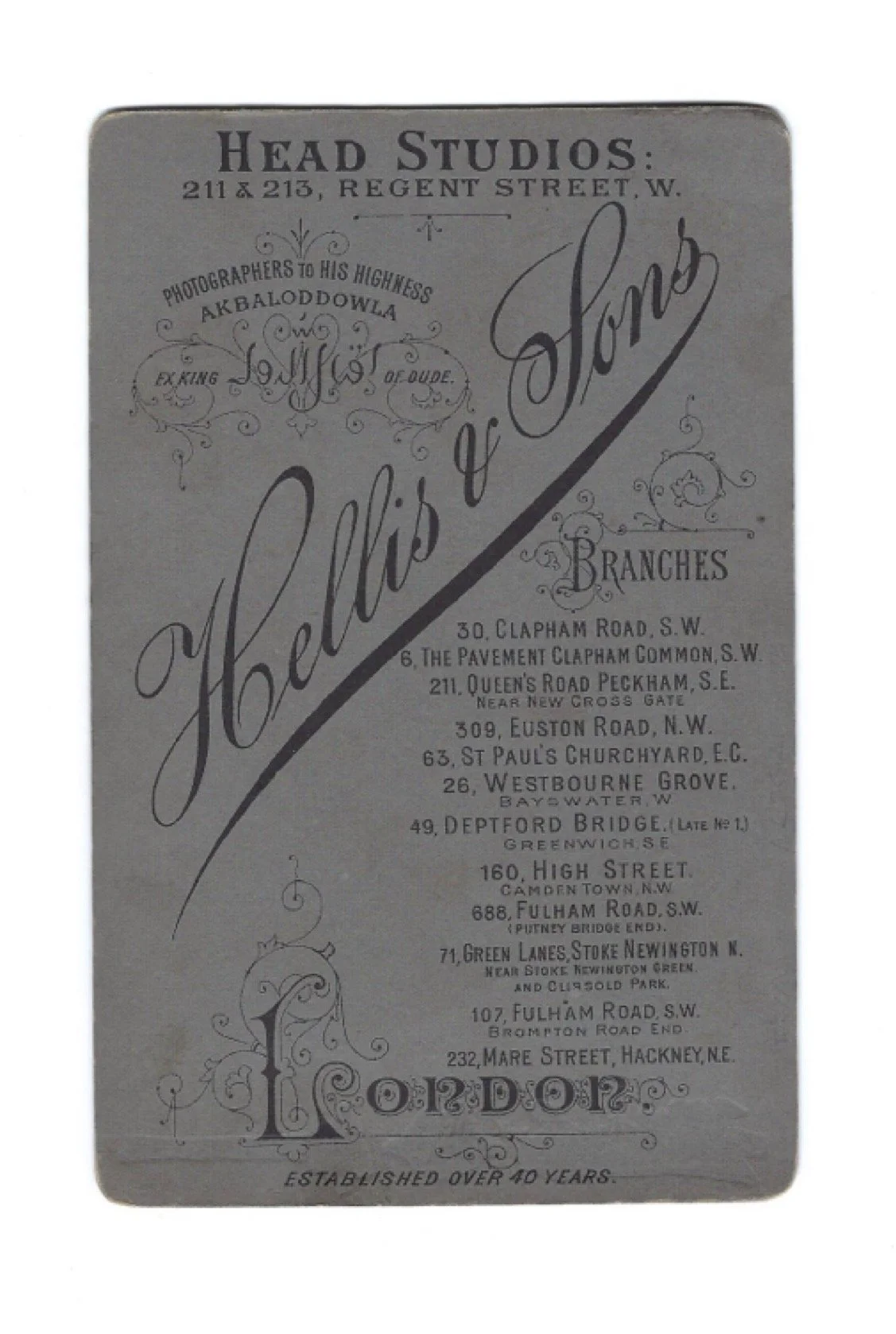
Hellis & Sons: 211 & 213 Regent Street, W. London. Circa 1870.
Cabinet card, 5.5” x 4” plus mount. Photographers imprint at foot of recto and at verso. Blue inkstamp reading “Copied by” underneath printed image.
The only known example of a photograph commissioned by a disenfranchised prince of Awad made while he pleaded his case to the London courts, likely showing a high-caste family from Awad alongside their household servant.
This dignified portrait shows a group of four barefooted South Asians, consisting of two women, a young boy, and an older man. The women are shown seated, wearing highly decorative saris and with an abundance of jewelry including anklets, bangles, nose-rings, and necklaces, as well as what appear to be toe-rings and marigolds accenting their feet. The child seems to be wearing a tailored shirt, while tipped back on his head rests an ornate cap. The plain garb of the accompanying man with this trio seems intentional, and, as he appears to be carrying a burlap sack under his arm and keeps an arms length from the group, we conjecture that he is a domestic servant employed by the present family.
Accompanying the details of Hellis & Sons’ various London branches, the studio notes that they were “photographers to His Highness, Akbaloddowla, ex-king of Oude.” Akbaloddowla, better known as Iqbal al-Daula (1808–1888), or Ekbal Ood Dowlah, was a prominent dispossessed nawab of the state of Awad, arguably the most important princely state in early nineteenth century India. Iqbal’s father was the chosen successor to the throne of Awad, but his title was passed over by the East India Company, in a violation of the traditional Muslim laws of succession that had been in place in Awad for centuries. As compensation, the Company promised to pay Iqbal’s father and his family a stipend of twenty-thousand pounds, yearly. But, after the death of Iqbal al-Daula’s parents, the Company reneged on paying this stipend to Iqbal, and claimed that neither he nor any of his family members were entitled to any pension because they were not royals according to the English laws of nobility. This was the cause of much protest, and led to Iqbal al-Daula first pleading his case to the nobles in Awad, before bringing it to the Company’s court in Calcutta. Finding little support among the British and nawabs of his native land, by 1838, Iqbal came to London, with family members as well as a group of courtly retainers and silver gifts, to present his cause in the empire’s capital and curry favor among the English gentry. While his appeals for title and pension were unsuccessful within the London courts, Iqbal’s two-year travels throughout England from 1838 and 1840 led him to meet a number of powerful political supporters, who connected him with artists and photographers, including evidently Robert Hellis, the founder of Hellis & Sons studio.
The newspaper record and secondary accounts indicate that well after the 1830s, Iqbal al-Daula made trips to England to argue for his inheritance and remind the English of his royal birth. During a trip to London in the 1860s, the pioneering English photographer Julia Cameron produced a stately portrait of Iqbal titled “The Ex-King of Oude by Right of Birth.” Shortly after, it appears that the “ex-king” enlisted the Hellis & Sons firm to produce cartes-de-visites that could be easily distributed while he traveled the country.
Based on this image being labeled a “copy,” we believe that Iqbal al-Daula brought photographs taken in Awad that were then reproduced and widely distributed by Hellis & Sons. This would explain how Hellis & Sons could produce images of subcontinental subjects without ever having to travel to India. Evidently, this was not done on a particularly wide scale as despite Hellis & Sons’ prominent place in nineteenth century England’s photographic landscape, we have located no examples of South Asians produced by this firm in the trade or in institutional repositories. On this basis, we believe that Iqbal somehow knew this family, given their ornate dress and the fact that this apparently did not produce an abundance of images like this.
Sources Consulted: Avril Lansdell, Fashion à la Carte, 1860–1900: a study of Fashion through cartes-de-visite (Indiana University 1985), p. 12; Michael H. Fisher, Counterflows to Colonialism: Indian Travellers and Settlers to Britain 1600-1857 (Delhi 2004), pgs. 271–275; Lindsay Smith, “Book Review of Julia Margaret Cameron: The Colonial Shadows of Victorian Photography by Jeff Rosen” (Spring 2025).
Hellis & Sons: 211 & 213 Regent Street, W. London. Circa 1870.
Cabinet card, 5.5” x 4” plus mount. Photographers imprint at foot of recto and at verso. Blue inkstamp reading “Copied by” underneath printed image.
The only known example of a photograph commissioned by a disenfranchised prince of Awad made while he pleaded his case to the London courts, likely showing a high-caste family from Awad alongside their household servant.
This dignified portrait shows a group of four barefooted South Asians, consisting of two women, a young boy, and an older man. The women are shown seated, wearing highly decorative saris and with an abundance of jewelry including anklets, bangles, nose-rings, and necklaces, as well as what appear to be toe-rings and marigolds accenting their feet. The child seems to be wearing a tailored shirt, while tipped back on his head rests an ornate cap. The plain garb of the accompanying man with this trio seems intentional, and, as he appears to be carrying a burlap sack under his arm and keeps an arms length from the group, we conjecture that he is a domestic servant employed by the present family.
Accompanying the details of Hellis & Sons’ various London branches, the studio notes that they were “photographers to His Highness, Akbaloddowla, ex-king of Oude.” Akbaloddowla, better known as Iqbal al-Daula (1808–1888), or Ekbal Ood Dowlah, was a prominent dispossessed nawab of the state of Awad, arguably the most important princely state in early nineteenth century India. Iqbal’s father was the chosen successor to the throne of Awad, but his title was passed over by the East India Company, in a violation of the traditional Muslim laws of succession that had been in place in Awad for centuries. As compensation, the Company promised to pay Iqbal’s father and his family a stipend of twenty-thousand pounds, yearly. But, after the death of Iqbal al-Daula’s parents, the Company reneged on paying this stipend to Iqbal, and claimed that neither he nor any of his family members were entitled to any pension because they were not royals according to the English laws of nobility. This was the cause of much protest, and led to Iqbal al-Daula first pleading his case to the nobles in Awad, before bringing it to the Company’s court in Calcutta. Finding little support among the British and nawabs of his native land, by 1838, Iqbal came to London, with family members as well as a group of courtly retainers and silver gifts, to present his cause in the empire’s capital and curry favor among the English gentry. While his appeals for title and pension were unsuccessful within the London courts, Iqbal’s two-year travels throughout England from 1838 and 1840 led him to meet a number of powerful political supporters, who connected him with artists and photographers, including evidently Robert Hellis, the founder of Hellis & Sons studio.
The newspaper record and secondary accounts indicate that well after the 1830s, Iqbal al-Daula made trips to England to argue for his inheritance and remind the English of his royal birth. During a trip to London in the 1860s, the pioneering English photographer Julia Cameron produced a stately portrait of Iqbal titled “The Ex-King of Oude by Right of Birth.” Shortly after, it appears that the “ex-king” enlisted the Hellis & Sons firm to produce cartes-de-visites that could be easily distributed while he traveled the country.
Based on this image being labeled a “copy,” we believe that Iqbal al-Daula brought photographs taken in Awad that were then reproduced and widely distributed by Hellis & Sons. This would explain how Hellis & Sons could produce images of subcontinental subjects without ever having to travel to India. Evidently, this was not done on a particularly wide scale as despite Hellis & Sons’ prominent place in nineteenth century England’s photographic landscape, we have located no examples of South Asians produced by this firm in the trade or in institutional repositories. On this basis, we believe that Iqbal somehow knew this family, given their ornate dress and the fact that this apparently did not produce an abundance of images like this.
Sources Consulted: Avril Lansdell, Fashion à la Carte, 1860–1900: a study of Fashion through cartes-de-visite (Indiana University 1985), p. 12; Michael H. Fisher, Counterflows to Colonialism: Indian Travellers and Settlers to Britain 1600-1857 (Delhi 2004), pgs. 271–275; Lindsay Smith, “Book Review of Julia Margaret Cameron: The Colonial Shadows of Victorian Photography by Jeff Rosen” (Spring 2025).
![[Hand-colored photograph of a Seated Woman]. Japan, Meiji Era.](https://images.squarespace-cdn.com/content/v1/687efeb0f3827b1e917a0b60/d48f5192-0f85-41a7-b2fd-590578202db9/JapaneseWomanHandcoloredPhotoScn.jpg)