Jos. Hallyworth: 1916.
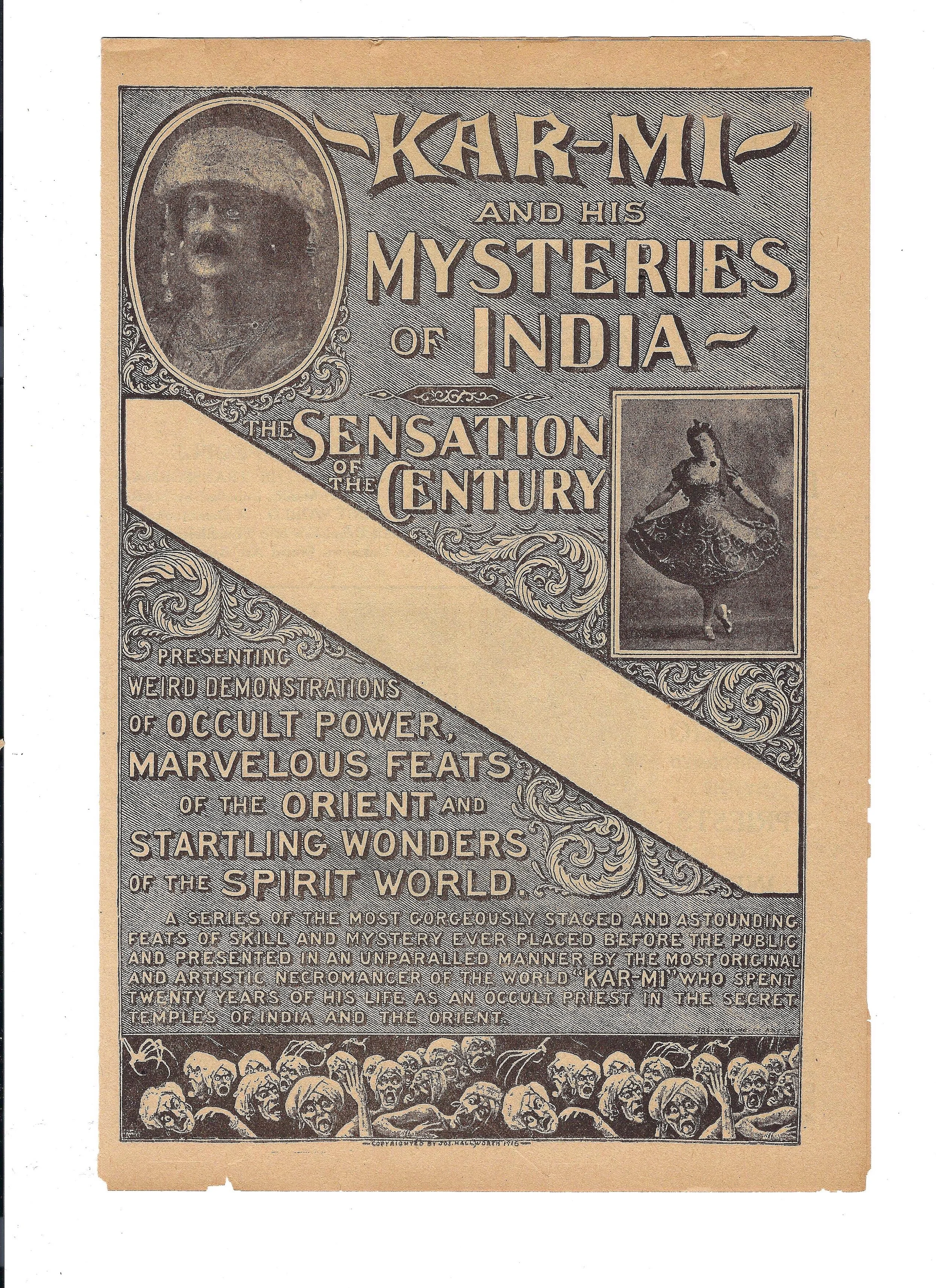
Circular, 10.5” x 7”. 4 pgs. CONDITION: Good, short chips and tears to edges and margins, contents fine and spine sound.
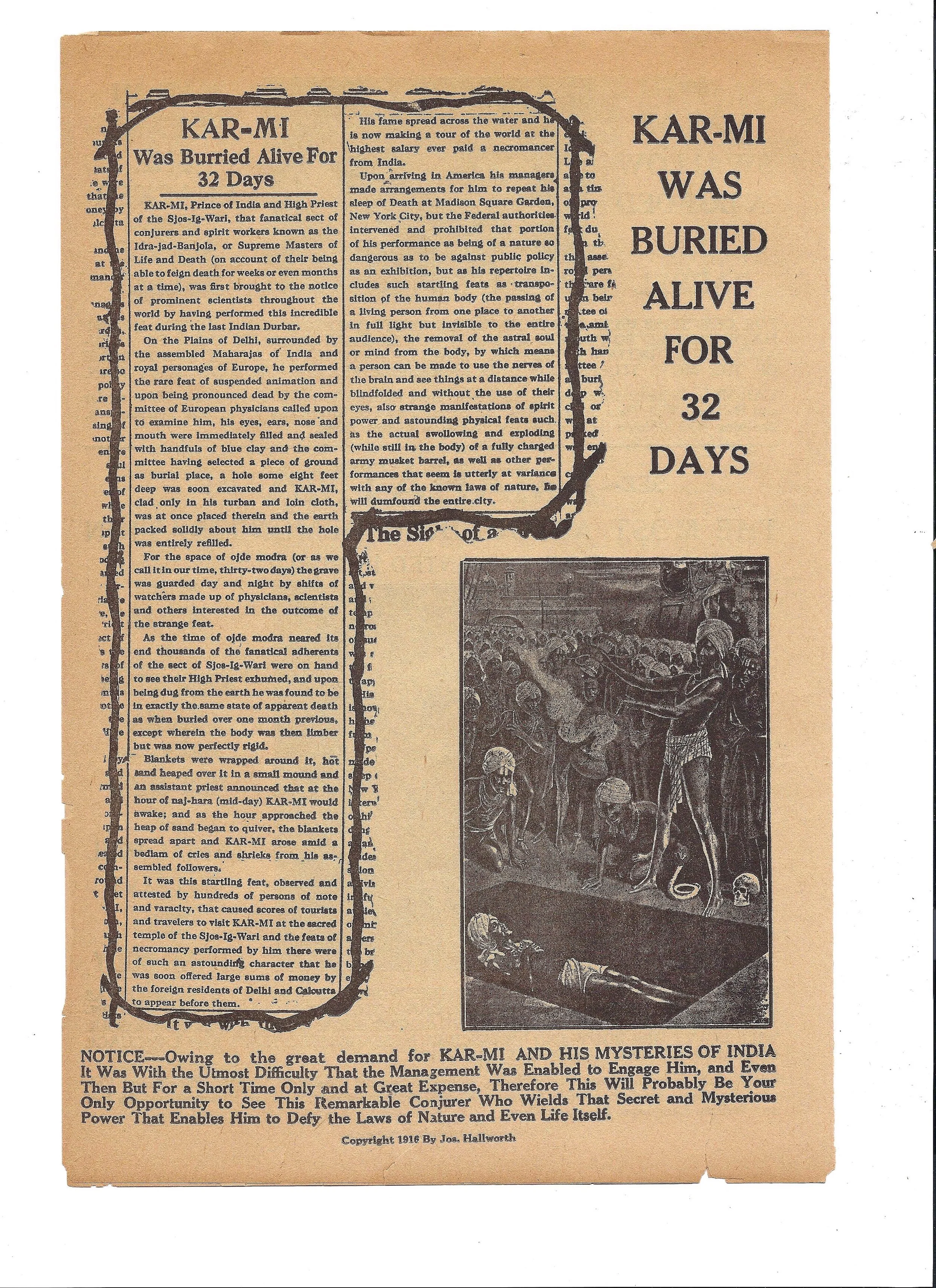
A scarce circular advertising the performance of the “most artistic necromancer of the world,” renowned for his adaptation of “Indian magic” for the American stage.
This leaflet advertises the sensationally Orientalist acts staged by Kar-mi’s magic troupe, including his renowned “Mystery of Selma…the transformation and restoration of a LIVING BODY;” the “CREATION OF GAMSHO…a LIVING WOMAN from the body of a LIVING MAN…as performed by the PRIESTS OF INDIA in the secret temple of the Sjos-Ig-Wari;” and “AMAHATMA…the ACTUAL PROJECTION of a LIVING HUMAN MIND THROUGH SPACE.” Also included is a report on Kar-mi being "buried alive for 32 days.”
Kar-Mi was the stage name for Joseph Hallworth (1872—1956), who was one of the most popular importers of “Indian magic” to the United States at the turn of the century. While Hallworth used magical India to add an exotic air to his performances, there was little, if any, authentic Indian magic present in his acts. A traveling performer, he got his start acting in the 1890s doing Wild West shows, before entering the circuit of “circuses, dime museums, riverboats, vaudeville, movie houses,” among other venues. As a lifelong performer, “Hallworth changed his professional name…over the years. Starting as ‘Joseph Hallworth,’…He became ‘Joe van Victorina,’ then ‘Victorina,’ then ‘Prince Kar-Mi,’ and finally ‘Kar-Mi.’” He frequently recycled his promotional material (which included chromolithographic posters), replacing old stage names with his latest moniker. He was highly regarded for developing “a fast-paced and breathtaking fifteen minutes of quick magic illusions, sword swallowing and sharpshooting tricks.” Most notable among these was his illusion, “Selma,” which “involved cremating and reviving his female assistant.”
A multitalented artist, “Hall[y]worth also learned the art of tattooing. Between his shows, he would set up a temporary tattoo parlor, and earn extra money etching the skins of eager customers.” By the 1930s, he retired from the stage, and found work as a printer and engraver.
OCLC records no holdings. We have placed a similar copy of this circular at the William L. Clements Library. Beyond that, the only institutional records of Kar-Mi that we have found are lithographic posters held at the Harry Ransom Center and the Library of Congress.
Sources Consulted: “Kar-Mi (Victorina): Energetic and Inventive Vaudeville Showman” at MagicTricks.com; “Karmi” at San Francisco Magic Theater online.
Jos. Hallyworth: 1916.
Circular, 10.5” x 7”. 4 pgs. CONDITION: Good, short chips and tears to edges and margins, contents fine and spine sound.
A scarce circular advertising the performance of the “most artistic necromancer of the world,” renowned for his adaptation of “Indian magic” for the American stage.
This leaflet advertises the sensationally Orientalist acts staged by Kar-mi’s magic troupe, including his renowned “Mystery of Selma…the transformation and restoration of a LIVING BODY;” the “CREATION OF GAMSHO…a LIVING WOMAN from the body of a LIVING MAN…as performed by the PRIESTS OF INDIA in the secret temple of the Sjos-Ig-Wari;” and “AMAHATMA…the ACTUAL PROJECTION of a LIVING HUMAN MIND THROUGH SPACE.” Also included is a report on Kar-mi being "buried alive for 32 days.”
Kar-Mi was the stage name for Joseph Hallworth (1872—1956), who was one of the most popular importers of “Indian magic” to the United States at the turn of the century. While Hallworth used magical India to add an exotic air to his performances, there was little, if any, authentic Indian magic present in his acts. A traveling performer, he got his start acting in the 1890s doing Wild West shows, before entering the circuit of “circuses, dime museums, riverboats, vaudeville, movie houses,” among other venues. As a lifelong performer, “Hallworth changed his professional name…over the years. Starting as ‘Joseph Hallworth,’…He became ‘Joe van Victorina,’ then ‘Victorina,’ then ‘Prince Kar-Mi,’ and finally ‘Kar-Mi.’” He frequently recycled his promotional material (which included chromolithographic posters), replacing old stage names with his latest moniker. He was highly regarded for developing “a fast-paced and breathtaking fifteen minutes of quick magic illusions, sword swallowing and sharpshooting tricks.” Most notable among these was his illusion, “Selma,” which “involved cremating and reviving his female assistant.”
A multitalented artist, “Hall[y]worth also learned the art of tattooing. Between his shows, he would set up a temporary tattoo parlor, and earn extra money etching the skins of eager customers.” By the 1930s, he retired from the stage, and found work as a printer and engraver.
OCLC records no holdings. We have placed a similar copy of this circular at the William L. Clements Library. Beyond that, the only institutional records of Kar-Mi that we have found are lithographic posters held at the Harry Ransom Center and the Library of Congress.
Sources Consulted: “Kar-Mi (Victorina): Energetic and Inventive Vaudeville Showman” at MagicTricks.com; “Karmi” at San Francisco Magic Theater online.
![[Portrait of a domestic servant in Ottoman Turkey].](https://images.squarespace-cdn.com/content/v1/687efeb0f3827b1e917a0b60/6487c241-402e-4aca-8016-484e8cd26687/TurbanManWatercolorScn.jpg)
![[Napkin-map of post-colonial India]. Indianapolis, circa 1947.](https://images.squarespace-cdn.com/content/v1/687efeb0f3827b1e917a0b60/e3834f1f-81f3-47e2-b7f2-705bbddb9982/IMG_4722.jpeg)