University of Durban-Westville: Durban, South Africa. Circa 1994.
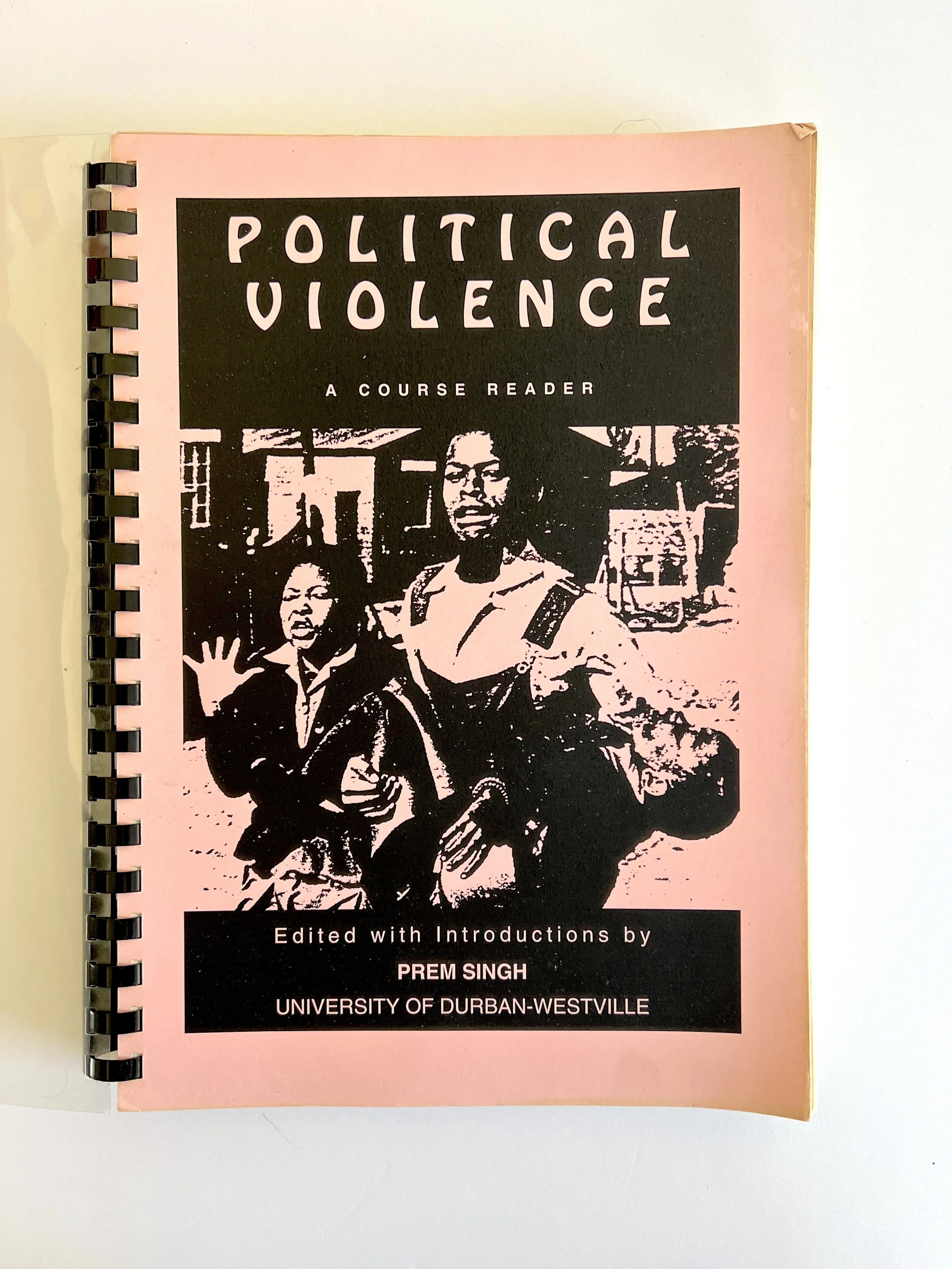
Comb-bound plastic leaves over pink card wrappers. 500 pp., 2 pg. “bibliography” at rear. Text largely a photocopy of material Singh assigned his students. Inscription in blue ink at ffep reading “Sept, 1994. To the Rev. Seawood, for kindness shown to Ruth and me. Prem.” CONDITION: Near-fine, binding sound and text clear and clean, some slight creases and toning to corners of wrappers and leaves.
A well preserved pedagogical packet, complete with photocopied readings, discussion questions, and annotations, for a course on the role of state-sanctioned and revolutionary violence in South Africa, composed by a South Asian teacher committed to the enlightenment of colored students in South Africa.
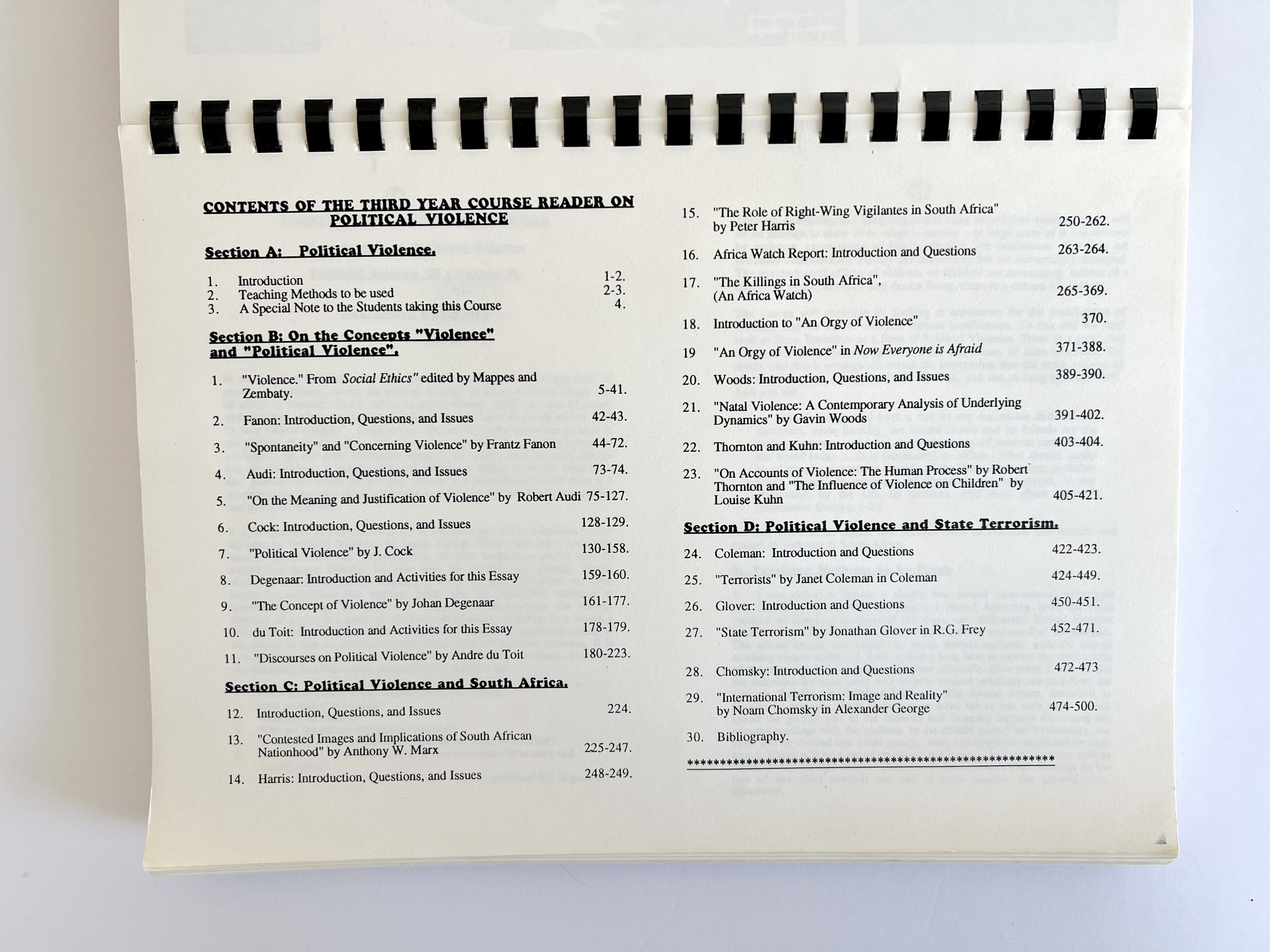
Singh’s course takes the then-pervasive image of South Africa as a “very violent country,” and interrogates the central premise, that violence is inherently negative and committed by Africans upon other Africans for inexplicable reasons. Among the questions asked by his course if “violence is necessarily wrong;” “Are ethnicity and cultural differences at the root of conflict?;” and “Are these factors [of violence] rooted in political and economic structures and arrangements?” In concluding his introduction to the course’s subject, Singh also notes that the students will “look at State Terrorism as a form of Political Violence.” Rather provocatively, he states “the media and…propaganda create the impression that the main sources of terrorism are Iran, Lybia, the PLO, the IRA…and yet, the ‘plain and painful truth is that on any reasonable definition of terrorism…the United States and its friends are the major…perpetrators of terrorist incidents in the world today.’”
Regarding the “teaching method” for this course, Singh says “I intend departing from the usual method of standing in front of the class and delivering formal lectures. Instead, there will be a great deal of participation expected of the students…the activities for each week will revolve around readings selected from the Course Reader on Political Violence.” Thus, each student was evidently expected to have their own copy of the present text. Along with providing instructions for the use of this course reader, Singh also describes some of the other pedagogical tools he used, including “video clips, TV programmes…newspapers…the radio,” as well as guest lectures by “experts in this field.”
Prem Singh (1955?–2007?) “was a Lecturer in Political Science at the University of Durban-Westville,” a university that had been “an historically Indian school in transition to a majority African student population.” Prem “was deeply committed to the well-being of his students, and willing to take on the responsibility of managing the South African side of” a program known as University Scholarships for South African Students, which was started by an American, Robert Wolff, and was intended to facilitate more equitable access to higher education for non-white students throughout South Africa. Singh has been remembered as an innovative teacher, “who…spent time experimenting with new teaching techniques in an effort to reach his Indian and African students” regardless of their socioeconomic backgrounds.
OCLC locates no copies. The only examples of Prem Singh’s work (his dissertation) that are held institutionally can be found in South African institutions.
Sources Consulted: Robert Paul Wolff, “The Philosopher’s Stone: A Commentary on the Passing Scene” at RobertPaulWolffBlogSpot online.
University of Durban-Westville: Durban, South Africa. Circa 1994.
Comb-bound plastic leaves over pink card wrappers. 500 pp., 2 pg. “bibliography” at rear. Text largely a photocopy of material Singh assigned his students. Inscription in blue ink at ffep reading “Sept, 1994. To the Rev. Seawood, for kindness shown to Ruth and me. Prem.” CONDITION: Near-fine, binding sound and text clear and clean, some slight creases and toning to corners of wrappers and leaves.
A well preserved pedagogical packet, complete with photocopied readings, discussion questions, and annotations, for a course on the role of state-sanctioned and revolutionary violence in South Africa, composed by a South Asian teacher committed to the enlightenment of colored students in South Africa.
Singh’s course takes the then-pervasive image of South Africa as a “very violent country,” and interrogates the central premise, that violence is inherently negative and committed by Africans upon other Africans for inexplicable reasons. Among the questions asked by his course if “violence is necessarily wrong;” “Are ethnicity and cultural differences at the root of conflict?;” and “Are these factors [of violence] rooted in political and economic structures and arrangements?” In concluding his introduction to the course’s subject, Singh also notes that the students will “look at State Terrorism as a form of Political Violence.” Rather provocatively, he states “the media and…propaganda create the impression that the main sources of terrorism are Iran, Lybia, the PLO, the IRA…and yet, the ‘plain and painful truth is that on any reasonable definition of terrorism…the United States and its friends are the major…perpetrators of terrorist incidents in the world today.’”
Regarding the “teaching method” for this course, Singh says “I intend departing from the usual method of standing in front of the class and delivering formal lectures. Instead, there will be a great deal of participation expected of the students…the activities for each week will revolve around readings selected from the Course Reader on Political Violence.” Thus, each student was evidently expected to have their own copy of the present text. Along with providing instructions for the use of this course reader, Singh also describes some of the other pedagogical tools he used, including “video clips, TV programmes…newspapers…the radio,” as well as guest lectures by “experts in this field.”
Prem Singh (1955?–2007?) “was a Lecturer in Political Science at the University of Durban-Westville,” a university that had been “an historically Indian school in transition to a majority African student population.” Prem “was deeply committed to the well-being of his students, and willing to take on the responsibility of managing the South African side of” a program known as University Scholarships for South African Students, which was started by an American, Robert Wolff, and was intended to facilitate more equitable access to higher education for non-white students throughout South Africa. Singh has been remembered as an innovative teacher, “who…spent time experimenting with new teaching techniques in an effort to reach his Indian and African students” regardless of their socioeconomic backgrounds.
OCLC locates no copies. The only examples of Prem Singh’s work (his dissertation) that are held institutionally can be found in South African institutions.
Sources Consulted: Robert Paul Wolff, “The Philosopher’s Stone: A Commentary on the Passing Scene” at RobertPaulWolffBlogSpot online.
![[Africa! Lecture by Major R. T. Browne]. The Great Southern Ptg. and Mfg. Co.: Frederick, Maryland. 1891.](https://images.squarespace-cdn.com/content/v1/687efeb0f3827b1e917a0b60/c24f7ef3-0262-4055-9bbf-8fd734e7c2ba/BrowneAfricaStreotipconBroadside.jpg)
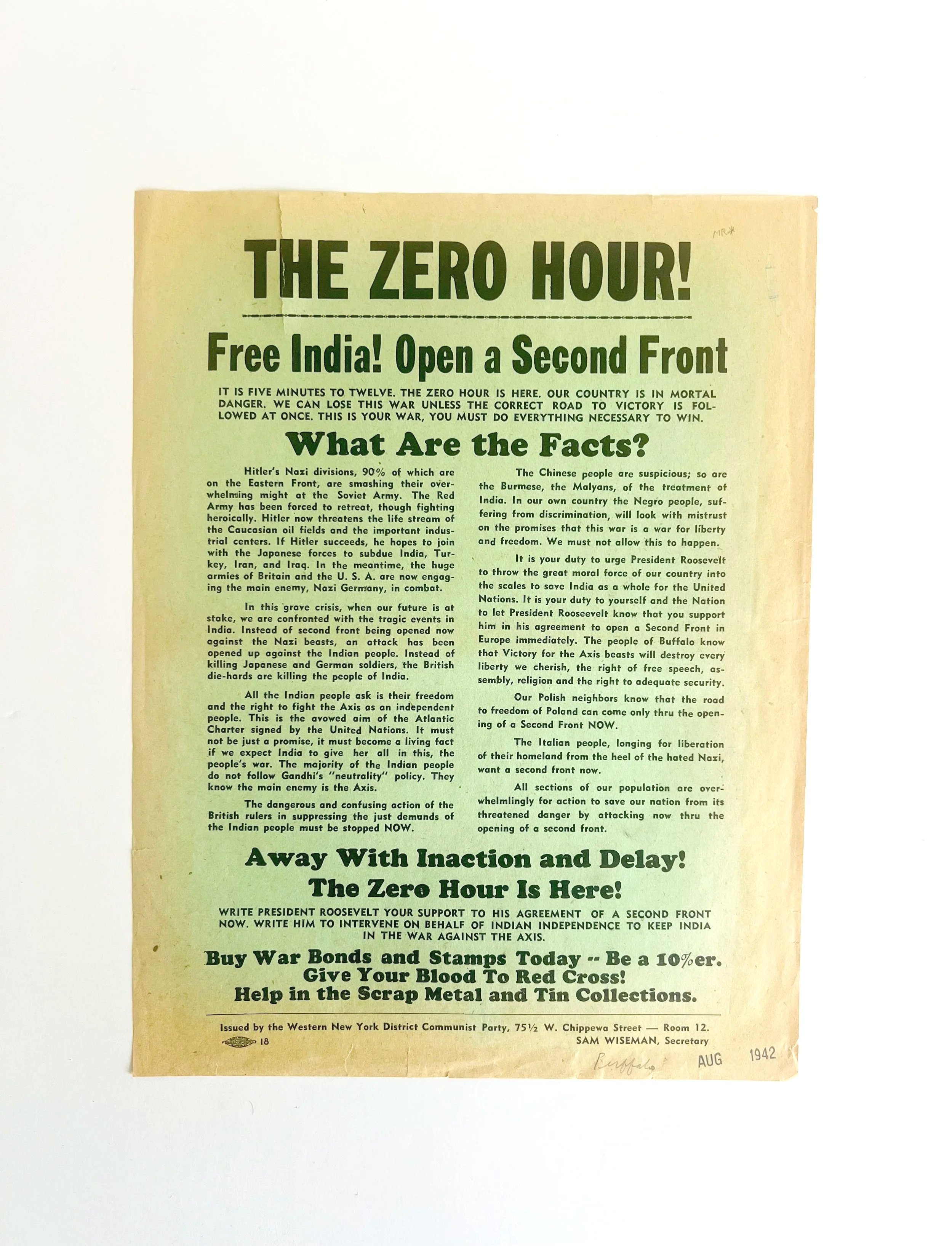
![Sam Wiseman. The Zero Hour! Free India! Open a Second Front. [Indian Independence poster, Buffalo NY, 1942].](https://images.squarespace-cdn.com/content/v1/687efeb0f3827b1e917a0b60/2b47bfc5-549a-416c-93c1-b9a00cf7ad35/IMG_4926.jpeg)
![Reginald Lal Singh. What about India – Now? [Indian Independence Poster, LA, 1943].](https://images.squarespace-cdn.com/content/v1/687efeb0f3827b1e917a0b60/fe4aa8f2-b303-4b63-9e1f-93c09a0eac98/IMG_4932.jpeg)
![[Sarojini Naidu at the Scottish Rite Auditorium].](https://images.squarespace-cdn.com/content/v1/687efeb0f3827b1e917a0b60/5aa76c12-6a1c-46ea-bb41-2c0da67df639/SarojiniNaiduFlierRecto.jpeg)