[University of Southern California]: [Los Angeles]. January 1945.
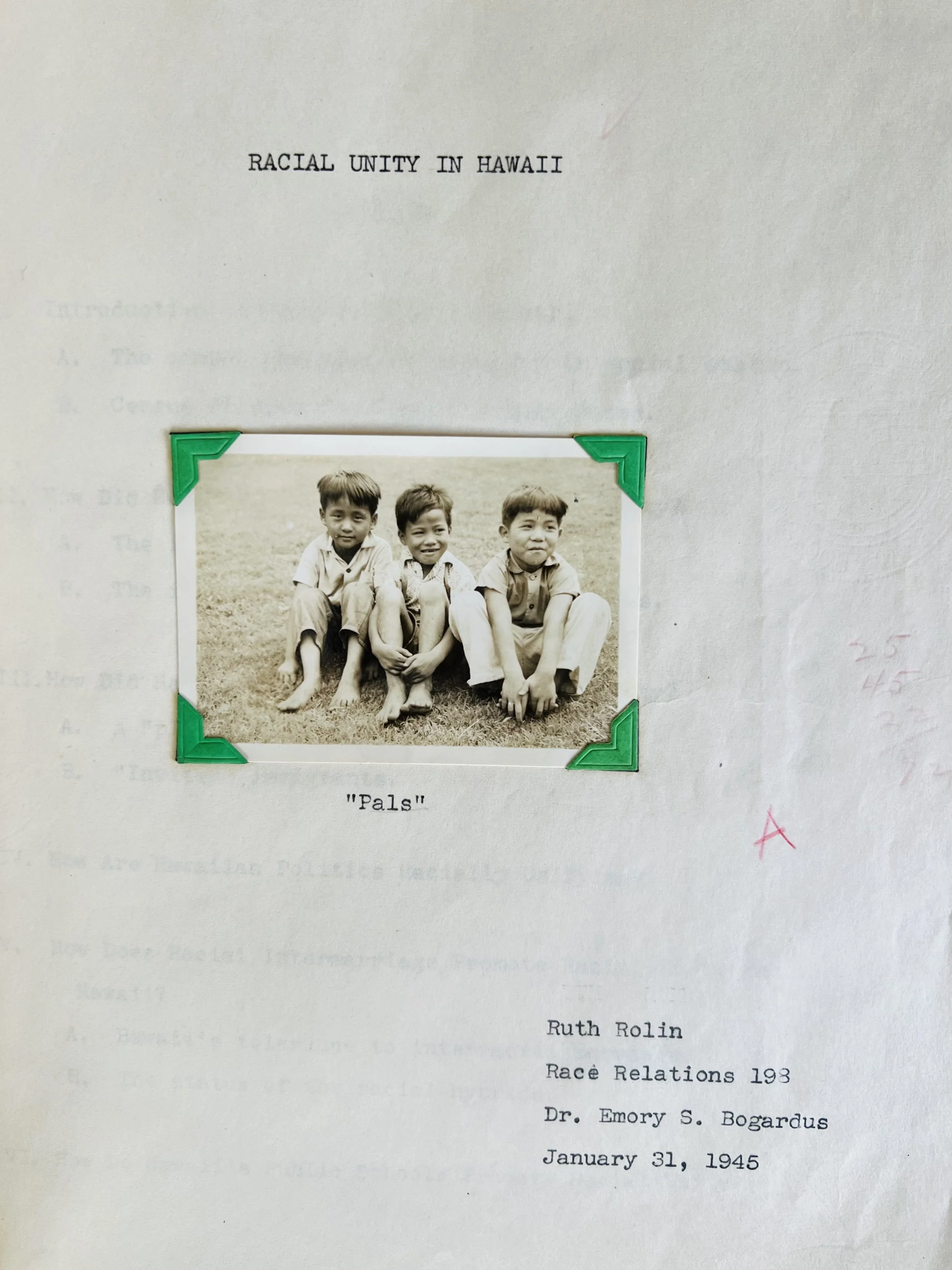
Type-script leaves connected via brass fasteners, bound in a folder. [iv], 42 pgs. w/ 2 pg. bibliography. 8 silver-print photographs, and 18 magazine clippings mounted as illustrations. Text printed on rectos only. Photographs captioned at versos in neat black ink. Occasional checkmarks in red pencil. CONDITION: Very good, minimal wear to covers, some offsetting to leaves from newsprint, no tears.
A wonderful record of a sociology student’s research findings, reporting on the state of Hawaii’s racial composition during the Second World War and highlighting the diverse indigenous, Asian, and African populations whose labor make the islands what they are.
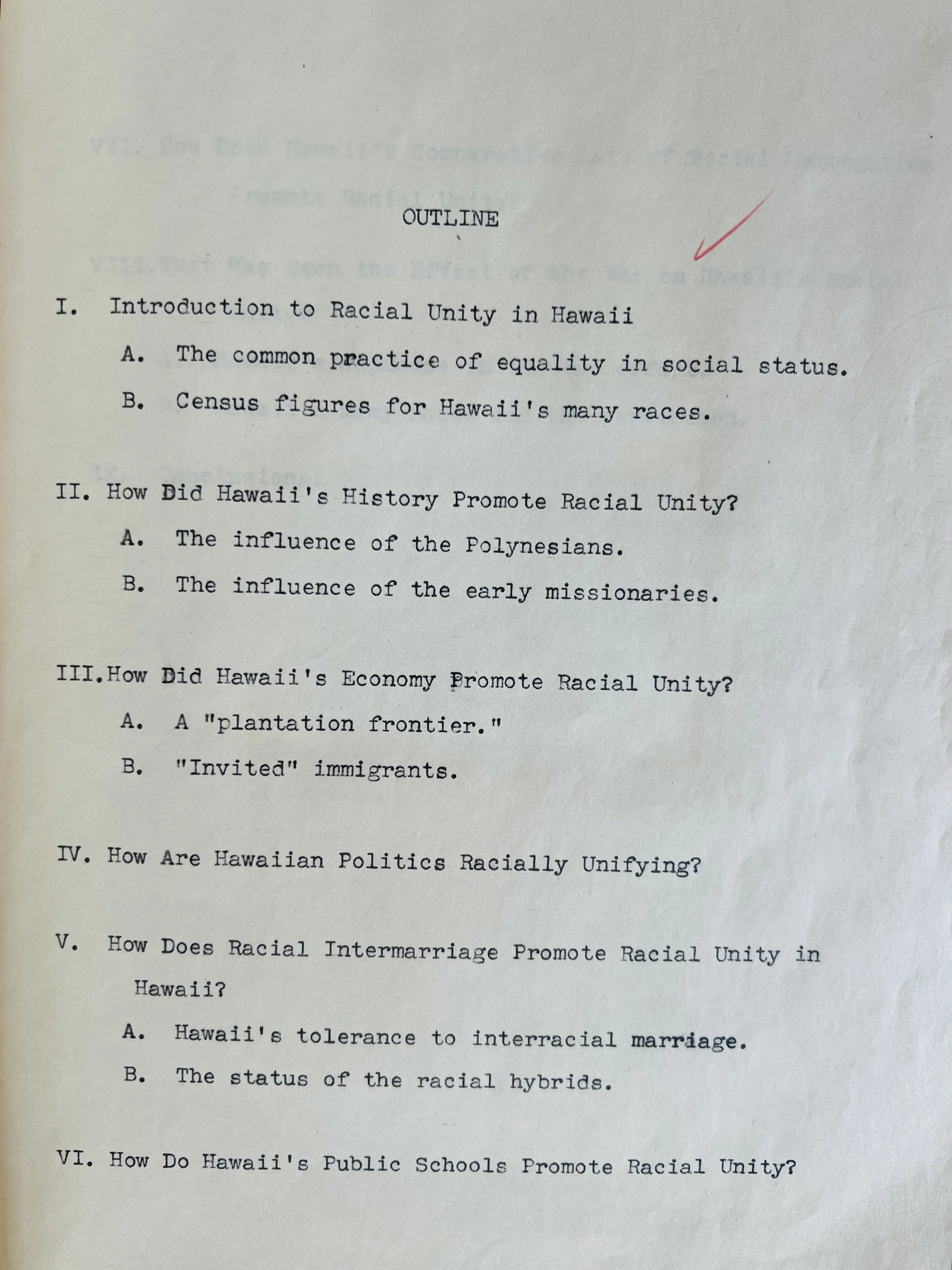
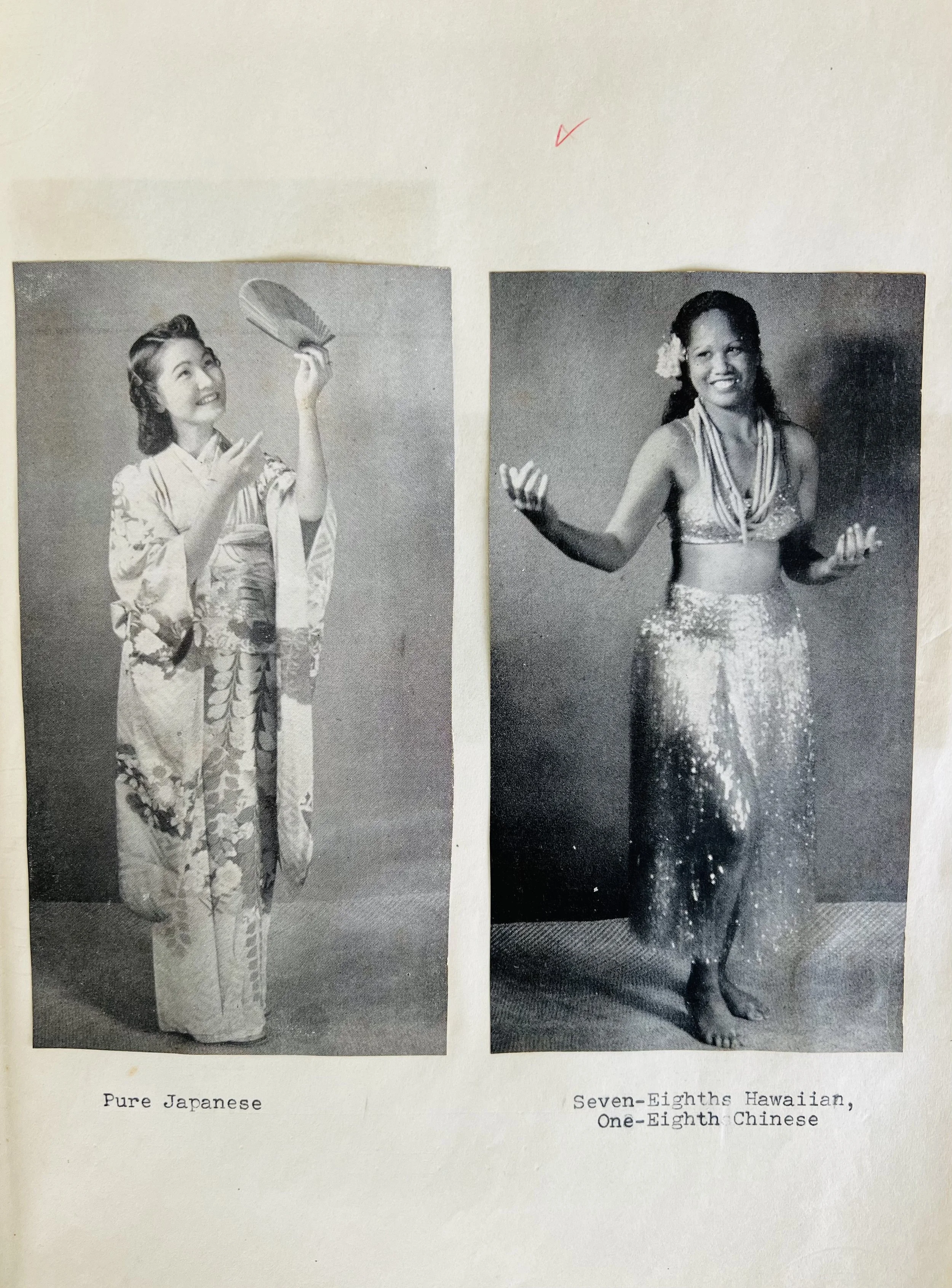
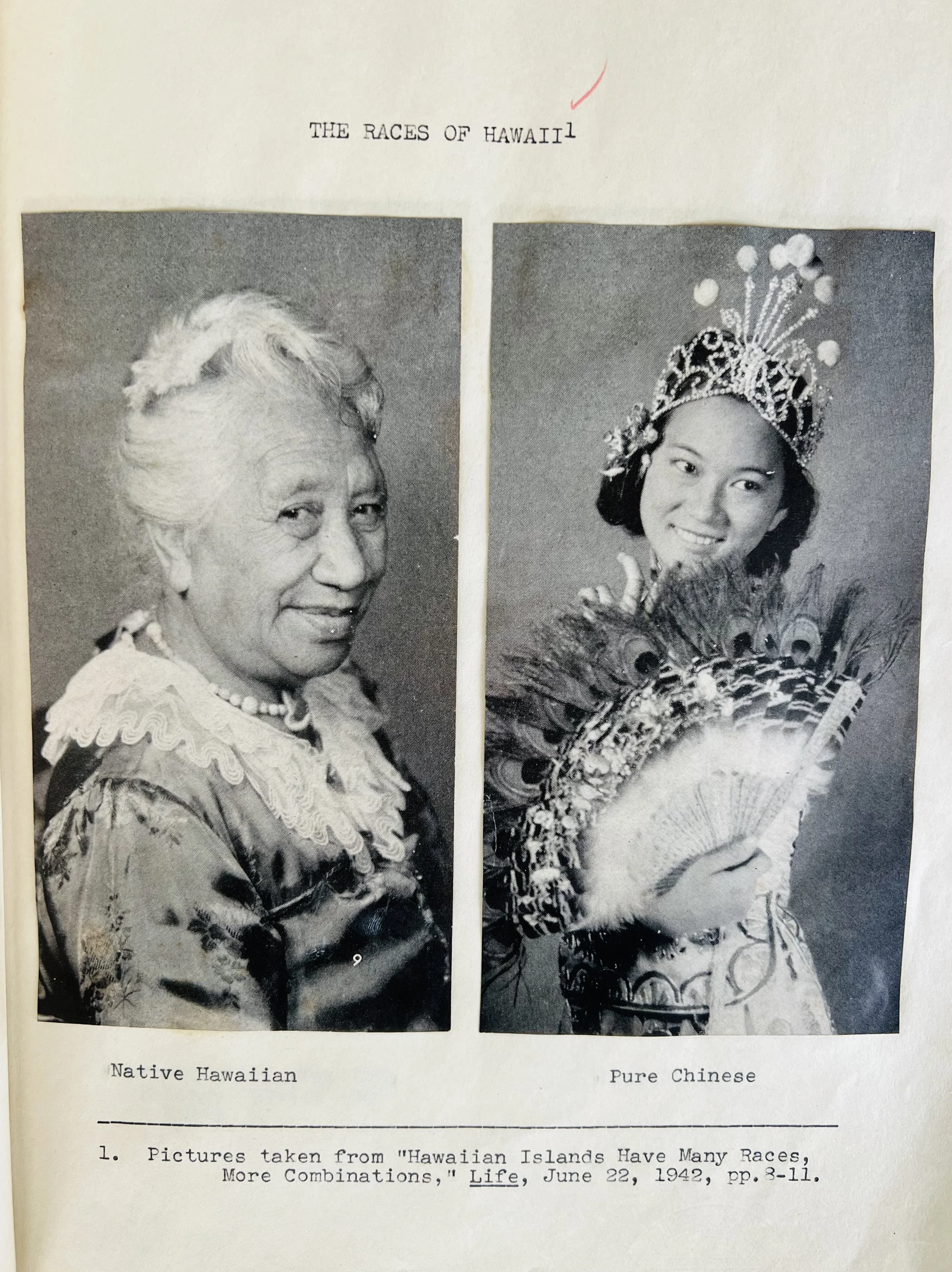
This document, written by Ruth Rolin for a course on “Race Relations” taught by the founder of the first sociology program in America, Dr. Emory Bogardus, describes “some of the more influential factors in the picture of Hawaii’s racial unity.” From the outset, Rolin highlights the extent of “interracial mixing” in Hawaii, as unlike the continental United States, on the Hawaiian islands, “Caucasian wives consult Korean dentists, Japanese physicians, Chinese pharmacists, and argue with Polynesian policemen.” Rolin’s report ranges across such subjects as “the influence of the Polynesians;” the role of plantations; “Racial Intermarriage;” and the effects of WWII on Hawaii’s “Racial Unity.”
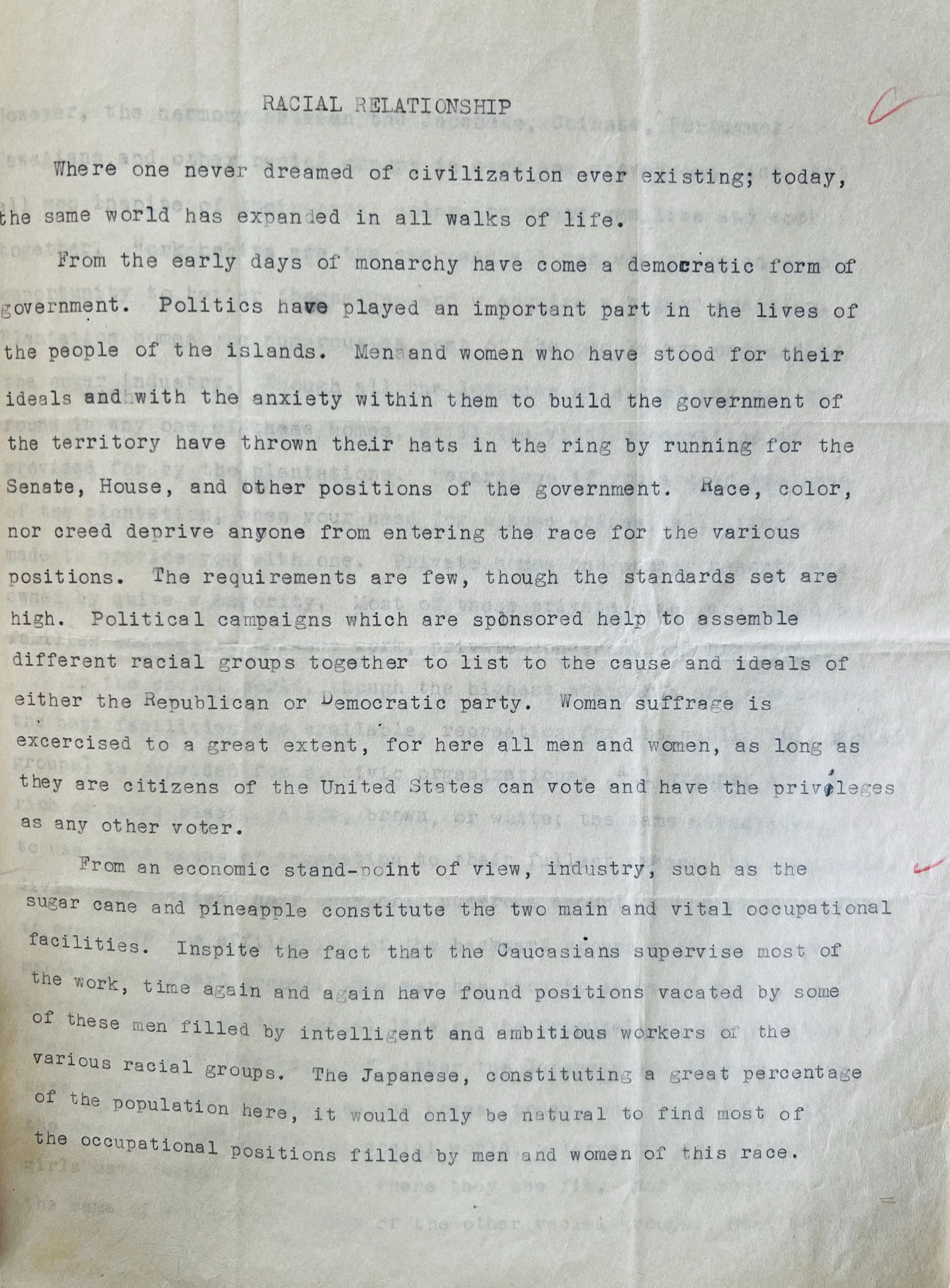
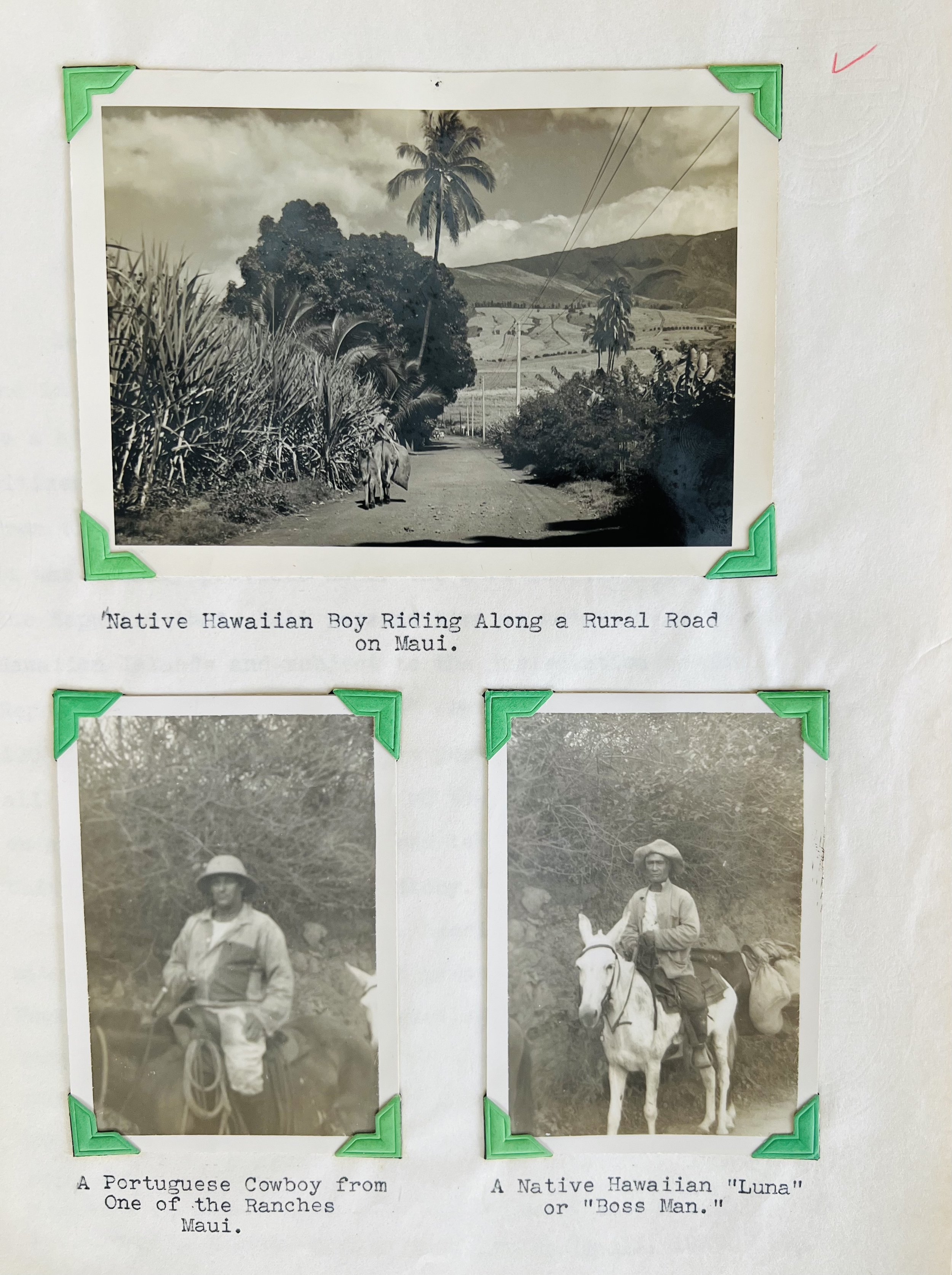
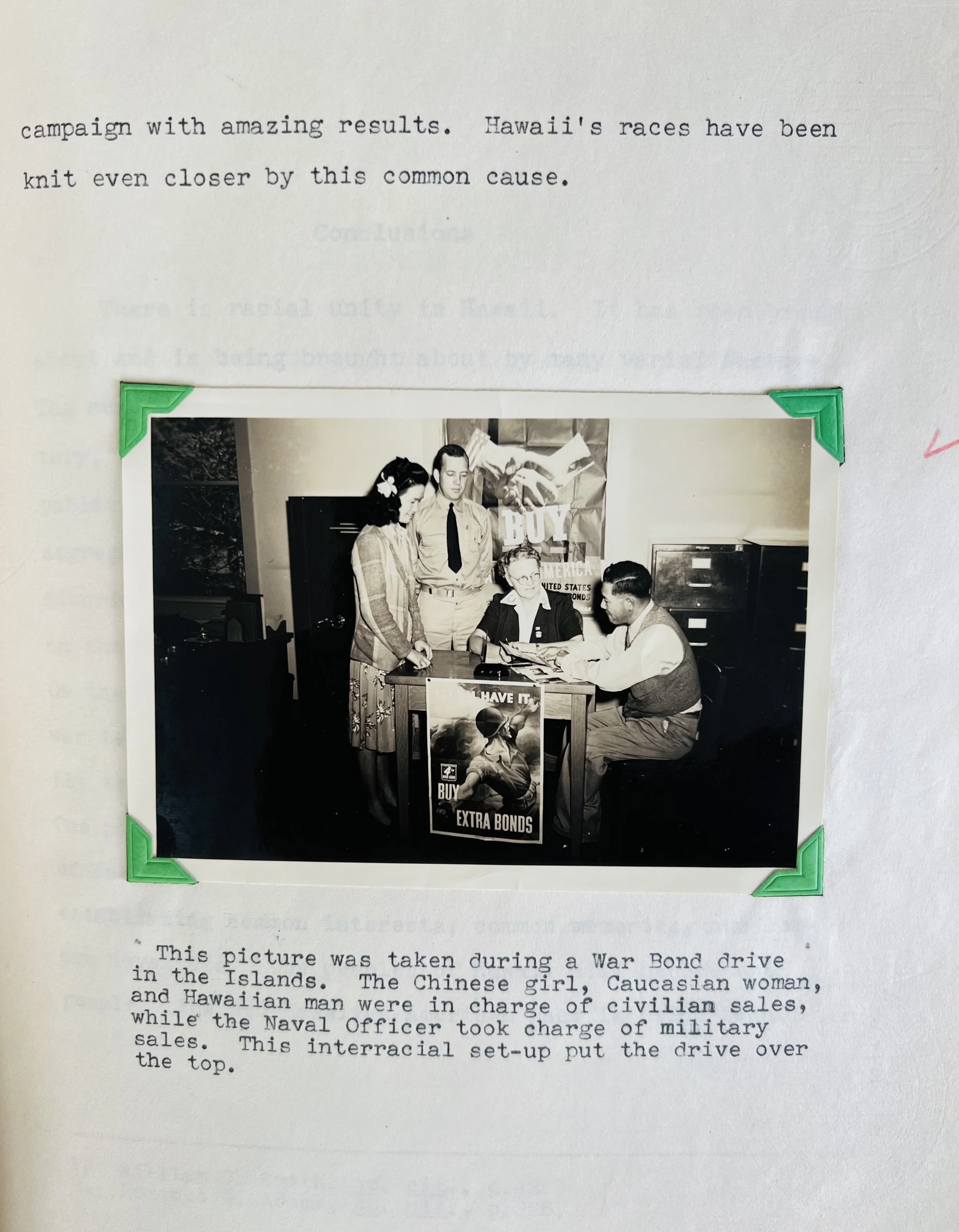
Complementing the statistical information gathered by Rolin is a four-page carbon copy of an essay on “Racial Relationship,” written by one “Nellie M.,” who was evidently “part-Negro, part-Portuguese, and part-Chinese,” and who worked “in a Naval Supply office on Maui.” Nellie’s treatise attests to “the harmony between the Japanese, Chinese, Portuguese, Hawaiians and other racial groups in work…inspite[sic]. of their race, color or creed.” Nellie notes that in particular, “the war has brought about a great change in…the social life of the Orientals in the islands. Where in pre-war days girls of either the Japanese and Chinese groups were…confined to their homes, today…a large number of these girls have taken their stands where they see fit.” The accompanying photographs, likely taken, captioned, and mailed by Nellie to Rolin, illustrate the Hawaiian melting pot.
While we could find no further information about Nellie M., newspaper reports from the 1950s suggest that after studying at the University of Southern California, Ruth Rolin went on to become a civics and history teacher in the Pasadena area.
[University of Southern California]: [Los Angeles]. January 1945.
Type-script leaves connected via brass fasteners, bound in a folder. [iv], 42 pgs. w/ 2 pg. bibliography. 8 silver-print photographs, and 18 magazine clippings mounted as illustrations. Text printed on rectos only. Photographs captioned at versos in neat black ink. Occasional checkmarks in red pencil. CONDITION: Very good, minimal wear to covers, some offsetting to leaves from newsprint, no tears.
A wonderful record of a sociology student’s research findings, reporting on the state of Hawaii’s racial composition during the Second World War and highlighting the diverse indigenous, Asian, and African populations whose labor make the islands what they are.
This document, written by Ruth Rolin for a course on “Race Relations” taught by the founder of the first sociology program in America, Dr. Emory Bogardus, describes “some of the more influential factors in the picture of Hawaii’s racial unity.” From the outset, Rolin highlights the extent of “interracial mixing” in Hawaii, as unlike the continental United States, on the Hawaiian islands, “Caucasian wives consult Korean dentists, Japanese physicians, Chinese pharmacists, and argue with Polynesian policemen.” Rolin’s report ranges across such subjects as “the influence of the Polynesians;” the role of plantations; “Racial Intermarriage;” and the effects of WWII on Hawaii’s “Racial Unity.”
Complementing the statistical information gathered by Rolin is a four-page carbon copy of an essay on “Racial Relationship,” written by one “Nellie M.,” who was evidently “part-Negro, part-Portuguese, and part-Chinese,” and who worked “in a Naval Supply office on Maui.” Nellie’s treatise attests to “the harmony between the Japanese, Chinese, Portuguese, Hawaiians and other racial groups in work…inspite[sic]. of their race, color or creed.” Nellie notes that in particular, “the war has brought about a great change in…the social life of the Orientals in the islands. Where in pre-war days girls of either the Japanese and Chinese groups were…confined to their homes, today…a large number of these girls have taken their stands where they see fit.” The accompanying photographs, likely taken, captioned, and mailed by Nellie to Rolin, illustrate the Hawaiian melting pot.
While we could find no further information about Nellie M., newspaper reports from the 1950s suggest that after studying at the University of Southern California, Ruth Rolin went on to become a civics and history teacher in the Pasadena area.
![Paul Oberst, photog. [Studio portrait of children in an oriental rug store].](https://images.squarespace-cdn.com/content/v1/687efeb0f3827b1e917a0b60/77315bff-97b4-43e3-803d-d55c73f26b9a/OberstChildRugmakersPhotoScn.jpg)