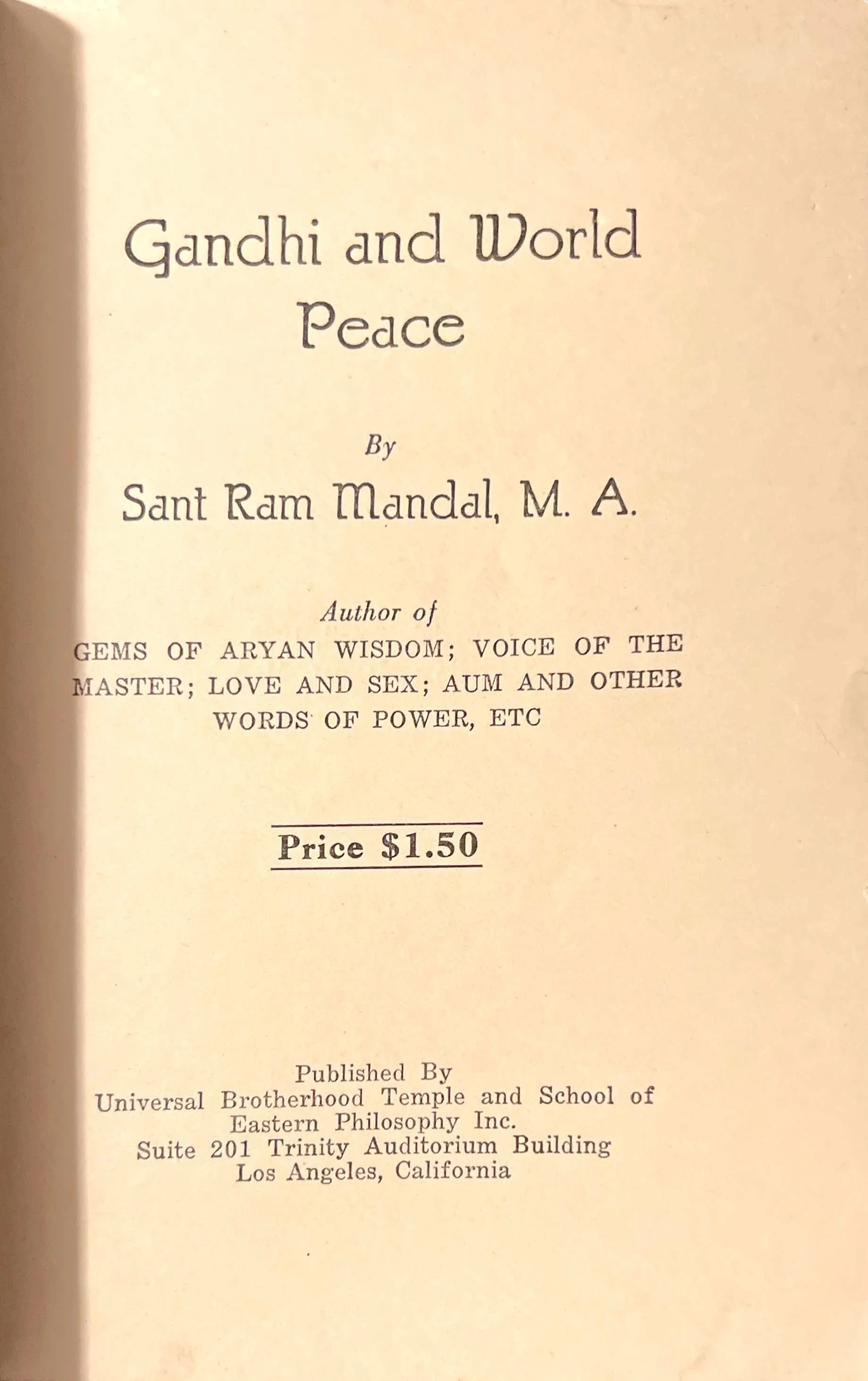
Universal Brotherhood Temple and School of Eastern Philosophy Inc: Suite 201 Trinity Auditorium Building, Los Angeles, California. 1932.
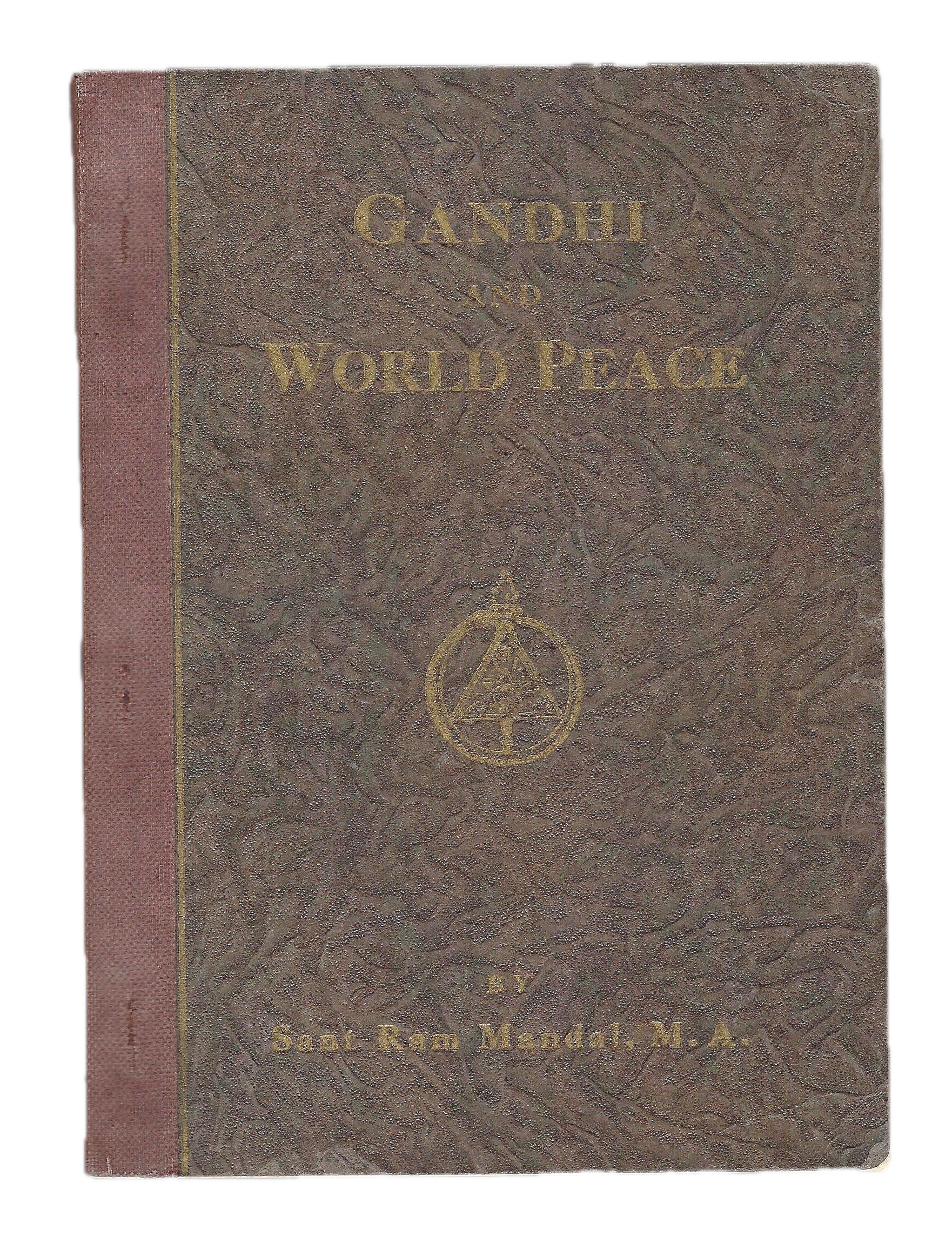
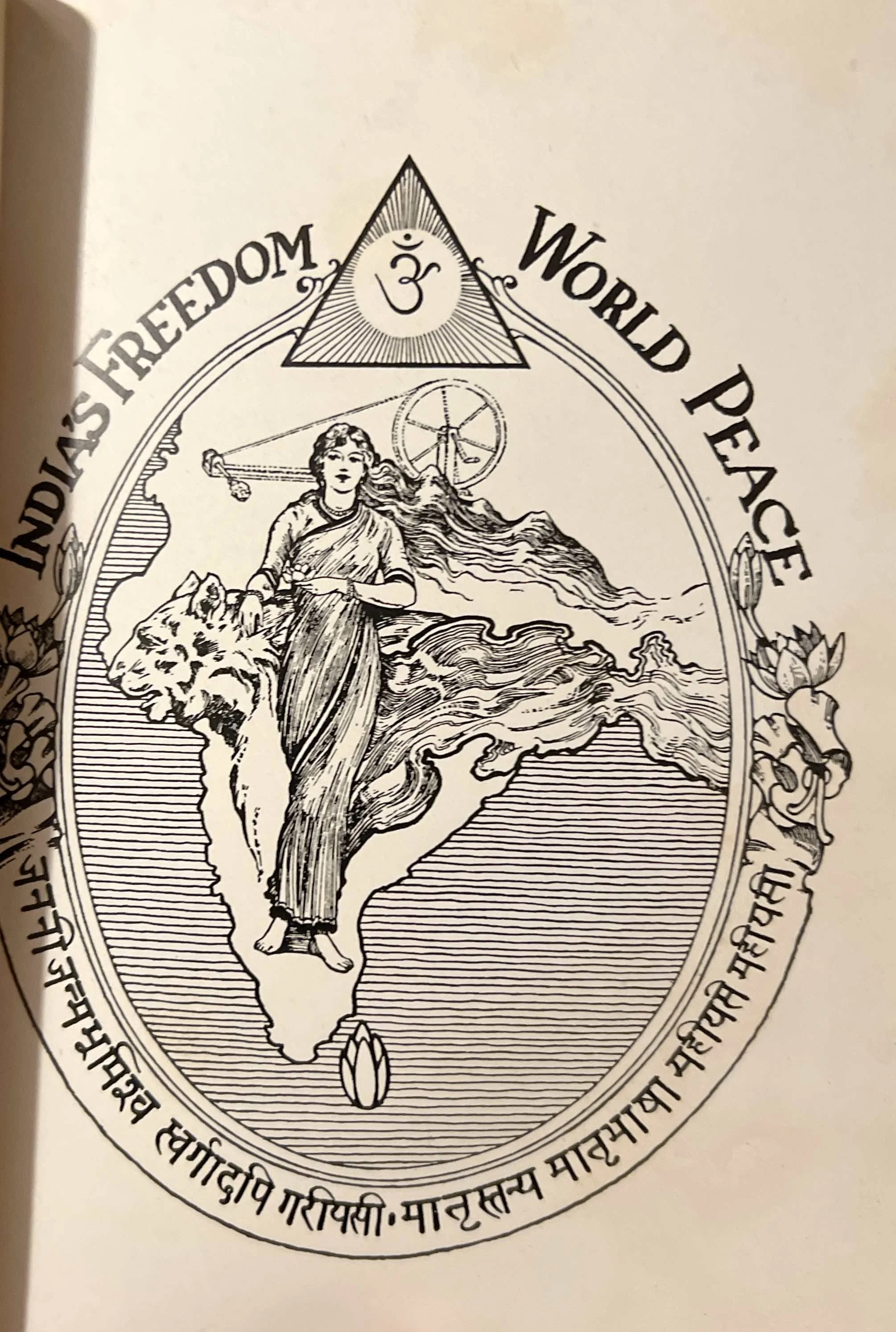
Tape-bound card wrappers. 198 pp., 2 pgs. of pub. ads., 3 plates. CONDITION: Very good, short tear at head of spine, title at front cover darkened, two short tears to extremities of front cover, short tears to right margin of preliminary leaves.
A glowing endorsement of Gandhi’s Satyagraha and his tactics of nonviolent resistance, by a Punjabi immigrant later known as the “astrologer of Broadway.”
Contents consist of text by Mandal, Rabindranath Tagore, and reprinted testimony. Mandal’s chapters are “A Brief History of India,” “A Career Briefly Told, “Three Days at Gandhi’s Retreat,” “Gandhi’s Ideas and Beliefs,” “The Charkha or the Spinning Wheel,” “The Gandhi Cap,” “Some of the Causes of Unrest,” and the “Conclusion.” Within these chapters, Mandal expresses his support for Gandhi, dubbing him India’s “noblest Son,” and “the first hope of the world for peace since the time of Jesus.” The chapter on Gandhi’s retreat records Mandal’s apparent stay at Gandhi’s Ashram in Sabarmati, during which he claims to have met Gandhi, as well as “Mr. Reginald Rhenolds” (one of Gandhi’s legal aides) and Gandhi’s spiritual daughter, “Miss Slade.” Since Gandhi was an internationally renowned figure by this date, we believe that Mandal’s mention of him and his entourage may have been an attempt to appear as a man of distinction before an American audience. In addition to Mandal’s writing, Tagore’s poem, “Where the Mind is Without Fear” (here called “A Prayer”), appears on page 84. Additionally, the testimonial chapters on Gandhi are divided into “What Others Say About Gandhi” and “Gandhi Glimpsed Through the American Press.” The former consists of reports by notables attesting to Gandhi’s ability to lead India to freedom, while the latter collects articles from the “Fresno Bee,” “The United States of India,” the “United Press,” and other papers of note.
Sant Ram Mandal (1894–1962) was a Punjabi immigrant who came to study first at Oakland High School, then the University of California in 1914, and by 1922, had earned his masters in chemistry. A report from the Oakland Tribune indicates that in 1919, he acted as the president of the Hindusthan Association of America, whose mission was to "further the interests of Hindustani students, [and] to interpret India to America and America to India.” In 1920, the San Francisco Examiner reported that while applying for citizenship, the California District Court ruled that Mandal was “a Hindu of the ruling or Aryan class and entitled to citizenship.” By 1924, he had begun lecturing on the Swami Circuit as a “Hindu Occult Philosopher,” quite likely because he had been de-naturalized in the aftermath of the Thind Decision. He continued to lecture in San Francisco until 1935, when he moved to Brooklyn. He would continue lecturing and fortune telling (via astrological readings) in the New York City area until 1962, when he fell and died on Broadway.
OCLC reports 20 American holdings as of January 2025.
Sources Consulted: Philip Deslippe, “The Swami Circuit: Mapping the Terrain of Early American Yoga,” Journal of Yoga Studies, UCSB, 2018; Mandal, S[ant]. R[am]. The elementary theory of equations as found in books published in the United States, UC Berkeley Dissertation, 1922; “Hindusthan Association of America Collection” at South Asian American Digital Archive Online; “Thind vs. United States (1923)” at ImmigrationHistory online.
Universal Brotherhood Temple and School of Eastern Philosophy Inc: Suite 201 Trinity Auditorium Building, Los Angeles, California. 1932.
Tape-bound card wrappers. 198 pp., 2 pgs. of pub. ads., 3 plates. CONDITION: Very good, short tear at head of spine, title at front cover darkened, two short tears to extremities of front cover, short tears to right margin of preliminary leaves.
A glowing endorsement of Gandhi’s Satyagraha and his tactics of nonviolent resistance, by a Punjabi immigrant later known as the “astrologer of Broadway.”
Contents consist of text by Mandal, Rabindranath Tagore, and reprinted testimony. Mandal’s chapters are “A Brief History of India,” “A Career Briefly Told, “Three Days at Gandhi’s Retreat,” “Gandhi’s Ideas and Beliefs,” “The Charkha or the Spinning Wheel,” “The Gandhi Cap,” “Some of the Causes of Unrest,” and the “Conclusion.” Within these chapters, Mandal expresses his support for Gandhi, dubbing him India’s “noblest Son,” and “the first hope of the world for peace since the time of Jesus.” The chapter on Gandhi’s retreat records Mandal’s apparent stay at Gandhi’s Ashram in Sabarmati, during which he claims to have met Gandhi, as well as “Mr. Reginald Rhenolds” (one of Gandhi’s legal aides) and Gandhi’s spiritual daughter, “Miss Slade.” Since Gandhi was an internationally renowned figure by this date, we believe that Mandal’s mention of him and his entourage may have been an attempt to appear as a man of distinction before an American audience. In addition to Mandal’s writing, Tagore’s poem, “Where the Mind is Without Fear” (here called “A Prayer”), appears on page 84. Additionally, the testimonial chapters on Gandhi are divided into “What Others Say About Gandhi” and “Gandhi Glimpsed Through the American Press.” The former consists of reports by notables attesting to Gandhi’s ability to lead India to freedom, while the latter collects articles from the “Fresno Bee,” “The United States of India,” the “United Press,” and other papers of note.
Sant Ram Mandal (1894–1962) was a Punjabi immigrant who came to study first at Oakland High School, then the University of California in 1914, and by 1922, had earned his masters in chemistry. A report from the Oakland Tribune indicates that in 1919, he acted as the president of the Hindusthan Association of America, whose mission was to "further the interests of Hindustani students, [and] to interpret India to America and America to India.” In 1920, the San Francisco Examiner reported that while applying for citizenship, the California District Court ruled that Mandal was “a Hindu of the ruling or Aryan class and entitled to citizenship.” By 1924, he had begun lecturing on the Swami Circuit as a “Hindu Occult Philosopher,” quite likely because he had been de-naturalized in the aftermath of the Thind Decision. He continued to lecture in San Francisco until 1935, when he moved to Brooklyn. He would continue lecturing and fortune telling (via astrological readings) in the New York City area until 1962, when he fell and died on Broadway.
OCLC reports 20 American holdings as of January 2025.
Sources Consulted: Philip Deslippe, “The Swami Circuit: Mapping the Terrain of Early American Yoga,” Journal of Yoga Studies, UCSB, 2018; Mandal, S[ant]. R[am]. The elementary theory of equations as found in books published in the United States, UC Berkeley Dissertation, 1922; “Hindusthan Association of America Collection” at South Asian American Digital Archive Online; “Thind vs. United States (1923)” at ImmigrationHistory online.
![[Sarojini Naidu at the Scottish Rite Auditorium].](https://images.squarespace-cdn.com/content/v1/687efeb0f3827b1e917a0b60/5aa76c12-6a1c-46ea-bb41-2c0da67df639/SarojiniNaiduFlierRecto.jpeg)
![[Africa! Lecture by Major R. T. Browne]. The Great Southern Ptg. and Mfg. Co.: Frederick, Maryland. 1891.](https://images.squarespace-cdn.com/content/v1/687efeb0f3827b1e917a0b60/c24f7ef3-0262-4055-9bbf-8fd734e7c2ba/BrowneAfricaStreotipconBroadside.jpg)