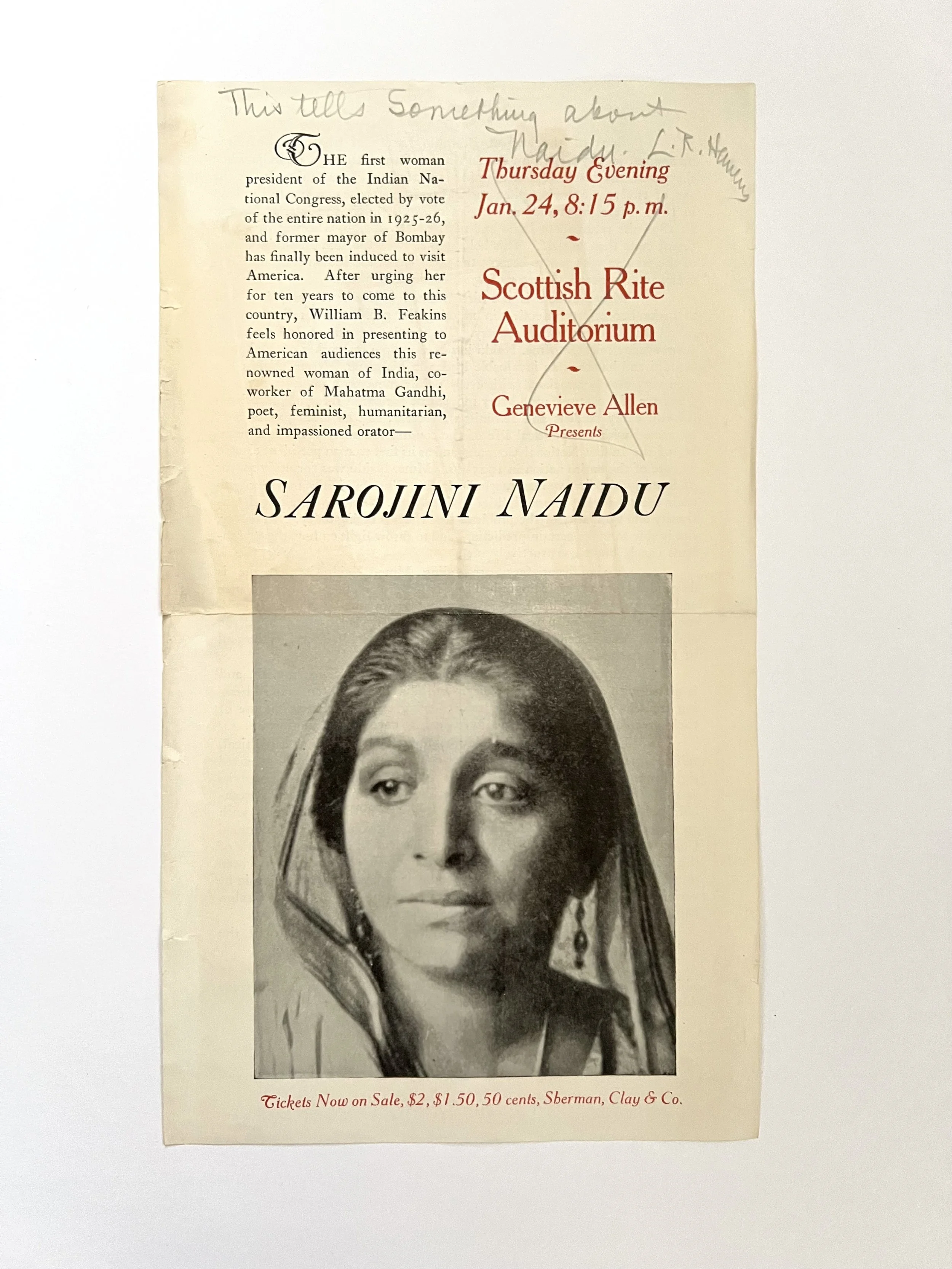
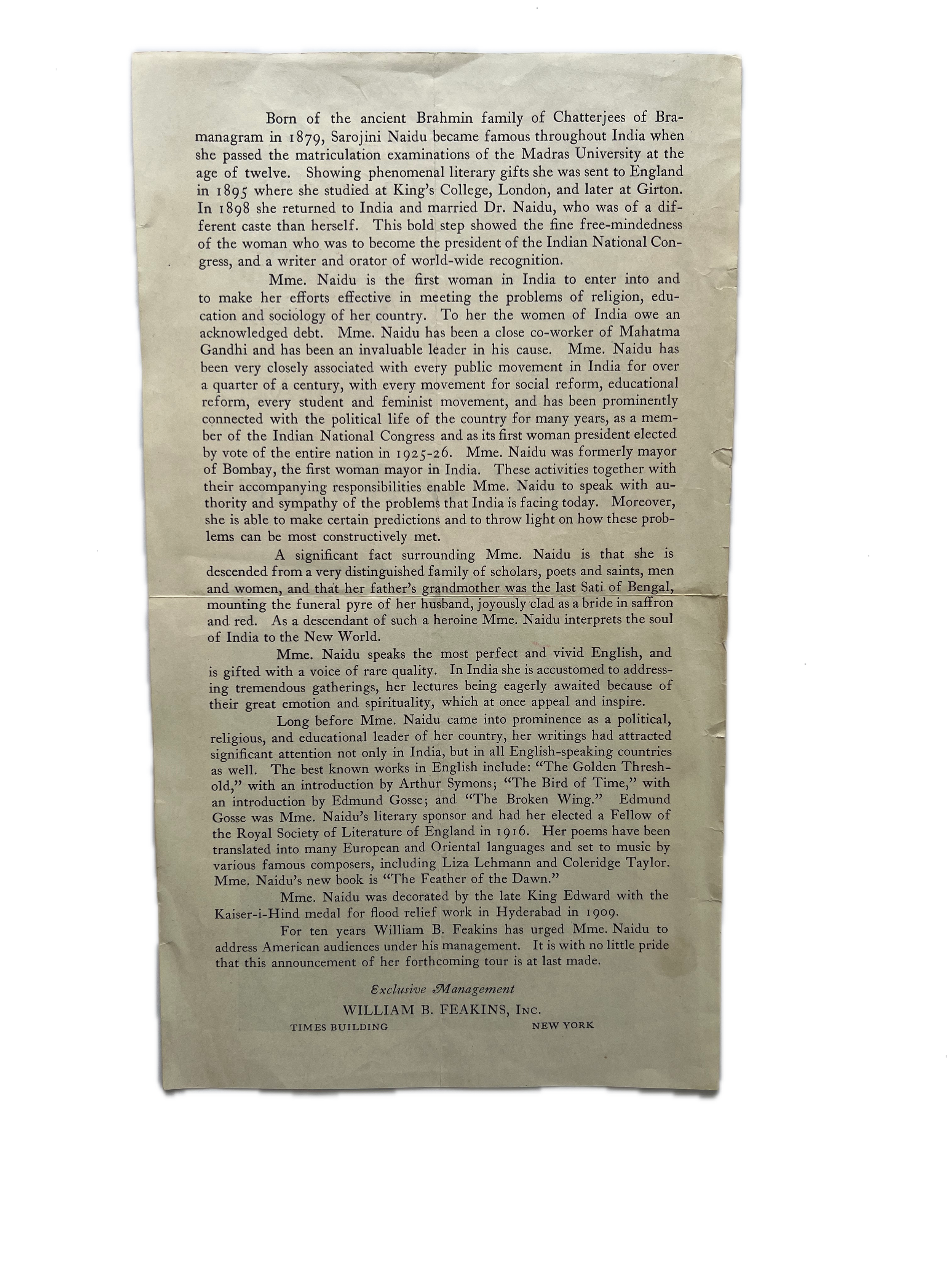
William B. Feakins, inc.: Times Building, New York. Circa 1928.
Handbill, 12.5” x 7”. Text on both sides, image on recto only. Early pencil inscription reading “This tells something about Naidu. L. K. Hallway[?]” on recto. CONDITION: Very good, old folds, slight split along horizontal fold.
An advertising leaflet announcing the first woman president of the Indian National Congress’s visit to America, which painted a vivid picture of India for thousands of Americans.
This flier documents Sarojini Naidu’s two-year tour of America, sponsored by William B. Feakins. At the time, Feakins was the head of a “lecture bureau” of the League for Political Education, based in New York City. Alongside Naidu, Feakins arranged tours for several notable figures of the interwar period, including Gertrude Stein, the pro-smoking British Evangelist Miss A. Maude Royden, the Grand Duchess Marie of Rumania, Bertrand Russell, and many more besides.
Naidu was “born of the ancient Brahmin family of Chatterjees of Bramanagram in 1879,” and the great-granddaughter of the last woman to participate in ritual self-immolation, otherwise known as Sati, in Bengal. She apparently possessed a prodigious intellect, as she “became famous throughout India when she passed the matriculation examinations of the Madras University at the Age of twelve.” A mere four years later, in 1895, she went to study literature at Kings College, London, before returning to India in 1898 to participate in a highly publicized inter-caste marriage with one Dr. Naidu. The handbill highlights that “Mme. Naidu is the first woman in India to enter into…the problems of religion, education and sociology of her country.” She had “been a close co-worker of Mahatma Gandhi, and has been an invaluable leader of his cause,” having been “very closely associated with every public movement in India for over a quarter of a century, with every movement for social reform, educational reform…and feminist movement.” Prior to her becoming the president of the Indian National Congress, Naidu “was formerly mayor of Bombay, [becoming] the first woman mayor in India.” Apart from her political accolades, Naidu was also a highly respected literary author, penning numerous English-language novels, essays, and poems.
Newspaper reports printed in California from January 1929 indicate that Naidu’s appearances in the Bay Area that month drew significant attention, especially by early South Asian Americans. Several early Sikh and Hindu organizations appeared to demonstrate a particular interest in her lectures.
William B. Feakins, inc.: Times Building, New York. Circa 1928.
Handbill, 12.5” x 7”. Text on both sides, image on recto only. Early pencil inscription reading “This tells something about Naidu. L. K. Hallway[?]” on recto. CONDITION: Very good, old folds, slight split along horizontal fold.
An advertising leaflet announcing the first woman president of the Indian National Congress’s visit to America, which painted a vivid picture of India for thousands of Americans.
This flier documents Sarojini Naidu’s two-year tour of America, sponsored by William B. Feakins. At the time, Feakins was the head of a “lecture bureau” of the League for Political Education, based in New York City. Alongside Naidu, Feakins arranged tours for several notable figures of the interwar period, including Gertrude Stein, the pro-smoking British Evangelist Miss A. Maude Royden, the Grand Duchess Marie of Rumania, Bertrand Russell, and many more besides.
Naidu was “born of the ancient Brahmin family of Chatterjees of Bramanagram in 1879,” and the great-granddaughter of the last woman to participate in ritual self-immolation, otherwise known as Sati, in Bengal. She apparently possessed a prodigious intellect, as she “became famous throughout India when she passed the matriculation examinations of the Madras University at the Age of twelve.” A mere four years later, in 1895, she went to study literature at Kings College, London, before returning to India in 1898 to participate in a highly publicized inter-caste marriage with one Dr. Naidu. The handbill highlights that “Mme. Naidu is the first woman in India to enter into…the problems of religion, education and sociology of her country.” She had “been a close co-worker of Mahatma Gandhi, and has been an invaluable leader of his cause,” having been “very closely associated with every public movement in India for over a quarter of a century, with every movement for social reform, educational reform…and feminist movement.” Prior to her becoming the president of the Indian National Congress, Naidu “was formerly mayor of Bombay, [becoming] the first woman mayor in India.” Apart from her political accolades, Naidu was also a highly respected literary author, penning numerous English-language novels, essays, and poems.
Newspaper reports printed in California from January 1929 indicate that Naidu’s appearances in the Bay Area that month drew significant attention, especially by early South Asian Americans. Several early Sikh and Hindu organizations appeared to demonstrate a particular interest in her lectures.
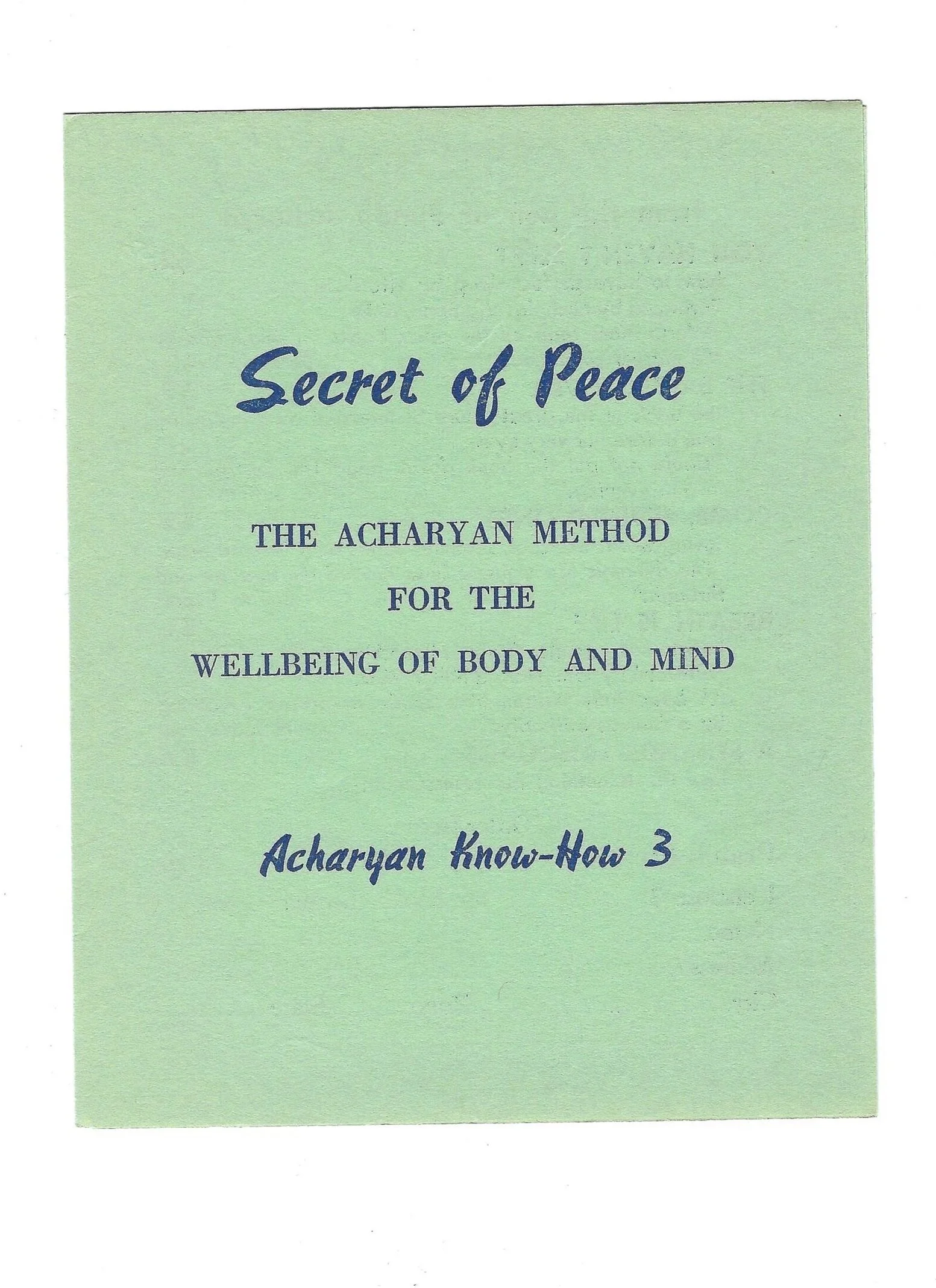
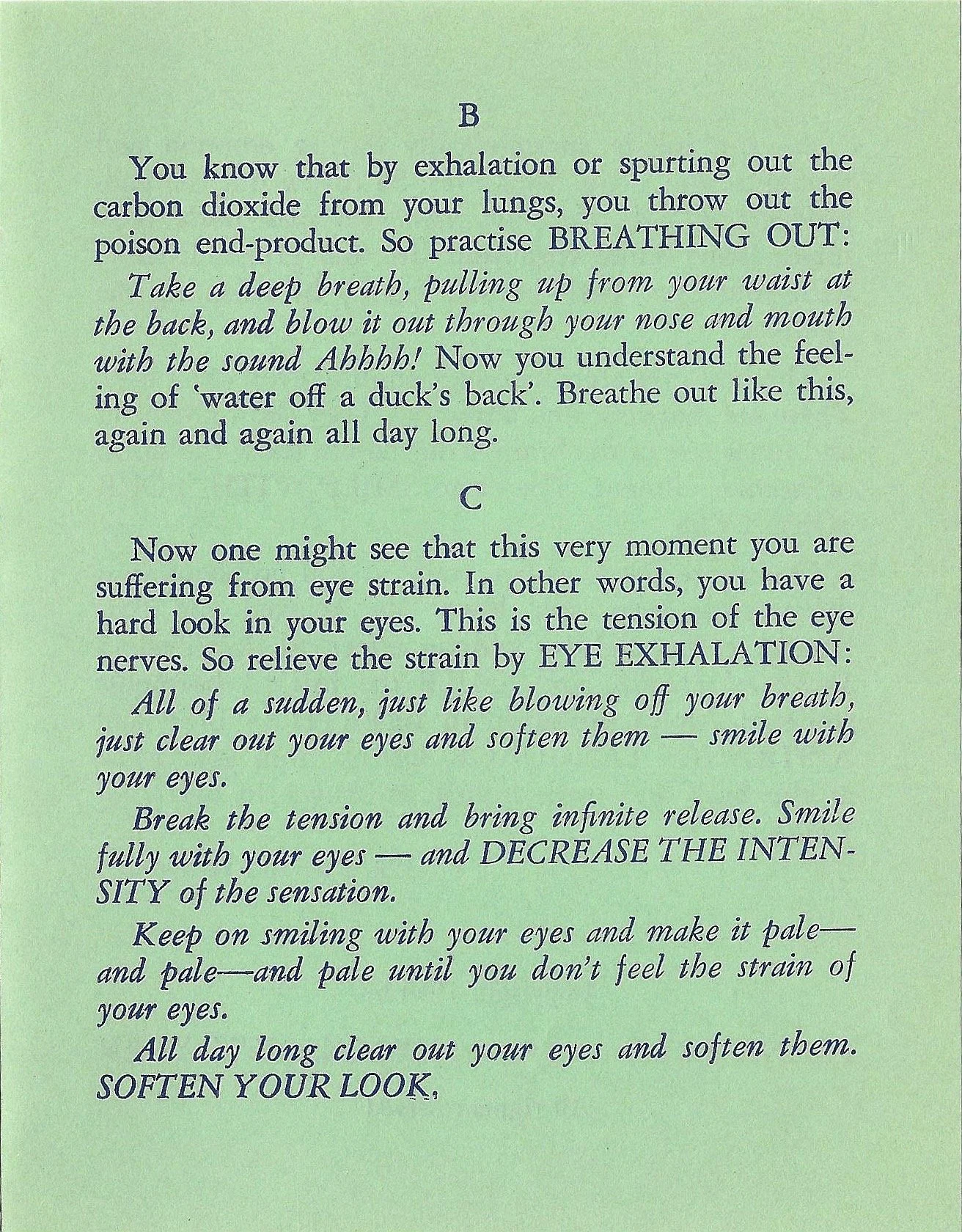
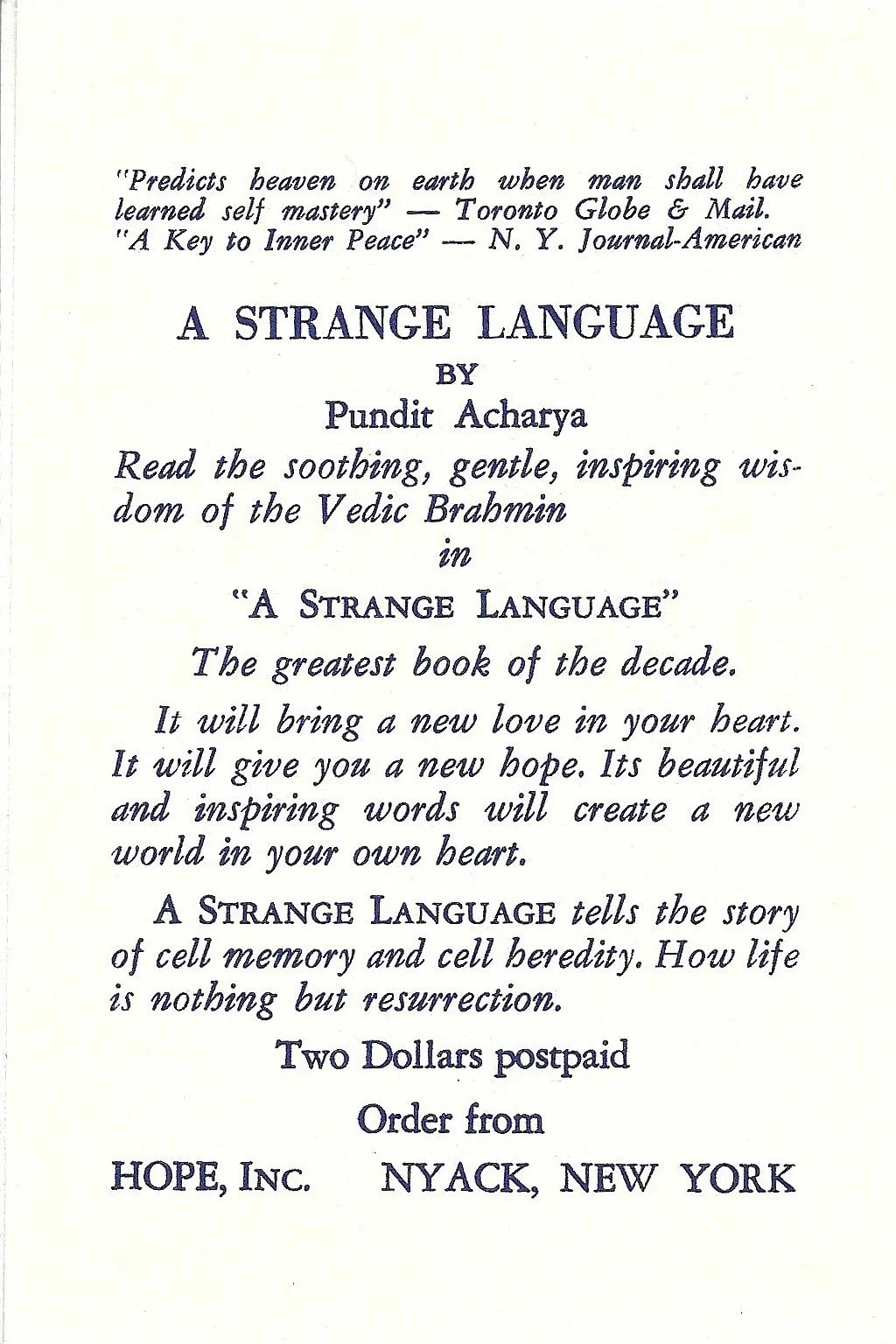
![Pundit Acharya. Studies in Neuro-Bio-Electronics: The Doctor’s Book of Yogas. Vol. 1 [with] Studies in Neuro-Bio-Electronics: Training of the Brain by the Brain. Vol. 2 [with 3 pieces of ephemera].](https://images.squarespace-cdn.com/content/v1/687efeb0f3827b1e917a0b60/d0e3a66c-eb7e-4867-afa4-03e5730ae75b/AcharyaElectronicsCover.jpeg)

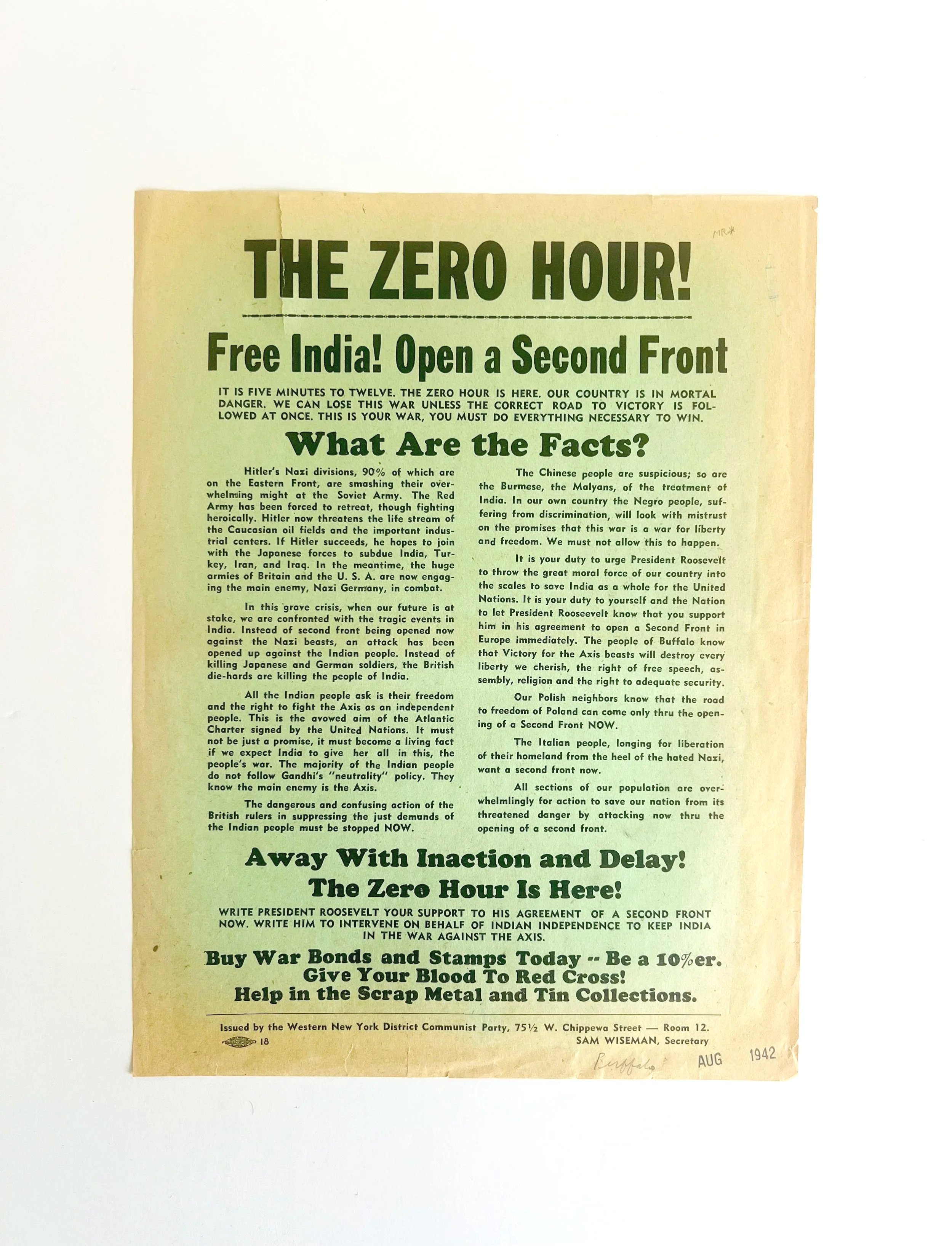
![Sam Wiseman. The Zero Hour! Free India! Open a Second Front. [Indian Independence poster, Buffalo NY, 1942].](https://images.squarespace-cdn.com/content/v1/687efeb0f3827b1e917a0b60/2b47bfc5-549a-416c-93c1-b9a00cf7ad35/IMG_4926.jpeg)