Likely Pittsburgh. [August 1964].
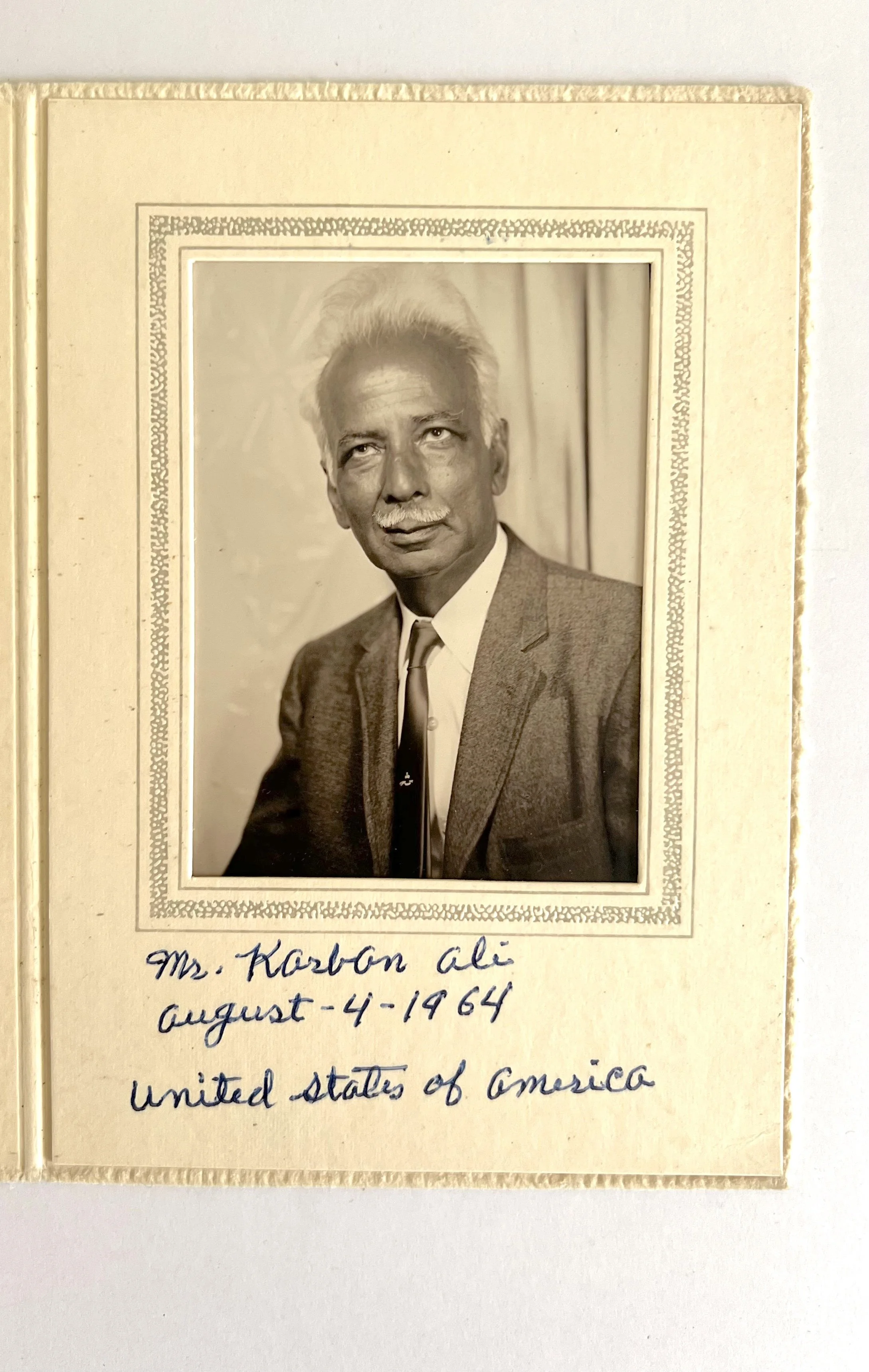
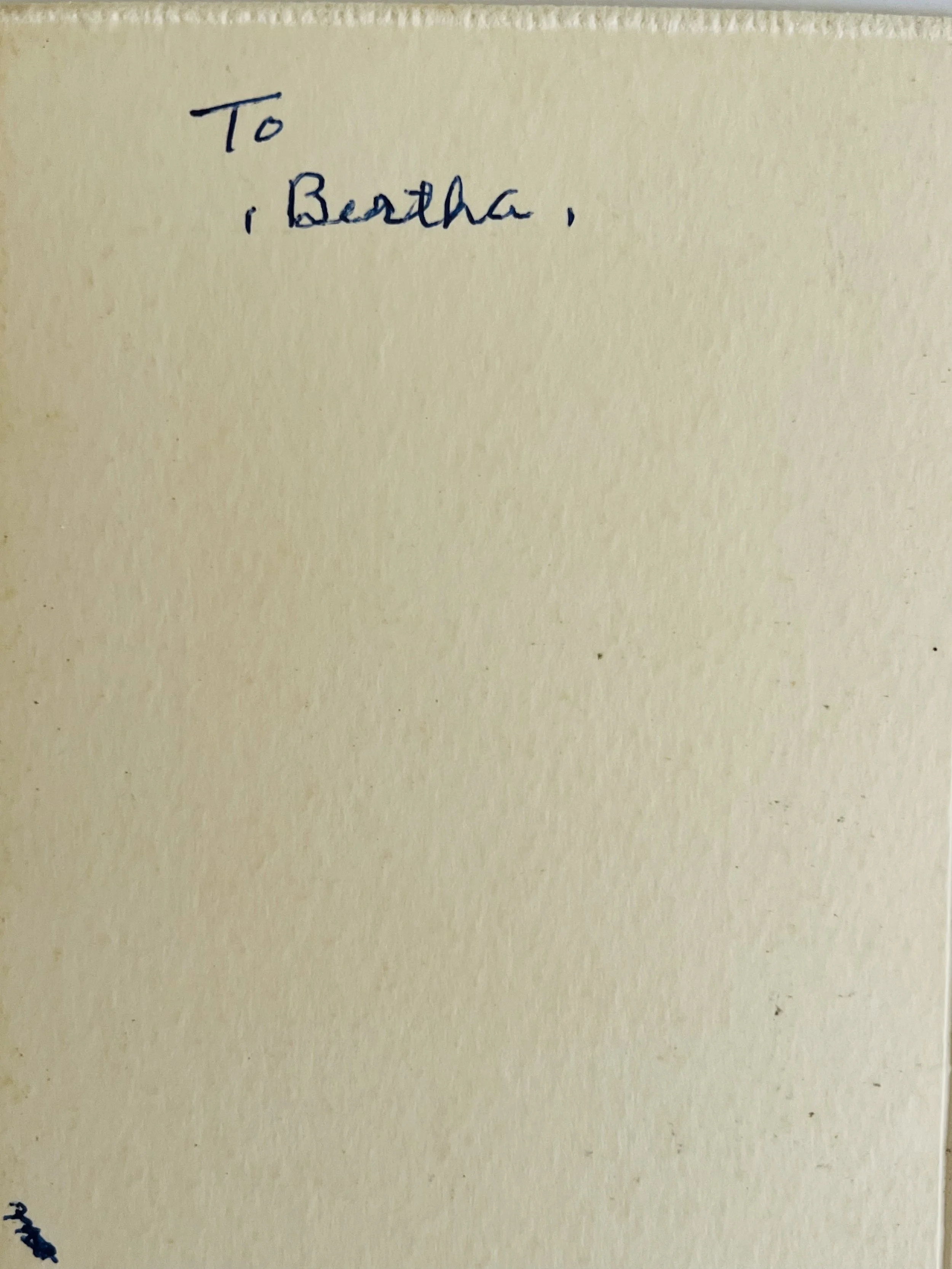
Silver-print photograph, measuring 3.75” x 2.75”, tipped into a 6.75” x 4.5” cloth sleeve. Inscription reading, “To Bertha, Mr. Karban Ali, August-4-1964, United States of America.” CONDITION: Photo fine, minimal wear to cloth.
A highly presentable image of an early Bengali Muslim immigrant, photographed in the final decade of his life.
Ancestry records indicate that Karban Ali (1895–1973) was born in Calcutta, India, to Palestinian parents who had migrated to the subcontinent at the turn of the twentieth century. After immigrating to the United States in 1916 and arriving at Ellis Island, Ali appears to have naturalized and become a citizen on April 2, 1919. By 1942, he lived on 19 Davenport Street, in Pittsburgh, Pennsylvania, where he lived with his wife, Karima Wahid, and worked at the Penndale Nursery flower-shop. By 1950, he appears to have separated from Karima and shared his house with one Lee G. Smith, a “Negro” from South Carolina. During this decade, Ali found employment in a new line of work, as a dry-goods salesman at the Wholesale Drug House in town. Evoking the complex racialization of early South Asian immigrants, we see that in the 1950 federal census, Ali’s race is recorded as “Negro (Black),” despite his country of origin being recorded as Pakistan.
Likely contributing to Ali’s racial confusion were the gentrification efforts that were undertaken in the Hill District of Pittsburgh during the mid-1950s. Ali’s house on Davenport Street, as well as his various places of employment, were located in this historically Black neighborhood that saw some several thousand African Americans displaced due to the city’s racist redevelopment efforts.
We note, by way of conclusion, that photographs of South Asian immigrants in the United States are institutionally uncommon, especially individuals who can boast a rich background such as Mr. Ali.
Likely Pittsburgh. [August 1964].
Silver-print photograph, measuring 3.75” x 2.75”, tipped into a 6.75” x 4.5” cloth sleeve. Inscription reading, “To Bertha, Mr. Karban Ali, August-4-1964, United States of America.” CONDITION: Photo fine, minimal wear to cloth.
A highly presentable image of an early Bengali Muslim immigrant, photographed in the final decade of his life.
Ancestry records indicate that Karban Ali (1895–1973) was born in Calcutta, India, to Palestinian parents who had migrated to the subcontinent at the turn of the twentieth century. After immigrating to the United States in 1916 and arriving at Ellis Island, Ali appears to have naturalized and become a citizen on April 2, 1919. By 1942, he lived on 19 Davenport Street, in Pittsburgh, Pennsylvania, where he lived with his wife, Karima Wahid, and worked at the Penndale Nursery flower-shop. By 1950, he appears to have separated from Karima and shared his house with one Lee G. Smith, a “Negro” from South Carolina. During this decade, Ali found employment in a new line of work, as a dry-goods salesman at the Wholesale Drug House in town. Evoking the complex racialization of early South Asian immigrants, we see that in the 1950 federal census, Ali’s race is recorded as “Negro (Black),” despite his country of origin being recorded as Pakistan.
Likely contributing to Ali’s racial confusion were the gentrification efforts that were undertaken in the Hill District of Pittsburgh during the mid-1950s. Ali’s house on Davenport Street, as well as his various places of employment, were located in this historically Black neighborhood that saw some several thousand African Americans displaced due to the city’s racist redevelopment efforts.
We note, by way of conclusion, that photographs of South Asian immigrants in the United States are institutionally uncommon, especially individuals who can boast a rich background such as Mr. Ali.
![Anup Singh India: Facts in Brief [with letter of provenance].](https://images.squarespace-cdn.com/content/v1/687efeb0f3827b1e917a0b60/34e3f97a-6da0-424f-aac9-2091d3cc9307/SinghIndiaFactsBriefC2.jpeg)