Underwood & Underwood: New York. 1921.
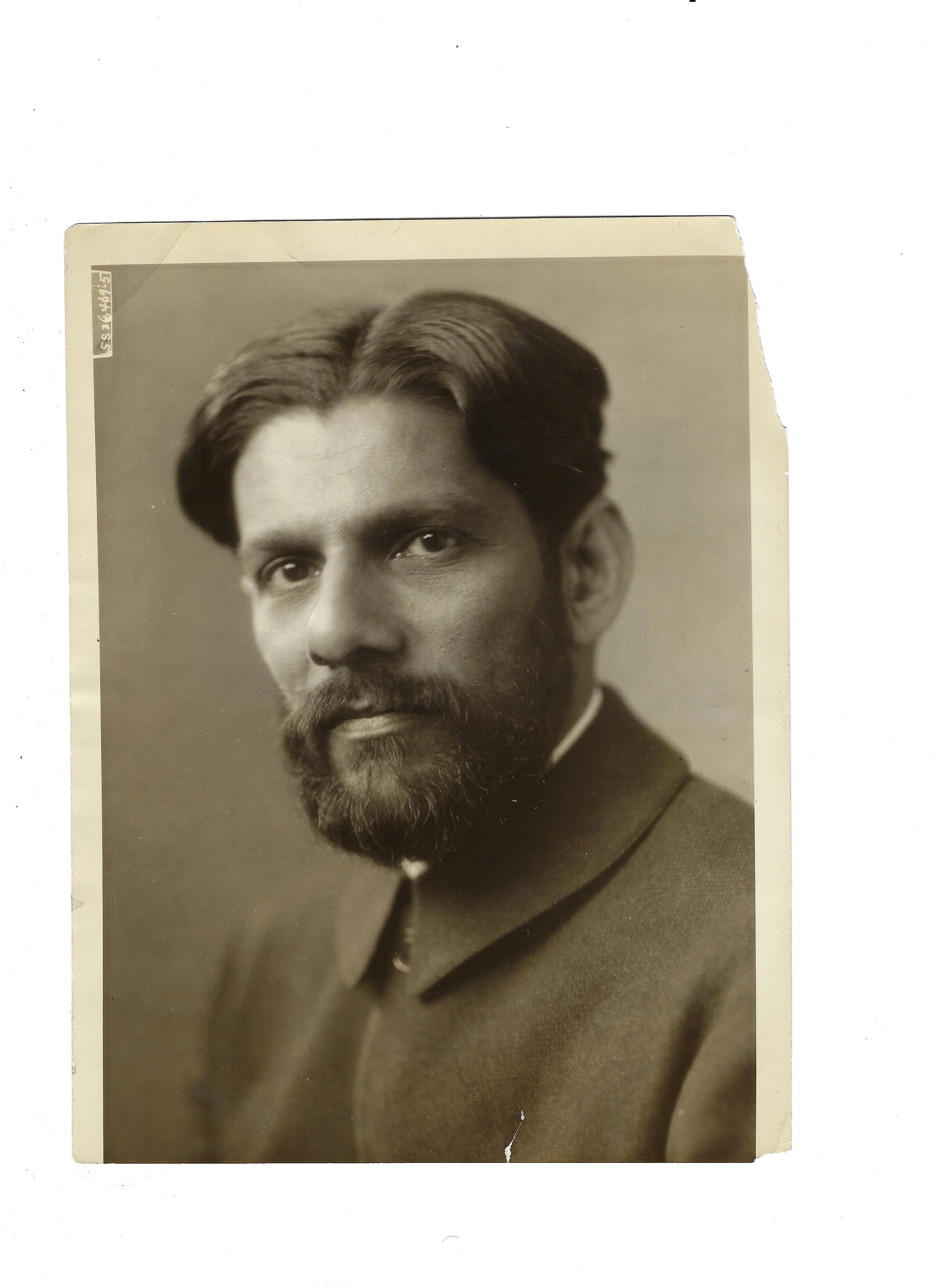
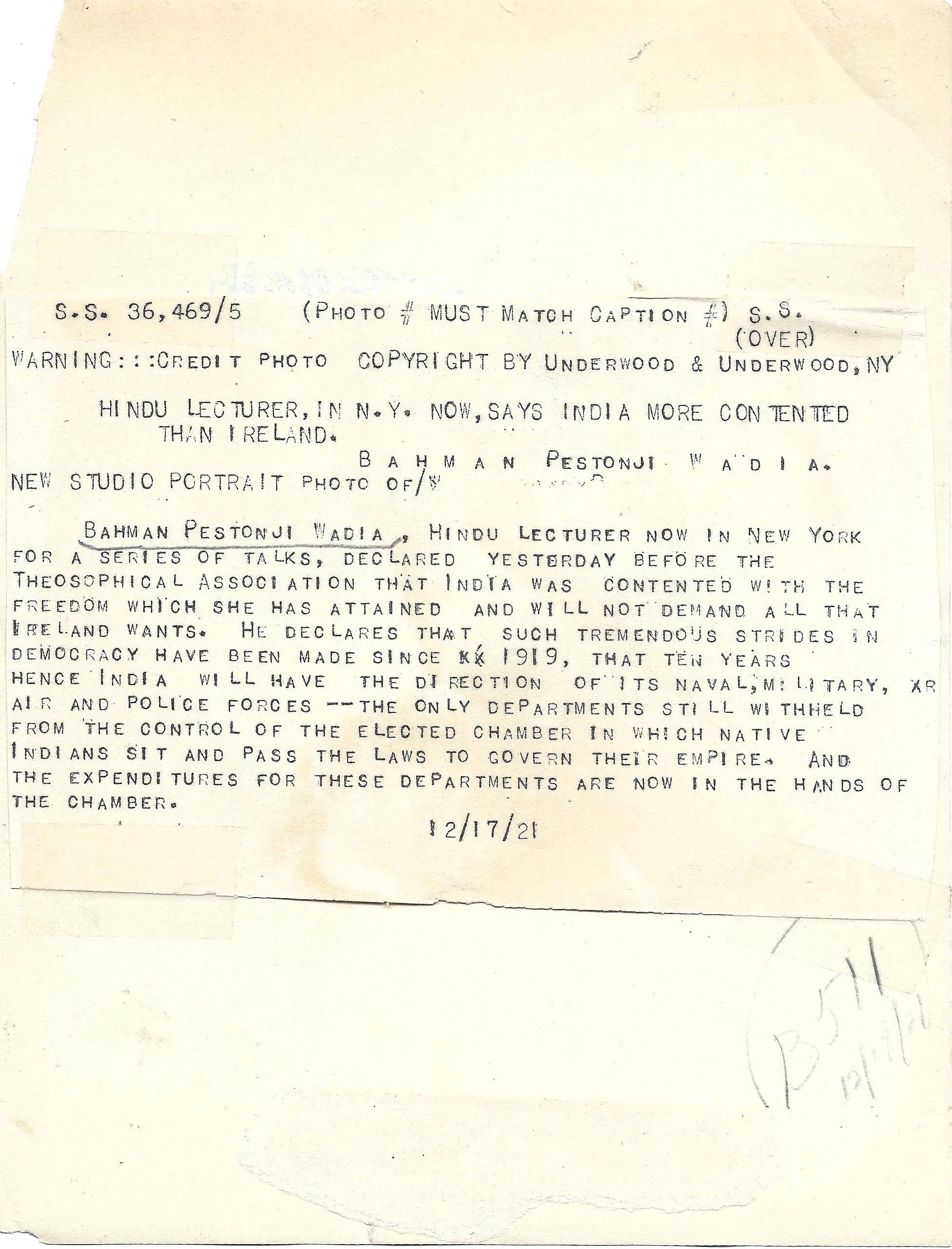
Press photograph, 8.5” x 6.5”. Type-written caption taped to verso. CONDITION: Good, upper right corner of margin lost, short tear to top margin, minimal creasing.
A photograph of a Parsi lecturer in the United States, who had previously helped establish the first organized labor union in India.
This photograph shows the forty year-old B.P. Wadia posing for his photograph to promote his lectures in New York City during the winter of 1921. The caption notes that only a day prior, on December 16, Wadia had “declared…before the Theosophical Association that India was contented with the freedom which she has attained and will not demand what Ireland wants. He declares that such tremendous strides in democracy have been made since 1919, that ten years hence India will have the direction of its naval, military, air, and police forces.”
Bahman Pestonji Wadia (1881–1958) was born into a wealthy Parsi family who made their legacy by building warships for the East India Company in the 1770s. Rather than pursue a life of business, Wadia’s was a life of theosophical tutelage whilst advocating for laborers’ rights in India. Wadia had come into contact with the writings of H.P. Blavatsky from a young age, and by 1907, he had “sailed seven miles out of…Bombay…to see the Elephanta caves. There he had a ‘vision’ concerning the universal value of theosophy.” Soon after, Wadia left Bombay to join “the Theosophical Society in Adyar,” near Madras, where he “began working as the manager of the Theosophical Publishing House” (“Those were the Days”). Whilst editing the New India, Wadia became close with Annie Besant and was active in her Home Rule Movement, for which he was arrested. It seems that his relationship with her, in addition to coming into contact with factory workers while working in Besant’s newspaper office, ignited Wadia’s compassion for the proletariat. By the onset of the First World War, he had organized a “public meeting…near the mills” of Madras “that attracted an audience of 20,000 despite intimidation from the British police” (“Those”), and in 1918, he formed and presided over the Madras Labor Union, India’s oldest surviving trade union.
Wadia began visiting the United States in 1919, when “the Indian Government…appointed him a delegate to attend the First International Labor Conference Under the League of Nations to be held at Washington D.C.” Upon the conclusion of this conference, Wadia began lecturing in the American and Canadian lodges of the Theosophical Society, teaching attendants about “The Secret Doctrine…H. P. Blavatsky…and…the need for every individual, to acquire…knowledge, and then…apply Theosophy individually” (Kell). Through promoting theosophy and the right for India’s self-rule, Wadia traveled throughout much of the continental United States, as well as Canada. According to several newspaper reports, while he was in New York City during February 1922, Wadia was a guest of honor at Saint Mark’s Church-in-the-Bowery when a “Parsee altar was set up in front of the Christian…and a Parsee priest said the prayers of his faith before the sacred fire in the church…the first such happening in the history of the Episcopal Church.”
Sources Consulted: Wane Kell, “B.P. Wadia: A Life of Service to Mankind” at United Lodge of Theosophists online; “Those Were the Days: Wadia’s long journey from building warships to trade union pioneer” at DTNext online.
Underwood & Underwood: New York. 1921.
Press photograph, 8.5” x 6.5”. Type-written caption taped to verso. CONDITION: Good, upper right corner of margin lost, short tear to top margin, minimal creasing.
A photograph of a Parsi lecturer in the United States, who had previously helped establish the first organized labor union in India.
This photograph shows the forty year-old B.P. Wadia posing for his photograph to promote his lectures in New York City during the winter of 1921. The caption notes that only a day prior, on December 16, Wadia had “declared…before the Theosophical Association that India was contented with the freedom which she has attained and will not demand what Ireland wants. He declares that such tremendous strides in democracy have been made since 1919, that ten years hence India will have the direction of its naval, military, air, and police forces.”
Bahman Pestonji Wadia (1881–1958) was born into a wealthy Parsi family who made their legacy by building warships for the East India Company in the 1770s. Rather than pursue a life of business, Wadia’s was a life of theosophical tutelage whilst advocating for laborers’ rights in India. Wadia had come into contact with the writings of H.P. Blavatsky from a young age, and by 1907, he had “sailed seven miles out of…Bombay…to see the Elephanta caves. There he had a ‘vision’ concerning the universal value of theosophy.” Soon after, Wadia left Bombay to join “the Theosophical Society in Adyar,” near Madras, where he “began working as the manager of the Theosophical Publishing House” (“Those were the Days”). Whilst editing the New India, Wadia became close with Annie Besant and was active in her Home Rule Movement, for which he was arrested. It seems that his relationship with her, in addition to coming into contact with factory workers while working in Besant’s newspaper office, ignited Wadia’s compassion for the proletariat. By the onset of the First World War, he had organized a “public meeting…near the mills” of Madras “that attracted an audience of 20,000 despite intimidation from the British police” (“Those”), and in 1918, he formed and presided over the Madras Labor Union, India’s oldest surviving trade union.
Wadia began visiting the United States in 1919, when “the Indian Government…appointed him a delegate to attend the First International Labor Conference Under the League of Nations to be held at Washington D.C.” Upon the conclusion of this conference, Wadia began lecturing in the American and Canadian lodges of the Theosophical Society, teaching attendants about “The Secret Doctrine…H. P. Blavatsky…and…the need for every individual, to acquire…knowledge, and then…apply Theosophy individually” (Kell). Through promoting theosophy and the right for India’s self-rule, Wadia traveled throughout much of the continental United States, as well as Canada. According to several newspaper reports, while he was in New York City during February 1922, Wadia was a guest of honor at Saint Mark’s Church-in-the-Bowery when a “Parsee altar was set up in front of the Christian…and a Parsee priest said the prayers of his faith before the sacred fire in the church…the first such happening in the history of the Episcopal Church.”
Sources Consulted: Wane Kell, “B.P. Wadia: A Life of Service to Mankind” at United Lodge of Theosophists online; “Those Were the Days: Wadia’s long journey from building warships to trade union pioneer” at DTNext online.
![Paul Oberst, photog. [Studio portrait of children in an oriental rug store].](https://images.squarespace-cdn.com/content/v1/687efeb0f3827b1e917a0b60/77315bff-97b4-43e3-803d-d55c73f26b9a/OberstChildRugmakersPhotoScn.jpg)