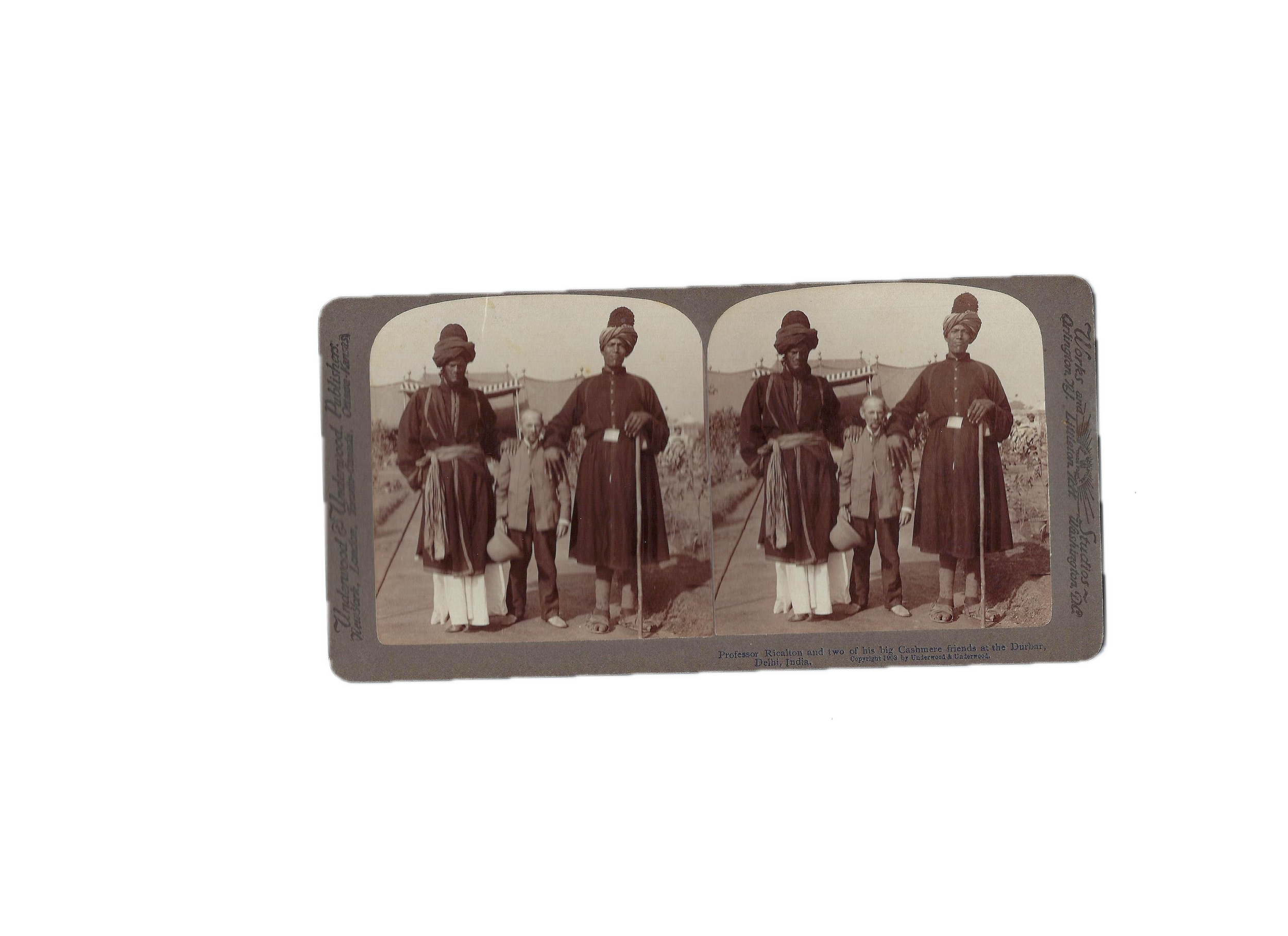
Underwood & Underwood: New York, London, Toronto, Ottawa, Kansas. 1903.
Stereoview, 3” x 6” plus mount. Printed text at recto of mount, verso blank. CONDITION: Near-fine, faint crease to left stereoview, tonality strong and image clear.
An amusing sight of an enigmatic pair of South Asian circus performers at a major celebration in Delhi, shown standing beside their American agent.
This photograph shows a pair of twin-brothers, known only as the “giants of Kashmir,” standing in front of tents at the Delhi Durbar of 1903. The Durbar was a major celebration to inaugurate the crowning of King Edward VII’s ascension to the throne after the passing of queen Victoria in 1901. Though the King refused to sail to the subcontinent, the occasion was still an immense affair, requiring two years of planning whereupon the Raj effectively staged a celebration of the greatest spectacles of India before the people of Delhi. Among the military parades, gold and diamond merchants, and floats of exotic animals, were these two giants, who were allegedly riflemen serving the king of Kashmir. With one man measuring a whopping seven feet and nine inches tall and the other nearly seven and a half feet in height, the twins were quite likely the two tallest men in the Indian subcontinent. Captions accompanying different images of the pair suggest that they were from the town of Balmokand, and, while no town with this name seems to exist in Kashmir, our consultation of the period press suggests that this may have been a small village in the Punjab, likely in the region that is now governed by the present-state of Pakistan.
The “giants” here are photographed beside one Professor Ricalton. Ricalton was something of an autodidact who quit college to become a teacher in Maplewood, New Jersey. Shortly after befriending Thomas Edison, he took off to Ceylon, and became a world-traveler. A prolific photographer, his images of celebrations and revolutions across the Indian subcontinent and East Asia became sensational among Americans, and were frequently bought by libraries.
OCLC locates three examples of Ricalton’s stereoviews, all of which are held at the Library of Congress (these are likely to have been sold by Ricalton himself).
Underwood & Underwood: New York, London, Toronto, Ottawa, Kansas. 1903.
Stereoview, 3” x 6” plus mount. Printed text at recto of mount, verso blank. CONDITION: Near-fine, faint crease to left stereoview, tonality strong and image clear.
An amusing sight of an enigmatic pair of South Asian circus performers at a major celebration in Delhi, shown standing beside their American agent.
This photograph shows a pair of twin-brothers, known only as the “giants of Kashmir,” standing in front of tents at the Delhi Durbar of 1903. The Durbar was a major celebration to inaugurate the crowning of King Edward VII’s ascension to the throne after the passing of queen Victoria in 1901. Though the King refused to sail to the subcontinent, the occasion was still an immense affair, requiring two years of planning whereupon the Raj effectively staged a celebration of the greatest spectacles of India before the people of Delhi. Among the military parades, gold and diamond merchants, and floats of exotic animals, were these two giants, who were allegedly riflemen serving the king of Kashmir. With one man measuring a whopping seven feet and nine inches tall and the other nearly seven and a half feet in height, the twins were quite likely the two tallest men in the Indian subcontinent. Captions accompanying different images of the pair suggest that they were from the town of Balmokand, and, while no town with this name seems to exist in Kashmir, our consultation of the period press suggests that this may have been a small village in the Punjab, likely in the region that is now governed by the present-state of Pakistan.
The “giants” here are photographed beside one Professor Ricalton. Ricalton was something of an autodidact who quit college to become a teacher in Maplewood, New Jersey. Shortly after befriending Thomas Edison, he took off to Ceylon, and became a world-traveler. A prolific photographer, his images of celebrations and revolutions across the Indian subcontinent and East Asia became sensational among Americans, and were frequently bought by libraries.
OCLC locates three examples of Ricalton’s stereoviews, all of which are held at the Library of Congress (these are likely to have been sold by Ricalton himself).
![[Napkin-map of post-colonial India]. Indianapolis, circa 1947.](https://images.squarespace-cdn.com/content/v1/687efeb0f3827b1e917a0b60/e3834f1f-81f3-47e2-b7f2-705bbddb9982/IMG_4722.jpeg)