AA Kommune [with] Informationsblatt Zum Kommunelehrgang [with] Bestellschein.
[Austria]: AA Kommune. c. 1973.
Three mimeographed sheets, 11.5” x 8.25”. 1 pp. each. Text of one sheet in English, other two German. CONDITION: Very good, horizontal folds, minimal creasing to margins, text of English sheet faded but remains legible.
[with]
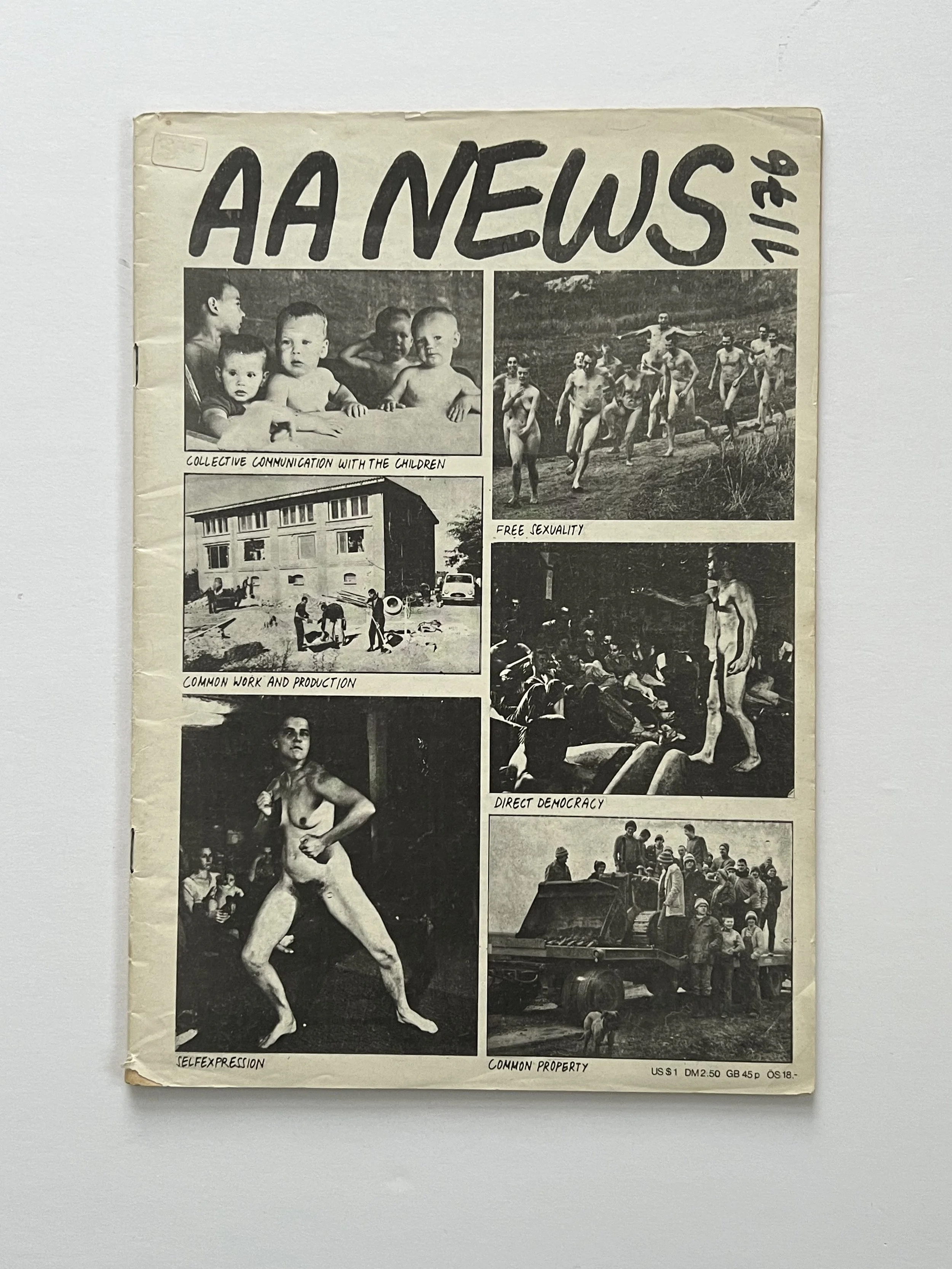
AA NEWS 1/76.
[Austria]: AA Kommune. January 1976.
Staple-bound wrappers, 11.5” x 8”. 40pp., illus. CONDITION: Very good, some foxing, short tears at bottom of spine, old price sticker at upper left corner of front wrapper.
A collection documenting one of the late twentieth century’s most controversial artistically inspired communal experiments, featuring two exceedingly scarce English-language publications.
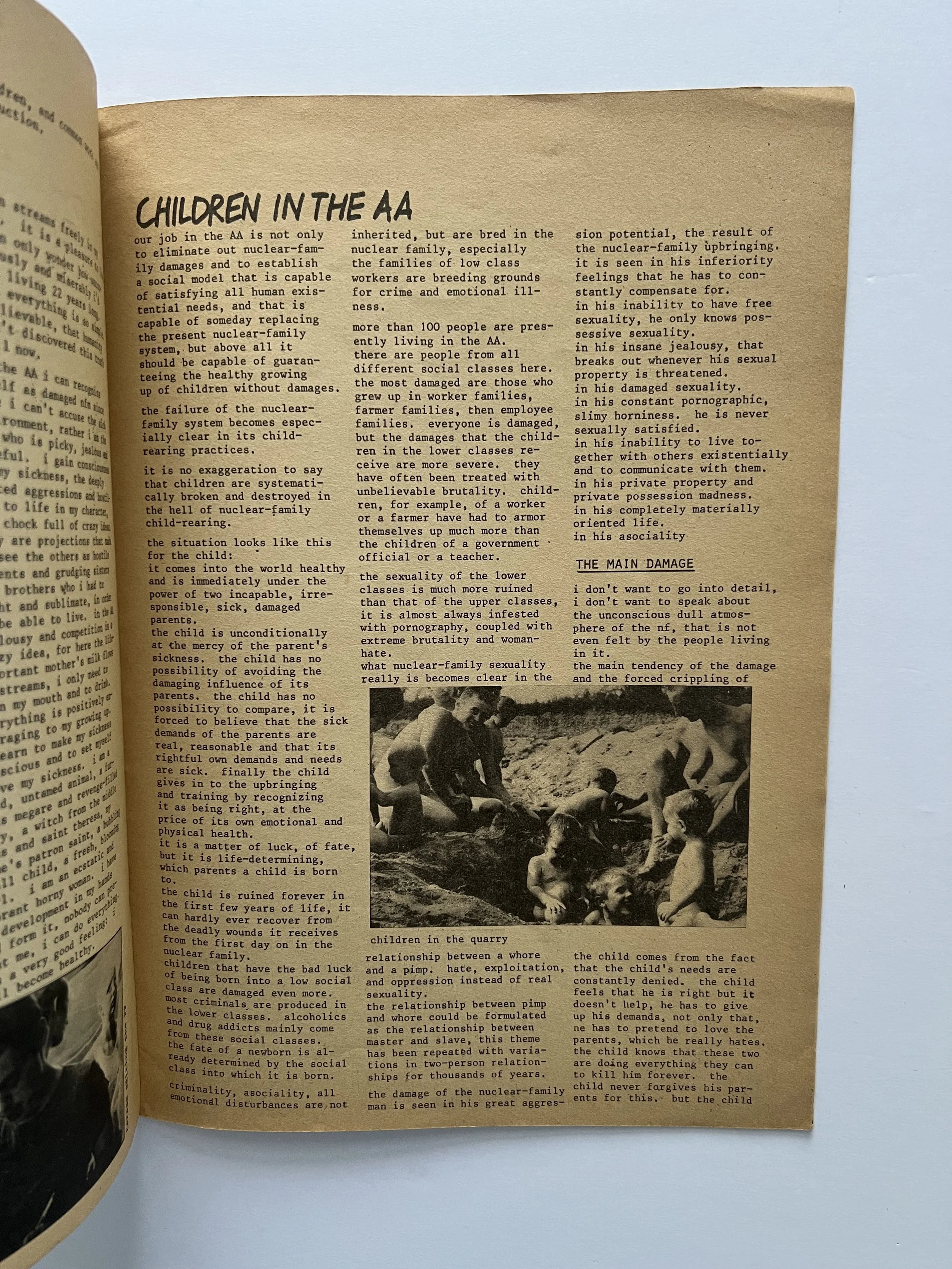
This second issue of the Commune’s journal presents the group’s united front in English and contains numerous illustrations of the commune’s activities, including a “natural birth,” their nude “self expression,” the “collective communication” with the children who were born there, examples of “direct democracy,” and unabashed polygamy. This issue, like others of the journal, was designed to bring new converts to the group, and thus butters over the more unseemly aspects of the “free sexuality” practiced by the commune.
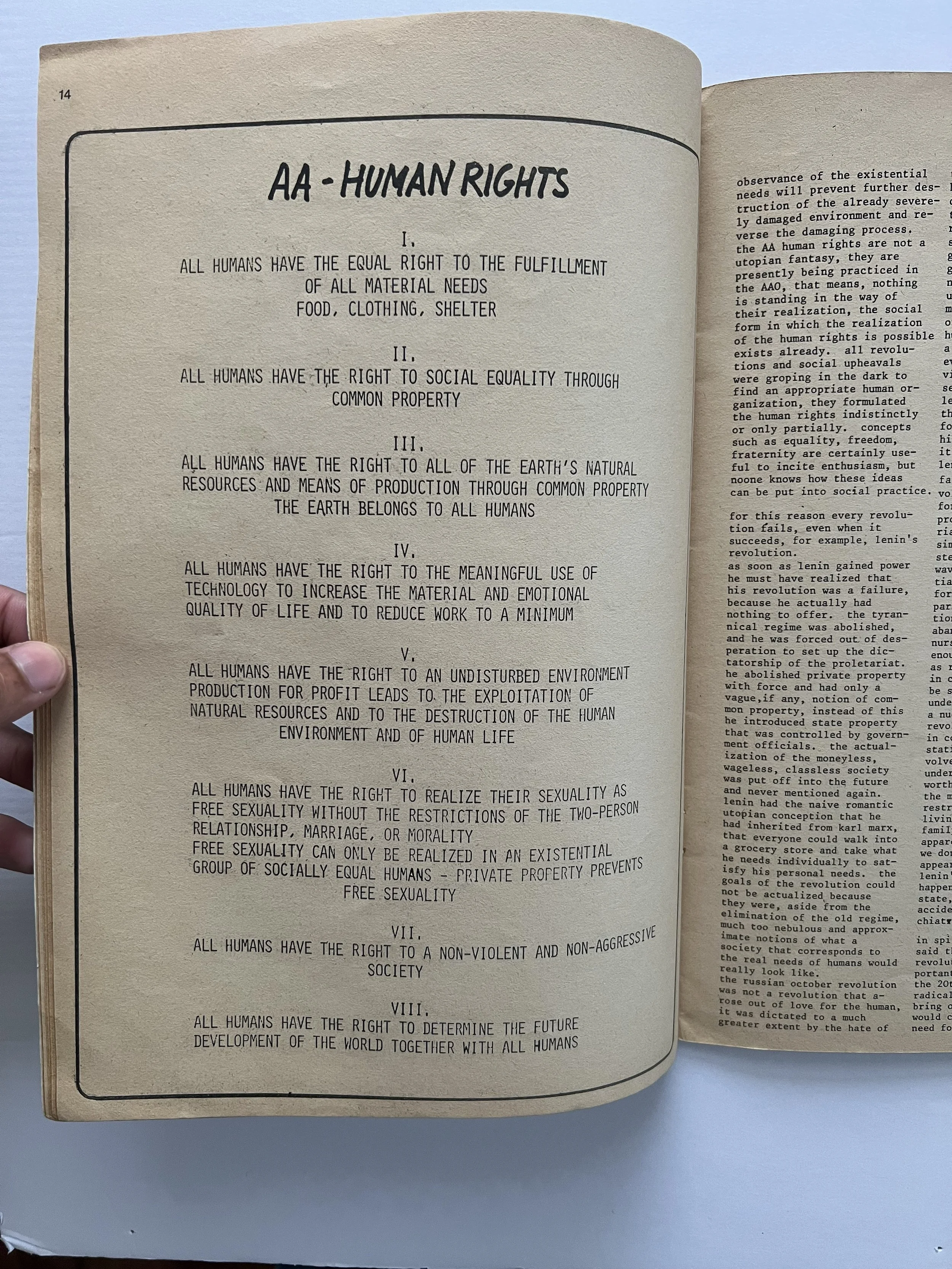
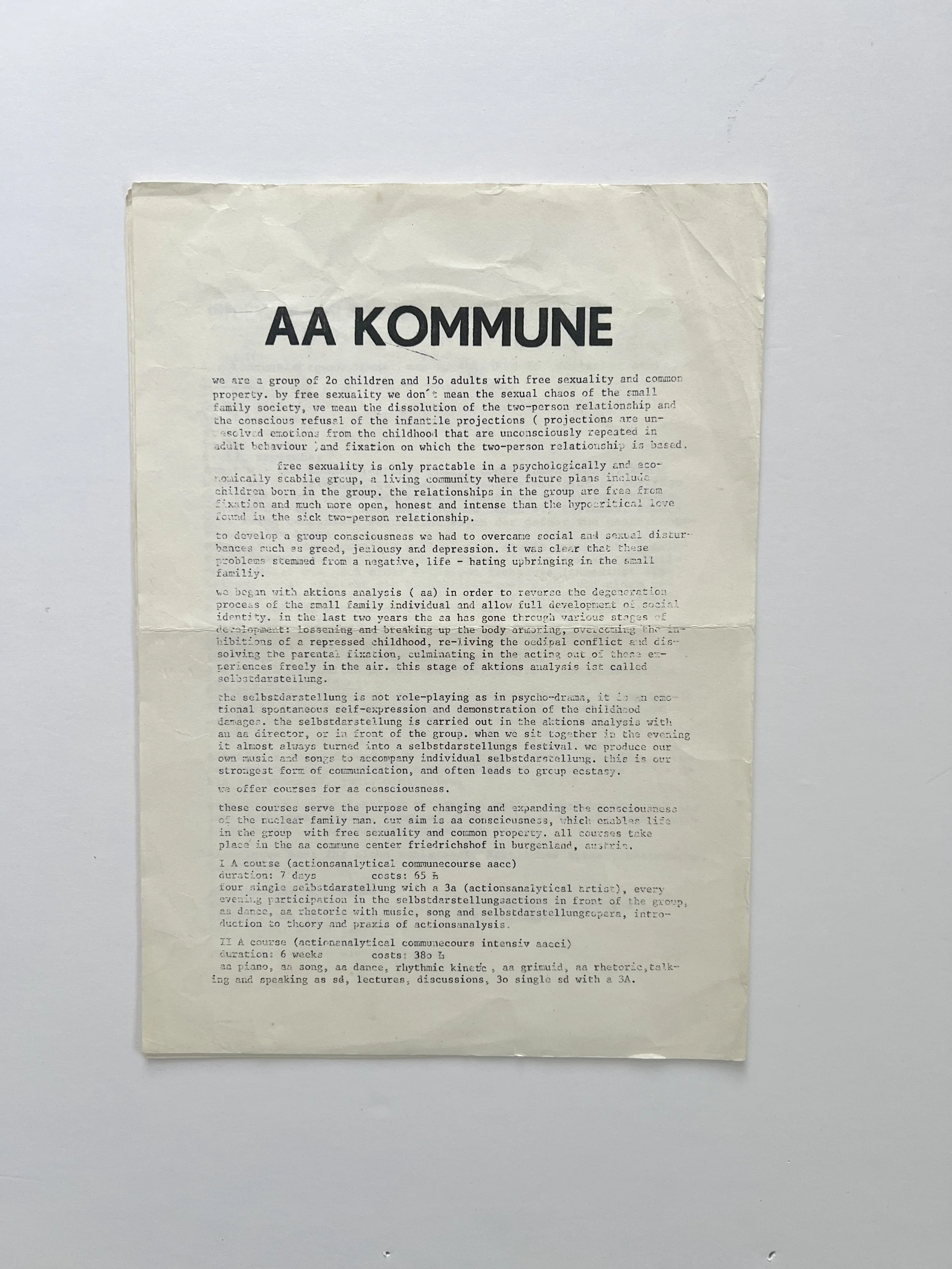
Also in this collection is an English-language leaflet recording the psycho-performance work that organized much of the Commune’s routines. As Muehl stated that it was imperative for the group to be both “psychologically and economically stable,” he required that there be a “living community” in Friedrichshof, and thus children were expected to be born in the group. However, these wouldn’t be any ordinary children, but rather, since all “relationships in the group are free from fixation,” the children would be communally raised. To develop the mindset required for this peculiar arrangement, Muehl implemented a quasi-therapeutic system that he dubbed “aktions analysis,” a Reichian version of psychoanalysis that was used to “reverse the degeneration process of the small family individual and allow full development of social identity.” In addition, to express themselves creatively, the commune practiced a kind of “emotional spontaneous self-expression and demonstration of the childhood damage” that they called “selbstdarstellung.” The two combined would establish “aa consciousness, which enables life in the group with free sexuality and common property.”
This booklet and ephemera were published shortly after the dissolution of the Viennese Aktionists. As a group of mixed media artists inspired by Situationist principles and postwar “Happenings,” the Aktionists strove to dismantle the distinction between art and life through highly planned, seemingly spontaneous, performances. At the center of the group were the painter Hermann Nitsch, sculptor Otto Muehl, and performer Günter Brus, whom together would stage “aktions” such as painting a canvas using the blood and organs of a horse; public urination; and impropmtu public screenings of avantgarde imagistic movies. Collaborating from 1960 through 1971, “their art had strong overtones of taboo breaking, ritualised dramaturgy and an array of transgressive performative experiments that aspired to self-liberation from the conventional confines imposed by their society… and generally against the sublimated social climate that dominated Austria in the postwar period.”
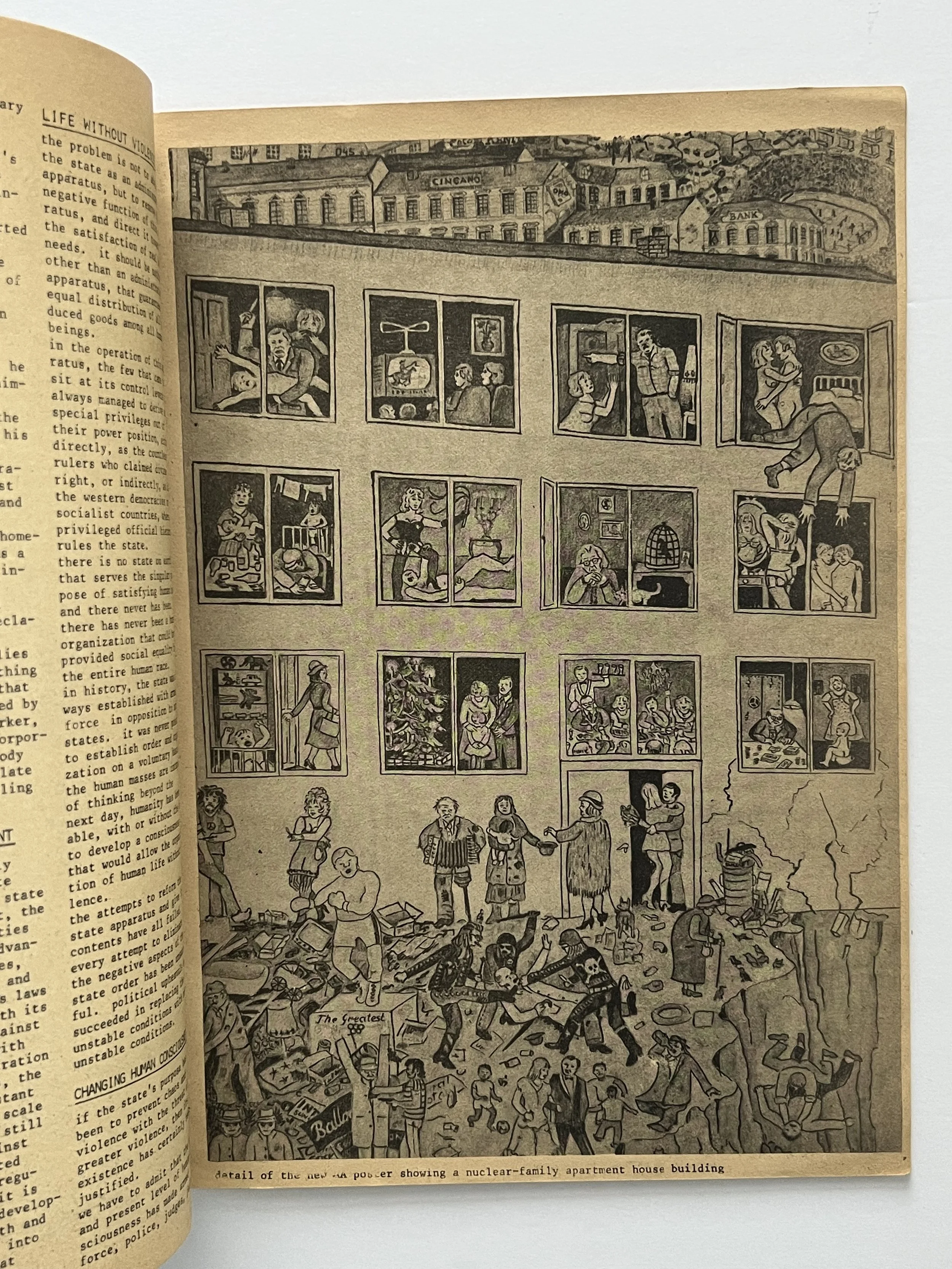
Dissolving amidst internal disputes and heated personalities, the 1970s saw each Aktionist take a different approach toward their work and the world. In Otto Muehl’s case, by 1970, he had assembled a group of fifteen people who at first, “lived in single rooms and had private money, the living costs were shared, [their] money was made in professions,” who commiserated in the evenings over their childhood sexual trauma and other psychosexual topics associated with Reichian psychoanalysis. By 1972, “the first collective project was the purchase of Friedrichshof farm,” located outside of Vienna. While living communally at the farm, “problems in the group became clearer,” and Muehl “began to carry out verbal self-expression sessions with the group. The difficulties in living together…was experienced as a damage that resulted from our upbringing in the nuclear family. Crises in the two-person relationships and the increased consciousness that exclusive couple relationships were an asocial and anti-communicative compulsion.”
Following these realizations, the members of what came to be known as the Friedrichshof Commune (here called the “Aktions Analysis Organization”) embarked on “A New Life Praxis with Free Sexuality and Common Property” that, by 1974, had become “a large living and economic community of 50 people” residing at Friedrichshof, and several allied groups in Berlin, Geneva, and Vienna. By 1976, six children were born and lived in the Friedrichshof Commune, and their upbringing was shared communally. In that same year, the heads of all the AAO centers “decided to establish international common property” and “made a series of lecture and business tours” in “Holland, Belgium, England, France, Canada and America.”
OCLC records only one holding of this issue of AA News in North America, at Emory. Issue One can be found only at Northwestern and the MOMA. Our searches do not turn up any holdings of the leaflets.
AA Kommune [with] Informationsblatt Zum Kommunelehrgang [with] Bestellschein.
[Austria]: AA Kommune. c. 1973.
Three mimeographed sheets, 11.5” x 8.25”. 1 pp. each. Text of one sheet in English, other two German. CONDITION: Very good, horizontal folds, minimal creasing to margins, text of English sheet faded but remains legible.
[with]
AA NEWS 1/76.
[Austria]: AA Kommune. January 1976.
Staple-bound wrappers, 11.5” x 8”. 40pp., illus. CONDITION: Very good, some foxing, short tears at bottom of spine, old price sticker at upper left corner of front wrapper.
A collection documenting one of the late twentieth century’s most controversial artistically inspired communal experiments, featuring two exceedingly scarce English-language publications.
This second issue of the Commune’s journal presents the group’s united front in English and contains numerous illustrations of the commune’s activities, including a “natural birth,” their nude “self expression,” the “collective communication” with the children who were born there, examples of “direct democracy,” and unabashed polygamy. This issue, like others of the journal, was designed to bring new converts to the group, and thus butters over the more unseemly aspects of the “free sexuality” practiced by the commune.
Also in this collection is an English-language leaflet recording the psycho-performance work that organized much of the Commune’s routines. As Muehl stated that it was imperative for the group to be both “psychologically and economically stable,” he required that there be a “living community” in Friedrichshof, and thus children were expected to be born in the group. However, these wouldn’t be any ordinary children, but rather, since all “relationships in the group are free from fixation,” the children would be communally raised. To develop the mindset required for this peculiar arrangement, Muehl implemented a quasi-therapeutic system that he dubbed “aktions analysis,” a Reichian version of psychoanalysis that was used to “reverse the degeneration process of the small family individual and allow full development of social identity.” In addition, to express themselves creatively, the commune practiced a kind of “emotional spontaneous self-expression and demonstration of the childhood damage” that they called “selbstdarstellung.” The two combined would establish “aa consciousness, which enables life in the group with free sexuality and common property.”
This booklet and ephemera were published shortly after the dissolution of the Viennese Aktionists. As a group of mixed media artists inspired by Situationist principles and postwar “Happenings,” the Aktionists strove to dismantle the distinction between art and life through highly planned, seemingly spontaneous, performances. At the center of the group were the painter Hermann Nitsch, sculptor Otto Muehl, and performer Günter Brus, whom together would stage “aktions” such as painting a canvas using the blood and organs of a horse; public urination; and impropmtu public screenings of avantgarde imagistic movies. Collaborating from 1960 through 1971, “their art had strong overtones of taboo breaking, ritualised dramaturgy and an array of transgressive performative experiments that aspired to self-liberation from the conventional confines imposed by their society… and generally against the sublimated social climate that dominated Austria in the postwar period.”
Dissolving amidst internal disputes and heated personalities, the 1970s saw each Aktionist take a different approach toward their work and the world. In Otto Muehl’s case, by 1970, he had assembled a group of fifteen people who at first, “lived in single rooms and had private money, the living costs were shared, [their] money was made in professions,” who commiserated in the evenings over their childhood sexual trauma and other psychosexual topics associated with Reichian psychoanalysis. By 1972, “the first collective project was the purchase of Friedrichshof farm,” located outside of Vienna. While living communally at the farm, “problems in the group became clearer,” and Muehl “began to carry out verbal self-expression sessions with the group. The difficulties in living together…was experienced as a damage that resulted from our upbringing in the nuclear family. Crises in the two-person relationships and the increased consciousness that exclusive couple relationships were an asocial and anti-communicative compulsion.”
Following these realizations, the members of what came to be known as the Friedrichshof Commune (here called the “Aktions Analysis Organization”) embarked on “A New Life Praxis with Free Sexuality and Common Property” that, by 1974, had become “a large living and economic community of 50 people” residing at Friedrichshof, and several allied groups in Berlin, Geneva, and Vienna. By 1976, six children were born and lived in the Friedrichshof Commune, and their upbringing was shared communally. In that same year, the heads of all the AAO centers “decided to establish international common property” and “made a series of lecture and business tours” in “Holland, Belgium, England, France, Canada and America.”
OCLC records only one holding of this issue of AA News in North America, at Emory. Issue One can be found only at Northwestern and the MOMA. Our searches do not turn up any holdings of the leaflets.