[Italy]. Circa 1845.
Watercolor painting, 8” x 5.5”, housed in decorative sleeve (13.25” x 9.5”). CONDITION: Very good, painting minimally rubbed, colors bright and paper remains sturdy.
A wonderfully preserved nineteenth century illustration of a mustachioed Turkish domestic servant, likely made by a European orientalist.
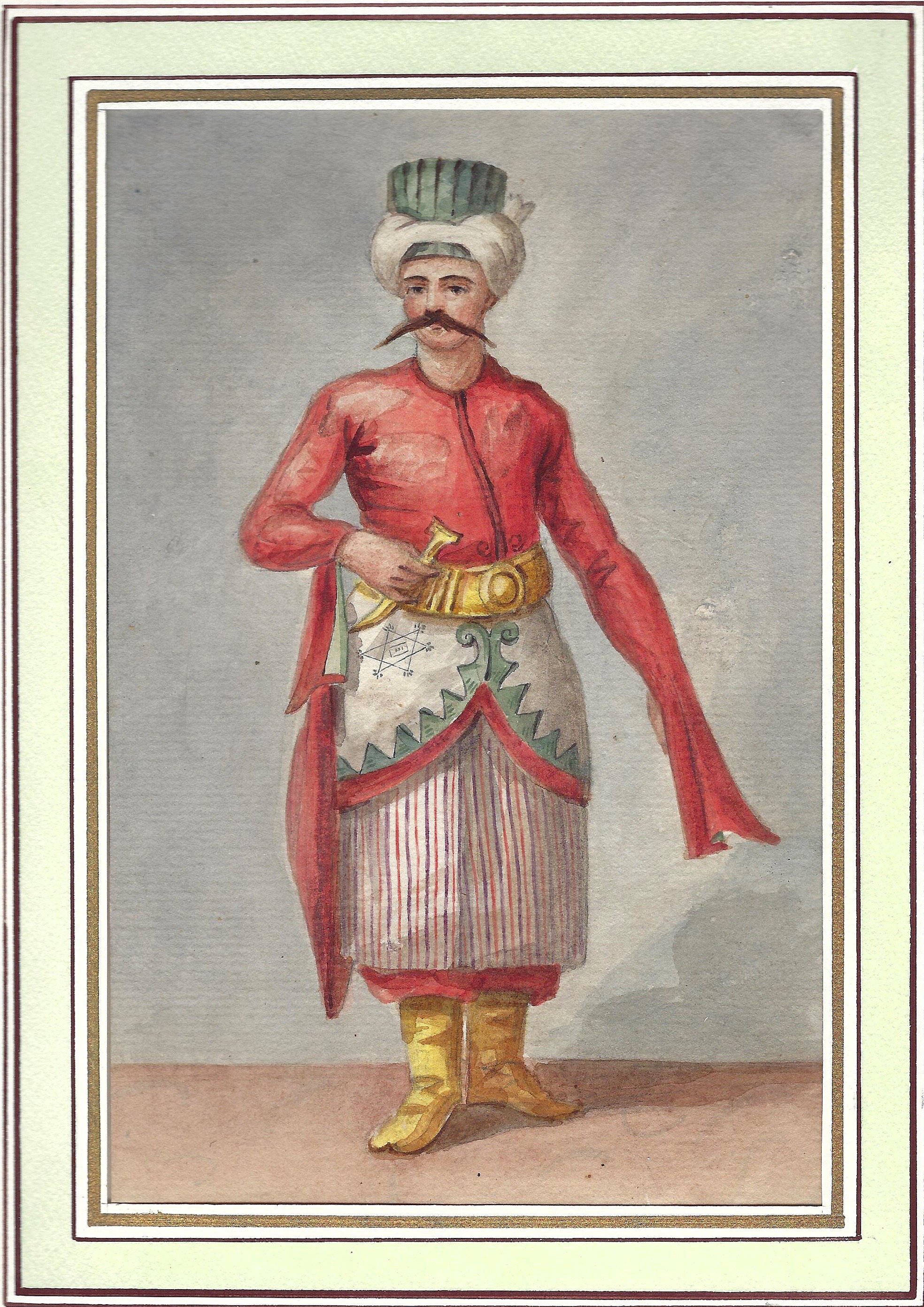
This painting shows a turban-clad man in light-red robes, a fringed half-skirt, striped trousers, and yellow boots. On the man’s waist can be seen a golden belt where his hand grasps a curved dagger, perhaps a yataghan blade that would be worn by wealthy nobles in the Ottoman empire. Below this, on the man’s hip can be seen a six-pointed star, likely signifying a Seal of Solomon, a protective talisman commonly seen in Islamic art.
This image appears to be a vernacular production based on Octavien d’Alvimart’s portraits of Ottoman Turks published in William Miller’s The Costume of Turkey (London, 1804). That monumental work of the orientalist imagination illustrated and described sixty prominent occupations in the Ottoman empire. This painting is likely based on d’Alvimart’s engraving of the “domestic belonging to the Grand Vizier.” In Miller’s note accompanying d’Alvimart’s image, he states “the portrait…[of the domestic]…is of one in his full dress, with his yellow boots and yataghan…The first of these is reckoned a great privilege, as the common people are forbidden to wear boots or slippers of a yellow colour. The yataghans, which are also sometimes accompanied by large pistols, are generally very richly ornamented, but without any marks of taste.”
Sources Consulted: William Miller, The Costume of Turkey (London 1802), p. 44.
[Italy]. Circa 1845.
Watercolor painting, 8” x 5.5”, housed in decorative sleeve (13.25” x 9.5”). CONDITION: Very good, painting minimally rubbed, colors bright and paper remains sturdy.
A wonderfully preserved nineteenth century illustration of a mustachioed Turkish domestic servant, likely made by a European orientalist.
This painting shows a turban-clad man in light-red robes, a fringed half-skirt, striped trousers, and yellow boots. On the man’s waist can be seen a golden belt where his hand grasps a curved dagger, perhaps a yataghan blade that would be worn by wealthy nobles in the Ottoman empire. Below this, on the man’s hip can be seen a six-pointed star, likely signifying a Seal of Solomon, a protective talisman commonly seen in Islamic art.
This image appears to be a vernacular production based on Octavien d’Alvimart’s portraits of Ottoman Turks published in William Miller’s The Costume of Turkey (London, 1804). That monumental work of the orientalist imagination illustrated and described sixty prominent occupations in the Ottoman empire. This painting is likely based on d’Alvimart’s engraving of the “domestic belonging to the Grand Vizier.” In Miller’s note accompanying d’Alvimart’s image, he states “the portrait…[of the domestic]…is of one in his full dress, with his yellow boots and yataghan…The first of these is reckoned a great privilege, as the common people are forbidden to wear boots or slippers of a yellow colour. The yataghans, which are also sometimes accompanied by large pistols, are generally very richly ornamented, but without any marks of taste.”
Sources Consulted: William Miller, The Costume of Turkey (London 1802), p. 44.